
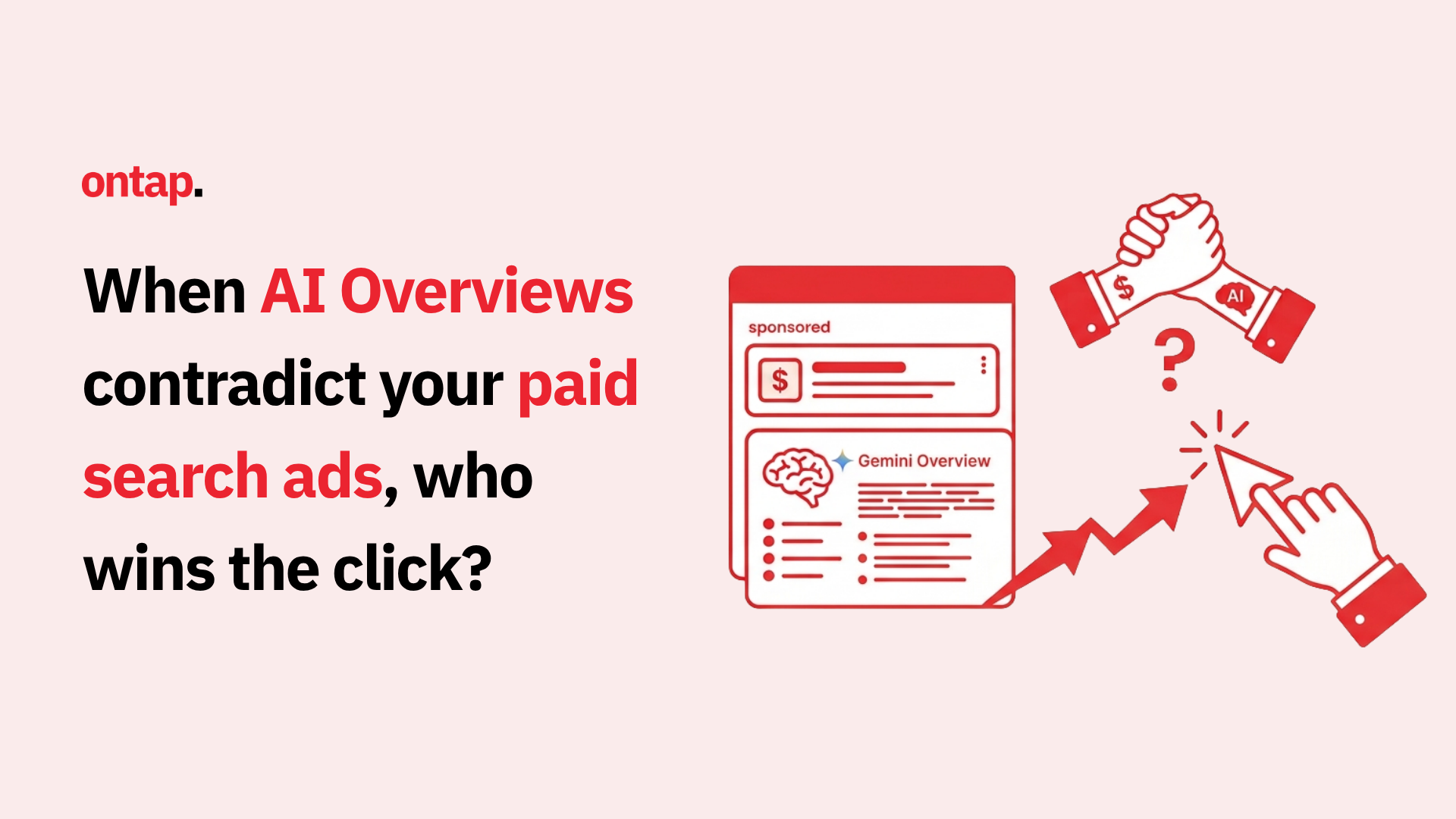
You are spending money on paid search. Your Shopping ads are running, your product listings are optimised, and your bidding strategy is dialled in. Then Google's AI Overview appears above your ad, recommends a different product, or suggests that the category you are advertising might not be the right solution for the shopper's query.
Who wins that moment? And more importantly, how would you even know it happened?
As Search Engine Land reported on 5 August 2026, when AI Overviews and paid search ads conflict on the same results page, AI Overviews carry editorial authority that paid ads do not. When they contradict what an ad promises, the ad's effectiveness drops. But that drop is invisible in standard ad reporting.
The mechanic of the conflict
Google's AI Overviews synthesise information from across the web and present it as an authoritative, editorially curated answer at the top of search results. When a shopper searches for a product category, the AI Overview might recommend specific brands, compare features, or even suggest alternative solutions, all before the shopper's eyes reach the paid ads below.
This creates three specific conflict scenarios.
-
Direct competitor recommendation: The AI Overview recommends a competitor's product in response to a query you are bidding on. Your ad still appears, but the shopper has already been told by Google's own AI that a different product is the better choice. Your click-through rate drops, but your impression count does not, so your CTR decline looks like an ad quality problem rather than an AI editorial problem.
-
Category undermining: The AI Overview reframes the shopper's query in a way that makes your product category seem less relevant. A query about "best office chair for back pain" might generate an AI Overview that suggests standing desks or ergonomic accessories as primary solutions. Your office chair ad still appears, but buyer intent has been redirected before it reaches your ad.
-
Feature contradiction: The AI Overview highlights product attributes that contradict your ad's value proposition. If your ad emphasises a specific feature and the AI Overview explains why that feature matters less than another, the ad's persuasive power is diminished.
Why your attribution cannot see it
There is no metric in Google Ads reporting that tells you "your ad appeared on a SERP where the AI Overview recommended a competitor." There is no filter for "queries where AI Overviews reframed buyer intent away from your product category."
What you see instead is a gradual, unexplained decline in click-through rates, conversion rates, or return on ad spend. You might attribute it to competitive pressure, ad fatigue, or seasonal patterns. You might respond by increasing bids or refreshing creative, all of which cost money without addressing the underlying problem.
According to an Attentive consumer survey cited by Search Engine Land's companion piece on the same day, 67% of shoppers have used AI tools for purchase decisions in the last three months. The AI influence happens before the click, which means it is pre-attribution: invisible to every standard measurement framework.
What eCommerce advertisers should do
Monitor AI Overviews for your core queries manually. There is currently no automated tool that reliably tracks when and how AI Overviews appear for specific commercial queries. Pick your top 20 to 30 revenue-generating search terms and check what AI Overviews show for those queries at least weekly.
-
Segment performance by query: If you can identify which of your keywords trigger AI Overviews and which do not, compare performance between those segments. The data will tell you whether, and how much, AI Overviews are affecting your paid search ROI.
-
Treat your product feed as an AI visibility asset: Your Google Merchant Centre feed is not just a Shopping ads input. It is a signal source for AI Overviews, Google AI Mode, and every other AI-powered discovery surface. Investing in feed quality, attribute completeness, and compelling product descriptions now serves both your paid search performance and your AI visibility.
-
Invest in the content that AI Overviews cite: AI Overviews pull from web content. If your brand's content is being cited, you are on the right side of this dynamic. The Search Engine Land analysis found that AI engines cite brands more readily where those brands have built topical authority through consistent, in-depth content coverage.
-
Reconsider your bidding strategy for AI-affected queries: If a query consistently generates an AI Overview that contradicts your ad, you have three options: bid less and reallocate budget to queries where AI Overviews are more neutral; create content that could be cited by the AI Overview itself; or adjust your ad messaging to acknowledge and counter the AI Overview's framing.
The bigger picture
Paid search attribution was built for a world where Google showed ten blue links and some ads. In a world where Google's own AI edits the narrative before shoppers reach the ads, the attribution model is incomplete. The merchants who recognise this first will allocate their budgets most effectively.
About On Tap
On Tap is a growth-focused eCommerce consultancy helping mid-market and enterprise merchants navigate the increasingly complex intersection of paid search, AI visibility, and product discovery. From paid media strategy and AI search monitoring to product feed optimisation and conversion measurement, On Tap helps merchants close the measurement gaps that are costing them revenue.
If you want to audit your paid search performance for AI Overview conflicts, get in touch.