
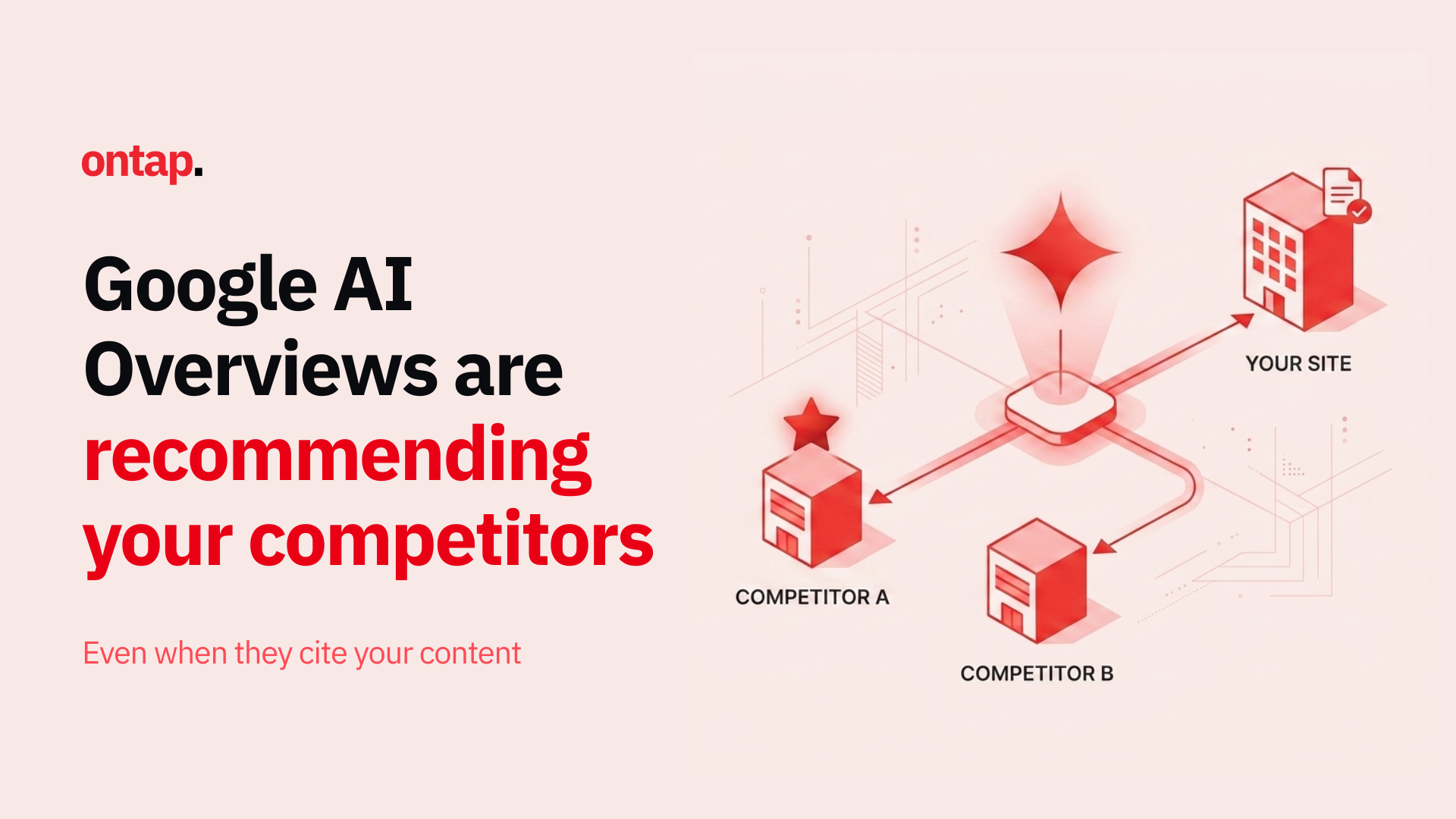
A new study by SEO researcher Lily Ray has exposed a troubling dynamic in Google's AI Overviews that every eCommerce brand needs to understand: Google is citing brands' own "best of" listicles as sources, but recommending competing products 69% of the time. Combine this with fresh Pew Research data showing 60% of Americans now read AI summaries in search results, and the implications for eCommerce visibility are profound.
The Lily Ray study: What actually happens in AI Overviews
The study, covered by Search Engine Land on 18 June 2026, examined how Google's AI Overviews handle product recommendation queries. Using Ahrefs Brand Radar data, Ray analysed 100 B2B "best [category] software" queries across three dates: 15 April, 15 May, and 8 June. Of the 80 prompts that triggered an AI Overview, self-promotional listicles were cited 323 times. In 224 of those cases, Google cited the brand's own page but did not recommend that brand.
The findings create a perverse incentive structure. Brands invest in content marketing to build authority and drive product discovery. Google's AI system then uses that authority signal, the citation, while directing purchase intent towards competing products. The brand gets the attribution but not the conversion.
As Ray documented in her full Substack analysis, the recommended brands consistently had far more referring domains and far more AI Overview and ChatGPT mentions than their cited-but-not-recommended counterparts. In other words, calling yourself "the best" changes nothing. Others calling you "the best" is what changes it.
Ray also reported that Google made an apparent algorithmic adjustment around 20 January 2026 that substantially demoted the organic visibility of sites heavily employing self-promotional listicles. Those declines continued and accelerated during Google's May 2026 core update, affecting not just the listicle pages but entire domains.
60% of Americans are reading these summaries
This would not be as urgent if AI Overviews were a niche feature. But Pew Research Center's "Americans and AI 2026" report, published on 17 June and based on a survey of 5,119 US adults, reveals that 60% of US adults now read AI-generated summaries in search results. 49% now use AI chatbots, up from 33% in 2024 and 23% in 2023. 40% use chatbots specifically for information search, making it the most common chatbot activity.
As Search Engine Land's coverage of the Pew data noted, a separate Pew study found that when Google AI Overviews accompany search results, people clicked on a traditional result just 8% of the time, compared with 15% when no AI summary appeared. AI summaries are not supplementing browsing. They are replacing it.
These are not early adopters any more. This is mainstream consumer behaviour. When six out of ten Americans are reading AI summaries instead of clicking through to individual websites, the question of what those summaries recommend becomes existentially important for eCommerce brands.
What eCommerce brands should do about this
The combination of these findings demands a strategic response.
Rethink your listicle strategy
If you are publishing "best of" articles that include competitor products alongside your own, understand that Google's AI may use your content to recommend those competitors. This does not mean you should stop creating authoritative content, but it does mean you should be deliberate about what you are feeding the AI recommendation engines.
Consider whether your content strategy should shift towards product-specific deep dives that establish authority for your individual products rather than category-level listicles that create a competitive buffet for AI systems.
Optimise for AI recommendation, not just citation
Being cited by AI Overviews and being recommended are fundamentally different outcomes with different value. Citations come from authority and relevance. Recommendations come from a more complex set of signals including reviews, ratings, third-party endorsements, and structured product data.
Invest in the signals that drive recommendations: customer reviews on authoritative platforms, structured product data (schema markup), presence on comparison and review sites, and consistent product information across all discoverable surfaces. As Ray's data shows, Reddit, Forbes, and YouTube were among the most-cited domains in AI Overview responses containing "best," reflecting Google's preference for third-party and user-generated content.
Monitor your AI search visibility
With tools such as Adobe's new brand visibility platform (backed by 300 million AI prompts and data from Semrush) and Microsoft's AI reporting updates in Bing Webmaster Tools, there is now enough instrumentation to track your AI search performance. Set up monitoring and establish baselines. You cannot improve what you cannot measure.
Strengthen your third-party review presence
AI systems draw heavily from trusted third-party sources when making product recommendations. Your presence on review sites, comparison platforms, and community discussions directly influences whether AI systems recommend your products. The urgency has increased dramatically now that 60% of Americans are reading AI-generated summaries.
Ensure product data consistency
AI systems are synthesising information from multiple sources. If your product specifications, pricing, or descriptions are inconsistent across your website, marketplaces, and retail partners, AI systems will either surface inaccurate information or default to competitors with cleaner data.
The bigger picture
The scale of AI summary consumption (60% of Americans), the competitive dynamics within AI recommendations (competitors recommended 69% of the time), and the arrival of measurement tools together mark the moment when AI search optimisation moves from "interesting trend to watch" to "core eCommerce competency."
The brands that recognise this shift and adjust their content, product data, and measurement strategies accordingly will capture disproportionate value. The brands that continue optimising exclusively for traditional search rankings will find themselves providing free research for AI systems that recommend their competitors.
About On Tap
On Tap is a growth-focused eCommerce consultancy helping mid-market and enterprise merchants build visibility across traditional search, AI summaries, and direct chatbot discovery. From content strategy and structured data implementation to AI search monitoring and product feed optimisation, On Tap helps merchants earn recommendations, not just citations.
If you want to understand how your brand appears in AI recommendation systems and what to do about it, get in touch.