
On June 16th, 2026, two announcements landed that together paint a picture eCommerce merchants can no longer afford to ignore: Meta launched AI Mode in Facebook search, and Microsoft rolled out significant AI reporting features in Bing Webmaster Tools. Taken separately, they're interesting platform updates. Taken together, they mark a fundamental shift in how consumers discover and evaluate products online.
Meta turns social search into an AI discovery engine
Facebook search has always been functional but unremarkable - useful for finding friends, groups, and pages, but rarely a starting point for product discovery. That changes with AI Mode.
Meta's new feature uses public posts, Groups, and Reels to power AI-generated responses to user questions. When someone searches Facebook for "best running shoes for flat feet" or "which coffee maker should I buy," instead of getting a list of blue links and group results, they'll now get synthesised AI answers drawn from the vast corpus of user-generated content across the platform.
For eCommerce brands, this is a new discovery surface that didn't exist yesterday. The implications are significant:
-
User-generated content becomes a ranking factor in a new context. Reviews posted in Facebook Groups, product discussions in community pages, and video content in Reels are now source material for AI-generated recommendations. Brands that have cultivated active, authentic communities on Facebook suddenly have a competitive advantage they may not have anticipated.
-
The recommendation engine moves upstream. Previously, Meta's commerce play was primarily about ads - you paid to interrupt someone's feed with a product promotion. AI Mode creates an organic discovery path where products can surface in response to intent-driven queries, similar to how Google's AI Overviews have reshaped search results pages.
-
Content quality matters more than content volume. AI systems drawing from social content will likely weight helpful, specific, experience-based content over generic promotional posts. The brands that have invested in genuine community engagement rather than pure broadcast marketing are better positioned here.
Bing Webmaster Tools: Finally, measurement for AI visibility
While Meta is creating new AI surfaces, Microsoft is solving one of the most pressing problems in AI-driven search: how do you actually measure your performance?
The new Bing Webmaster Tools AI reporting features, rolling out in preview globally, introduce several capabilities that eCommerce teams should pay attention to:
-
Intents and Topics let you understand what queries are driving AI-generated responses that cite your content. This is fundamentally different from traditional keyword reporting. Instead of seeing individual search terms, you're seeing the underlying intent categories where your brand appears in AI responses.
-
Citation Share shows you what percentage of AI-generated responses in a given topic area cite your content versus competitors. Think of it as the AI equivalent of share of voice - a metric that marketers have been desperately seeking as AI search has grown.
-
Compare allows you to benchmark your AI citation performance against competitors directly within the tool. For the first time, you can quantify whether you're winning or losing the AI visibility battle in your category.
This matters because measurement drives investment. Many eCommerce brands have hesitated to invest in AI search optimisation because they couldn't prove it was working. Bing's new tools remove that excuse. And while Bing's market share is smaller than Google's, Microsoft's Copilot and the broader Bing-powered AI ecosystem reach far more users than Bing's traditional search numbers suggest.
The convergence of paid and organic in an AI world
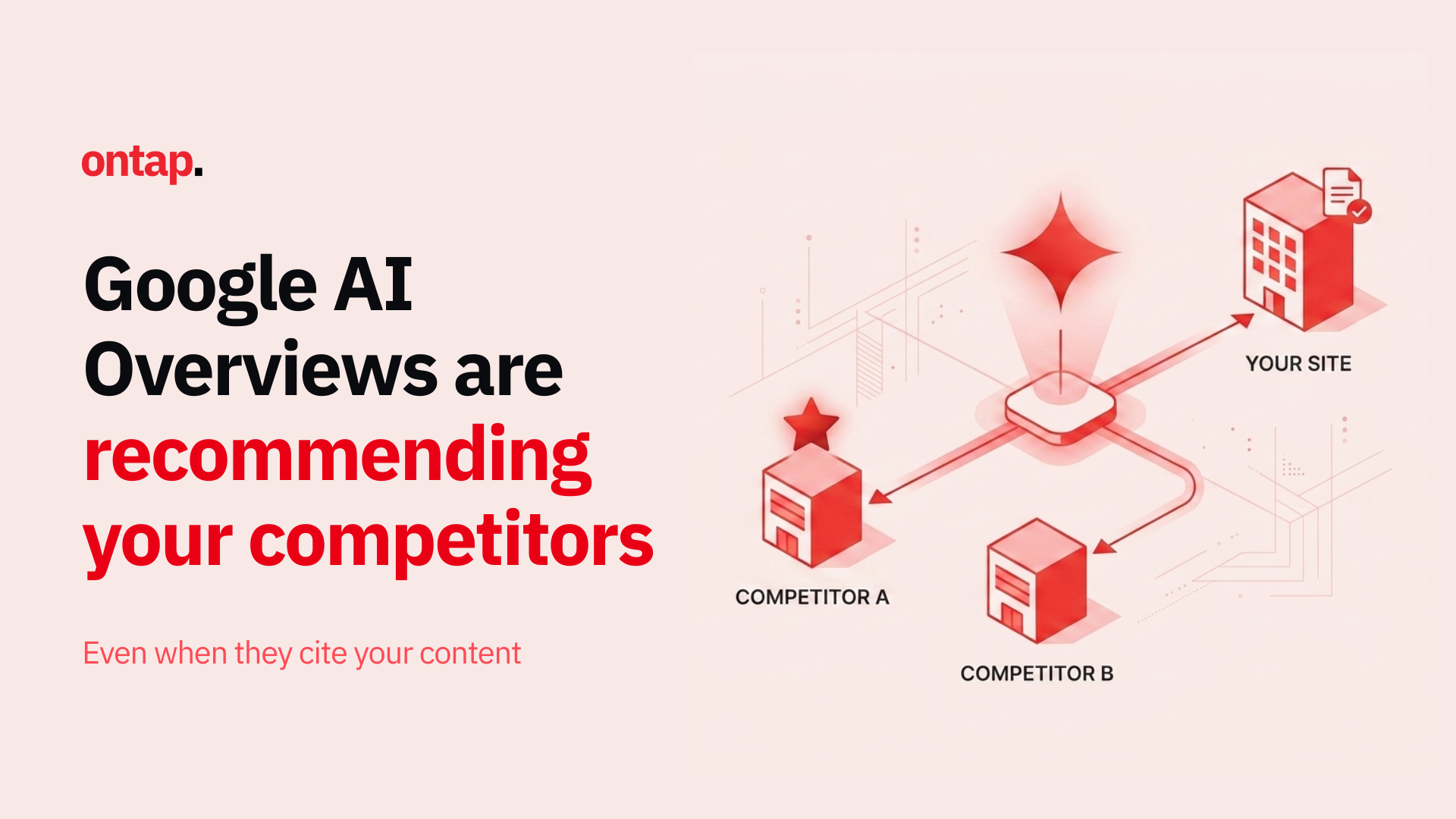
These two announcements sit within a broader trend that Search Engine Land highlighted on the same day: AI is merging paid and organic visibility in ways that make the traditional distinction increasingly meaningless.
Google's Gemini AI is already shaping both advertising campaigns and organic search experiences simultaneously. When an AI system decides which products to recommend in a search response, it draws on signals that span what we used to think of as separate channels: your product feed data (traditionally "paid"), your content quality and authority (traditionally "organic"), and your brand mentions across the web (traditionally "PR").
For eCommerce merchants, this convergence has practical implications:
-
Siloed marketing teams are at a disadvantage. If your SEO team, your paid media team, and your social media team operate independently, each optimising for their own channel's metrics, you're missing the connections that AI systems are already making. The brands that win AI visibility will be those with unified content strategies that create consistent, high-quality signals across every surface.
-
Product data quality becomes a universal foundation. Your product feed isn't just for Google Shopping and Meta Advantage+ anymore. The same structured data about your products - accurate descriptions, high-quality images, detailed specifications, competitive pricing - feeds into every AI system's understanding of what you sell and who you sell it to.
-
Brand authority compounds. AI systems aggregate signals from multiple sources. A product that's well-reviewed in Facebook Groups, well-described in your product feed, well-ranked in traditional search, and frequently mentioned in independent content has compounding advantages in AI-driven discovery that no single channel optimisation can replicate.
What eCommerce brands should do now
Here's the practical playbook:
-
Audit your Facebook presence for AI readiness. Are your products being discussed in relevant Groups? Is your brand content in Reels helpful and specific rather than purely promotional? Do you have an active community that generates authentic product-related content?
-
Set up Bing Webmaster Tools AI reporting. Even if Bing isn't your primary search channel, the Citation Share and Intent data will give you insights into your AI visibility that no other tool currently provides. Use these insights to inform your broader content strategy.
-
Unify your product data strategy. Ensure your product information is consistent, complete, and high-quality across every surface: your website, your product feeds, your social content, and your third-party marketplace listings.
-
Invest in "next-question" content. Research highlighted by Search Engine Land suggests that content which anticipates and answers the follow-up question, not just the initial query, performs significantly better in AI search contexts. For product content, this means going beyond basic specifications to address use cases, comparisons, and decision-making factors.
-
Start measuring AI visibility. Use Bing's new tools as a starting point, and supplement with manual testing. Search for your products in ChatGPT, Copilot, Gemini, and now Facebook AI Mode. Document where you appear and where you don't.
Conclusion
The era of optimising for a single search engine is ending. AI-powered discovery now spans social platforms, search engines, and assistant ecosystems, and it rewards businesses that join the dots between product data, community signals, and content that answers the next question.
If you act now, you gain a compounding advantage: better product feeds, authentic social proof, and content that surfaces in AI answers will drive discovery and conversion across multiple AI surfaces. If you wait, your competitors will own those early AI citations, and the customers that follow.
On Tap helps eCommerce teams move from uncertainty to a clear, measurable AI discovery strategy. We audit your social footprint for AI readiness, configure AI reporting and citation tracking, and unify product data and content so your brand shows up where intent-driven shoppers are asking questions. Our playbook combines tactical fixes with measurement so you can prove ROI and scale what works.
Ready to protect and grow your AI visibility? Contact On Tap, and we’ll show one immediate change you can make this week to improve AI citations for a priority product.