
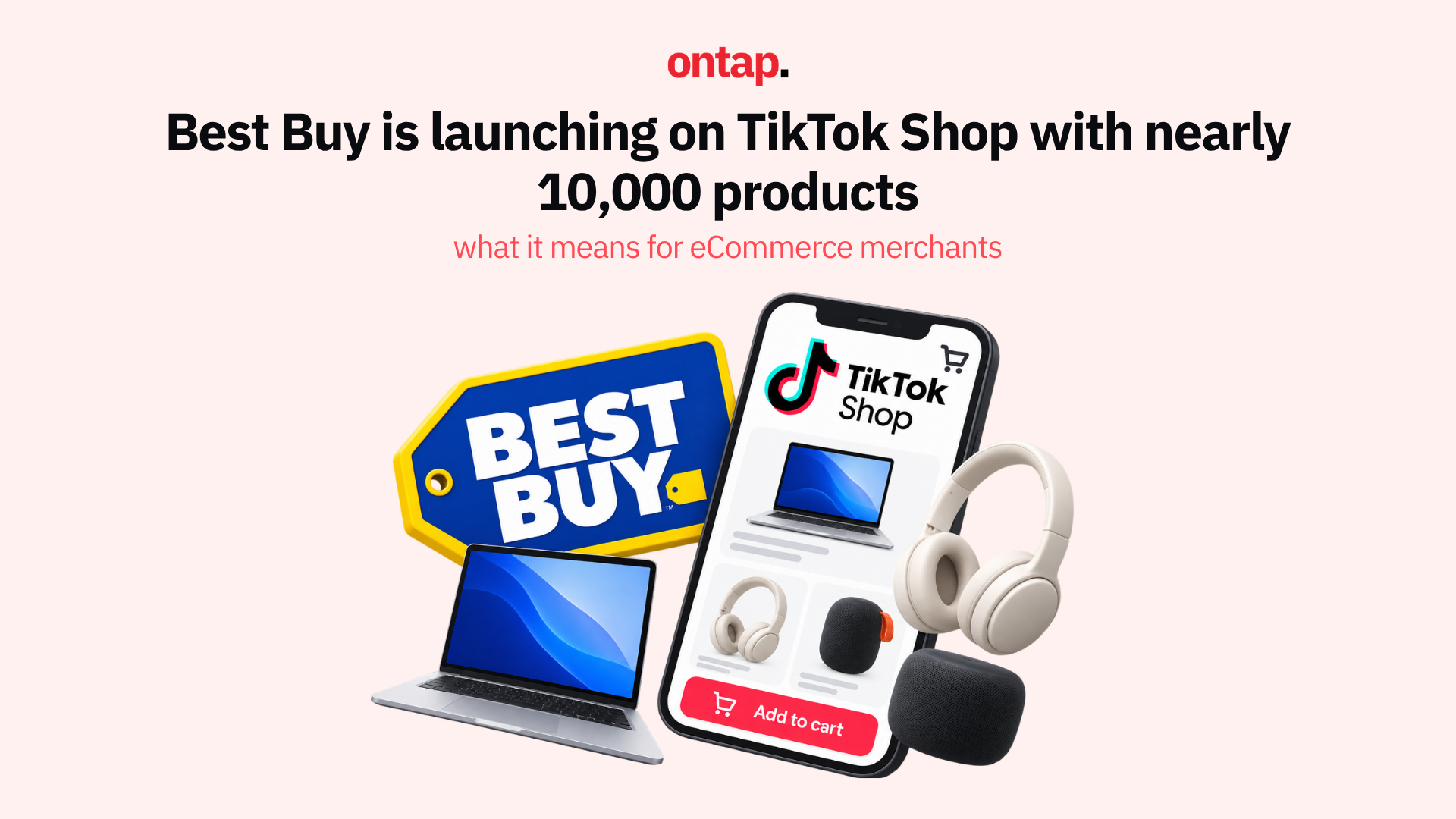
Best Buy announced on 22 September that it will launch on TikTok Shop in the US in late October 2026, with nearly 10,000 products from brands including Microsoft, Dyson, Bose and Oura.
According to Best Buy’s official announcement, customers will be able to find products through shoppable creator videos, the Best Buy shop page, the TikTok Shop tab and in-app product pages. Orders will be fulfilled by Best Buy, while eligible TikTok Shop purchases can be returned in a Best Buy store or by post.
The scale makes the launch worth watching. Best Buy is one of the first large US big-box retailers to bring such a broad technology catalogue to TikTok Shop, giving eCommerce merchants another indication of how social platforms are bringing product discovery and transactions closer together.
Why Best Buy's TikTok Shop launch matters
TikTok Shop is already a sizeable eCommerce channel in the US. Research firm Momentum Works and analytics provider Tabcut estimated that US TikTok Shop gross merchandise value reached US$11.8 billion in the first half of 2026, up 103% year on year. Globally, they estimated TikTok Shop GMV at US$50.3 billion over the same period, up 92%.
More broadly, EMARKETER forecasts US retail social commerce sales will exceed US$100 billion in 2026. These figures are forecasts and third-party estimates rather than TikTok financial disclosures, but they illustrate the growing commercial scale of the channel.
Best Buy's entry is particularly interesting because of the products involved. Electronics such as laptops, cameras, headphones and smart devices often involve more specification, price and feature comparison than low-cost impulse purchases.
Best Buy is therefore testing TikTok Shop across a substantial technology range rather than using it only for a small promotional assortment. Its launch includes:
-
Nearly 10,000 products: including laptops, cameras, headphones, small appliances and accessories;
-
Multiple discovery surfaces: including creator content, TikTok Shop search and browsing, product pages and Best Buy's shop page;
-
Direct fulfilment: orders placed through TikTok Shop will be fulfilled by Best Buy;
-
Existing returns infrastructure: eligible purchases can be returned in Best Buy stores or by post.
That does not establish that TikTok Shop will work equally well for every high-consideration category. It does show that a major electronics retailer sees enough opportunity in social discovery to make a sizeable catalogue directly purchasable within the platform.
Best Buy's own explanation focuses on meeting customers at the point of discovery, with creators playing a role in what shoppers notice and consider.
The data and measurement opportunity
Best Buy's announcement also highlights a measurement opportunity that deserves attention.
For Best Buy Ads partners, the retailer says brands can use creator content in campaigns, provide a direct path to purchase through shoppable content and affiliate links, and connect campaigns with Best Buy's first-party data and measurement capabilities. This is intended to give participating brands a clearer view of which creators, content and products are generating engagement and sales.
TikTok Shop itself provides similar commerce measurement tools for sellers. Its affiliate analytics can report metrics including GMV, orders, items sold, traffic, creators, products, videos and livestream performance. TikTok Shop's Affiliate Seller Analytics documentation also allows sellers to break performance down by creator and content.
That makes TikTok Shop more than an additional checkout destination. For merchants using its commerce and affiliate tools, it can provide another source of attributable data around content-led sales.
The distinction is important: this does not mean TikTok Shop gives merchants complete visibility into every customer's original discovery journey, nor does Best Buy's announcement establish that every TikTok purchase becomes a new first-party customer data point for the retailer. The practical opportunity is narrower and more defensible: connecting specific commerce activity with creator, content, and product performance inside the available measurement framework.
What this means for mid-market eCommerce merchants
Best Buy's scale is very different from that of a mid-market merchant, so its launch should not be treated as a template that every retailer needs to copy. It does, however, provide a useful reason to reassess whether TikTok Shop fits your own customers, products and economics.
Where TikTok Shop can be a stronger fit:
-
Visually demonstrable products: products whose features, results or use cases can be communicated effectively through short-form video;
-
Creator-influenced categories: categories where product demonstrations, reviews and recommendations contribute meaningfully to consideration;
-
Existing creator programmes: brands that already work with creators or affiliates and can extend those relationships into shoppable content;
-
Sustainable unit economics: products with enough margin to accommodate platform fees, creator commissions, fulfilment costs, promotions and returns.
Where TikTok Shop can create additional complexity:
-
Configuration-heavy products: items requiring substantial customisation, consultation or technical explanation before purchase;
-
Complex fulfilment: operations that do not fit comfortably with the platform's delivery, service or returns requirements;
-
High-return categories: products where additional marketplace and reverse-logistics costs materially affect margin;
-
Limited content capability: brands without the internal resources or creator partnerships needed to produce consistent product-led content.
UK merchants should also avoid applying US fee assumptions to their own business case. As of October 2026, TikTok Shop UK's published commission policy states a standard platform commission rate of 9% inclusive of applicable taxes, before eligible reductions. Affiliate commissions and other operating costs can apply separately.
The more useful strategic question is: does TikTok play a meaningful role in how your customers discover or evaluate products, and can you turn that activity into profitable sales?
Best Buy's stated rationale is to make products purchasable at the point where customers are already discovering them. Mid-market merchants need to assess the same question against their own audience, margins, and content capabilities.
The broader shift: discovery and transaction are converging
Best Buy's TikTok Shop launch sits within a wider eCommerce development: several platforms are shortening the distance between product discovery and checkout.
Other September 2026 developments illustrate different approaches:
-
Tapestry and Google: on 16 September, Tapestry announced that US customers could purchase eligible Coach and Kate Spade products within Google Search, including AI Mode, and the Gemini app, using Google Pay and without a conventional website redirect. Each transaction still requires customer approval. Tapestry's announcement on its Google and Gemini integration;
-
Shopify and WebMCP: on 28 September, Shopify extended WebMCP support to checkout, allowing supported browser-based AI agents to read and update eligible checkouts and submit an order after buyer confirmation. Shopify had previously introduced storefront and cart tools for Liquid storefronts and its Hydrogen developer preview. Browser and checkout eligibility limitations still apply. Shopify's WebMCP checkout release note;
-
Amazon and Meta Muse: in September, Amazon confirmed that it had blocked Meta's Muse agent from shopping on Amazon after saying that the automated access had not been authorised. This illustrates that agent-led commerce also depends on retailer policies, platform permissions and technical access rather than operating uniformly across the web. Retail Dive's report, including Amazon's statement.
These developments should not be treated as a single, fully established purchasing model. TikTok Shop, embedded AI checkout and browser-based shopping agents operate differently and remain at different stages of adoption.
They do, however, point towards a practical eCommerce priority: merchants increasingly need product information, content, inventory and checkout systems that can support discovery across more than their own storefront.
What to do before peak season
For merchants considering TikTok Shop before the 2026 peak trading period, the decision should start with commercial fit rather than channel momentum.
If you are already on TikTok Shop, review whether the channel is producing sustainable sales:
-
Check which creators, products, videos and other content formats generate attributable orders;
-
Review listing quality, product information and discoverability;
-
Include platform commission, affiliate commission, discounts, fulfilment and returns when calculating margin;
-
Compare customer acquisition and contribution margin with your other commerce channels.
If you are considering TikTok Shop, build the content and operating model before treating the marketplace as another product feed:
-
Identify products that can be demonstrated clearly in short-form content;
-
Decide whether content will come from your internal team, creators or a combination of both;
-
Establish affiliate economics and creator selection criteria;
-
Confirm fulfilment, customer service and returns processes;
-
Review the current seller policies and fee structure for the market in which you operate.
If TikTok Shop is not right for your business, the wider lesson still applies. Discovery is spreading across social platforms, search, AI interfaces and shopping agents.
That makes structured and accurate product data, useful content and a low-friction checkout experience increasingly important even when the final transaction still takes place on your own eCommerce site.
The bottom line
Best Buy's forthcoming TikTok Shop launch is significant because of its scale: a major US electronics retailer is making nearly 10,000 products available through a platform built around content-led discovery.
That does not mean every eCommerce merchant needs a TikTok Shop, or that social commerce has become equally effective across every category.
The more useful takeaway is to understand where customers discover and evaluate your products, what role those channels play in conversion, and whether you can support a commercially sustainable route from discovery to purchase.
For merchants heading into peak season, that assessment is more valuable than adopting a new sales channel simply because a major retailer has done so.
About On Tap
On Tap is a growth-focused eCommerce consultancy helping mid-market and enterprise merchants improve their digital commerce operations. Product data, checkout performance and analytics are practical starting points for assessing readiness for agent-assisted shopping.
To discuss what WebMCP means for your store, get in touch.