
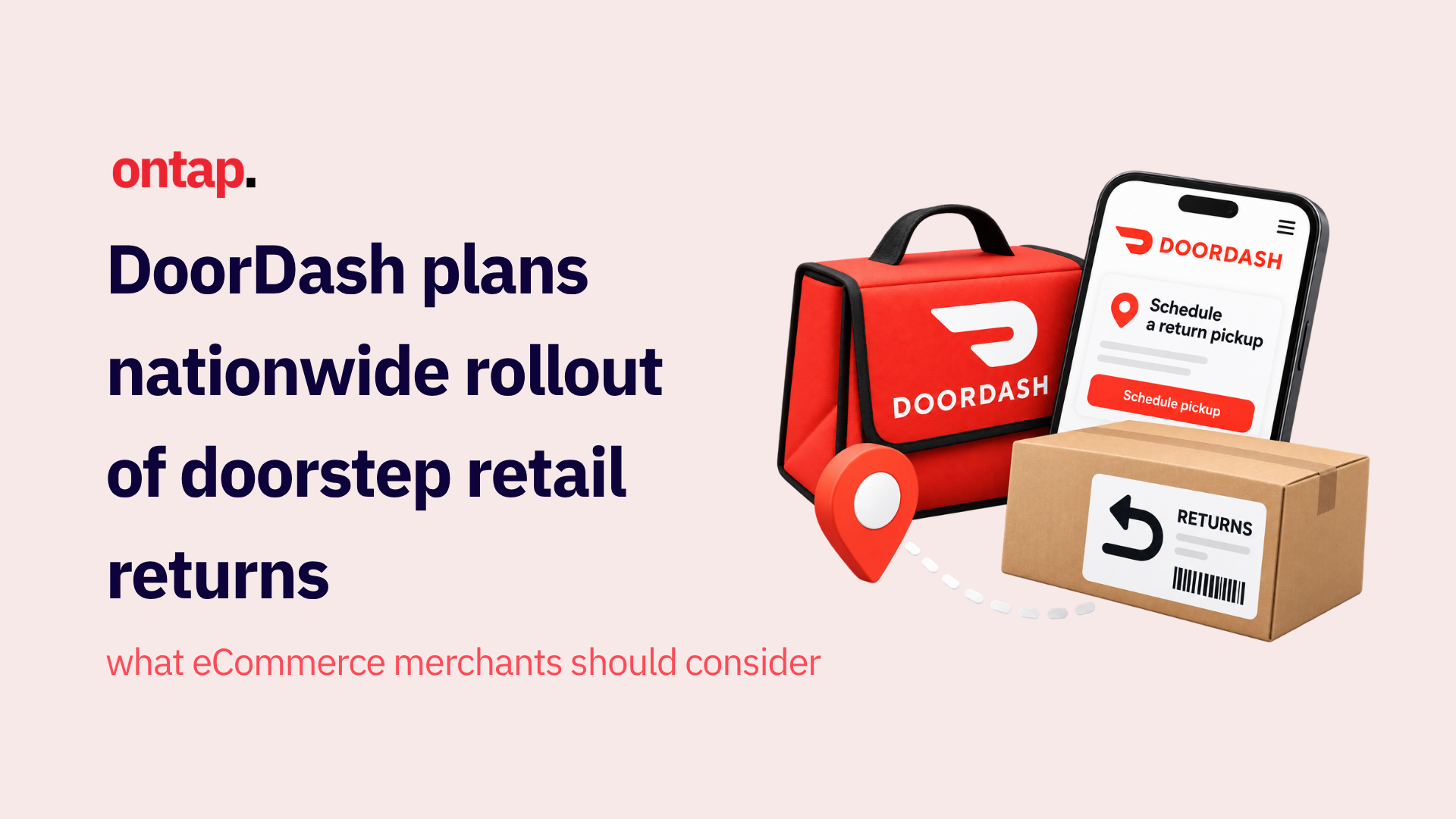
DoorDash has introduced Dasher Returns, a service that allows US consumers to arrange doorstep collection for eligible retail orders purchased through DoorDash. The service is currently available in selected cities and, according to DoorDash’s official announcement, is expected to roll out across the US in November 2026.
For a flat US$7.99 consumer fee, a Dasher can collect an eligible return without the shopper needing a box or shipping label and take it back to the retailer’s store. DoorDash says the return is processed at the store, the item can go back on the shelf, and the customer receives their refund within days, although pickup and refund timings can vary.
For eCommerce merchants, the development is less about DoorDash becoming a universal returns provider and more about the continued move towards lower-friction, more flexible returns.
For UK merchants in particular, Dasher Returns is not currently a nationwide service they can adopt. The more relevant question is what growing expectations around home collection, box-free returns and faster processing mean for their own reverse logistics.
What DoorDash is actually offering
DoorDash announced Dasher Returns alongside a broader expansion of its retail Marketplace on 30 September 2026.
The new service works differently from a traditional carrier return:
-
Eligible DoorDash retail orders: Dasher Returns applies to qualifying retail purchases made through DoorDash;
-
Doorstep collection: consumers schedule a pickup and currently pay a flat US$7.99 fee;
-
No box or label required: eligible merchandise can be handed directly to a Dasher;
-
Return to the retailer: the Dasher takes the item back to the store, where DoorDash says the return is processed;
-
Selected-city availability: the service is currently live in selected US cities, with nationwide US rollout expected in November 2026.
DoorDash says an eligible pickup can arrive in as little as 30 minutes, while also noting that timing varies and is not guaranteed. Refund timing can vary as well.
The launch sits within DoorDash’s wider retail expansion. In September, Costco became available through DoorDash from all Costco warehouses across the US. Lowe’s also launched a pilot in Matthews, North Carolina, where selected products ordered through DoorDash can be delivered using Wing drones. DoorDash has also added retailers including Macy’s, Anthropologie, The North Face, Vans and Timberland to its Marketplace.
The practical significance is that DoorDash is extending infrastructure associated with on-demand delivery into another stage of the retail journey: getting eligible merchandise back to the store.
Why doorstep returns change the calculation
Returns already play an important role in the eCommerce customer experience.
According to the 2025 Retail Returns Landscape from the National Retail Federation and Happy Returns, an estimated 19.3% of online sales were expected to be returned in 2025. The research also found that 82% of consumers considered free returns important when shopping online.
Return experience can influence future purchasing behaviour too. Around 71% of consumers said they were less likely to shop with a retailer again after a poor returns experience.
DoorDash adds another return option by bringing collection to the customer’s home.
For merchants, that creates three areas worth considering:
-
Customer convenience: removing packaging, label printing and travel requirements can reduce effort for eligible returns;
-
Return processing speed: DoorDash says merchandise is taken directly back to the retailer and processed at the store, potentially shortening the journey back towards sellable inventory;
-
Purchase confidence: an accessible returns process can influence how customers assess a purchase, although its impact will vary by category, customer and commercial model.
Other retailers and logistics providers have been addressing similar friction in different ways. UPS-owned Happy Returns now operates a 10,000-location box-free and label-free Return Bar network in the US, while FedEx Easy Returns offers participating merchants consolidated, box-free and label-free returns through FedEx Office and Kohl’s locations.
The evidence supports treating returns as part of the customer experience. It does not establish that doorstep collection will automatically increase conversion or retention for every merchant.
The cost question merchants need to answer
The economics require more nuance than assuming doorstep collection will simply increase merchant return costs.
For Dasher Returns, DoorDash currently states that the consumer pays a flat US$7.99 fee. DoorDash has not publicly detailed the full commercial arrangements between participating retailers and DoorDash for the returns service in its launch announcement.
Merchants assessing doorstep or lower-friction returns should therefore look beyond the collection fee itself.
Three areas matter most:
-
Return processing cost: calculate the full cost of receiving, inspecting, refunding, restocking, reselling or disposing of returned merchandise;
-
Value recovery speed: measure the time between a customer initiating a return and the product becoming available for resale, particularly for seasonal or depreciating inventory;
-
Customer retention: compare repeat purchase behaviour after successful and problematic returns, rather than looking at the return transaction in isolation.
DoorDash’s model is particularly interesting from an inventory perspective because the company says a Dasher takes the product back to the retailer’s store, where the return can be processed and the item can potentially go directly back on the shelf.
That does not mean the model will always produce faster or more profitable returns. Condition checks, refund processes and resale eligibility still depend on the retailer and product involved.
For UK merchants, the useful comparison is therefore not the US$7.99 DoorDash fee itself. It is whether the current balance between postage, drop-off, home collection, customer service and inventory recovery is commercially effective for their own business.
What merchants should evaluate now
DoorDash’s announcement does not mean every eCommerce retailer needs to offer doorstep collection. It does provide a useful prompt to review the existing returns journey.
-
Identify return friction hotspots: analyse the categories, price points, customer groups and return reasons associated with long completion times, repeated support contacts or poor satisfaction;
-
Model the economics by category: compare return rates, margin, handling costs and resale potential rather than applying one returns model across the entire catalogue;
-
Audit your reverse logistics timeline: measure the time between return initiation, physical receipt, inspection, refund and the product becoming sellable again;
-
Review customer choice: assess whether customers have practical return options such as post, carrier drop-off, store return, box-free return or home collection where appropriate;
-
Track retention after returns: compare repeat purchasing and customer-service outcomes following successful and problematic return experiences.
-
The objective is not necessarily to remove every point of friction at any cost. It is to understand where additional convenience improves the customer experience while maintaining sustainable reverse-logistics economics.
The broader reverse logistics trend
DoorDash’s launch sits within wider investment in returns infrastructure and policy management, although the services involved solve different problems.
Several recent developments illustrate the range of approaches:
-
UPS and Happy Returns: in April 2026, the Return Bar network expanded to 10,000 US locations, allowing participating shoppers to make box-free and label-free returns that can be consolidated through the reverse-logistics network;
-
FedEx: FedEx Easy Returns provides participating merchants with a consolidated returns model in which consumers can bring eligible items to around 3,000 FedEx Office and Kohl’s locations without a box or label;
-
Shopify: on 29 September 2026, Shopify introduced return window overrides, allowing merchants to apply different return periods to specific collections, products or variants. Shopify also supports market-specific return and cancellation rules, although those market-specific rules are currently in early access for certain merchants.
These capabilities address different parts of reverse logistics. DoorDash is introducing doorstep-to-store collection, carriers are expanding consolidated returns infrastructure, and platforms such as Shopify are giving merchants more control over the policies governing returns.
Together, they reinforce a practical point: reverse logistics increasingly spans customer experience, policy, inventory recovery and operational cost, rather than functioning only as a post-purchase shipping task.
For merchants preparing for peak trading, useful preparation includes reviewing return rules, checking customer-facing information, forecasting return volumes and understanding how quickly returned stock can move back into sellable inventory.
The bottom line
DoorDash’s Dasher Returns service is notable because it extends the company’s on-demand delivery model into the return journey.
Its current scope should remain clear: the service is available in selected US cities for eligible DoorDash retail orders, currently costs consumers US$7.99 per eligible return, and is expected to expand nationwide in the US in November 2026.
For UK eCommerce merchants, the immediate takeaway is therefore not that they need to adopt DoorDash. It is to assess whether their current reverse-logistics experience meets customer expectations while remaining commercially sustainable.
The key metrics are straightforward: what a return costs, how long it takes to recover the inventory, how easy the process is for the customer, and what happens to that customer relationship afterwards.
About On Tap
On Tap is a growth-focused eCommerce consultancy helping mid-market and enterprise merchants improve their digital commerce operations. From checkout and fulfilment to returns and customer experience, we help businesses identify friction, strengthen performance and build more efficient commerce journeys.
To review your returns experience and broader eCommerce operations, get in touch.