
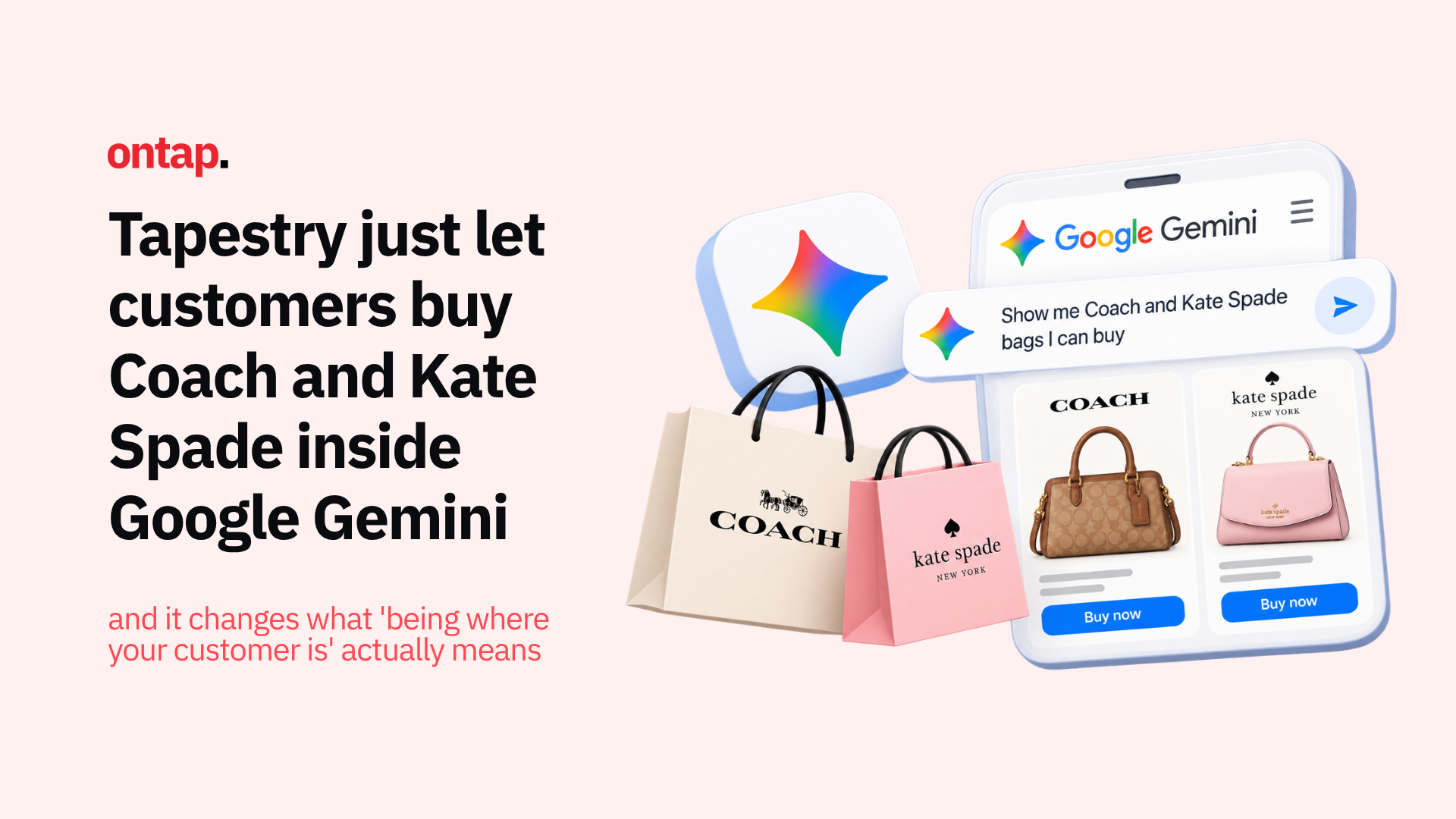
On 16 September 2026, Tapestry announced that shoppers in the US could purchase Coach and Kate Spade products directly within Google Search, including AI Mode, and the Gemini app, without visiting the brands’ websites.
According to Tapestry’s announcement, shoppers can complete single-item checkout using Google Pay, with explicit consumer approval required for every transaction.
For eCommerce merchants, this adds another route from product discovery to purchase: an AI interface can support checkout as well as refer shoppers to a website.
The transaction happened before the website
For years, a familiar eCommerce approach has been to get discovered, drive traffic to your site, and convert visitors on your pages. AI search adds another discovery channel, making accurate product information useful for both AI recommendations and the customers who follow them.
Tapestry’s integration adds a purchasing route that does not require a website visit:
-
Discovery and checkout: shoppers can find an eligible product and complete the purchase within Google’s interface;
-
Merchant responsibilities: the retailer remains the merchant of record, responsible for the sale and the operational systems supporting it;
-
Customer relationship: checkout on Google does not mean that Google becomes the seller or takes over every part of the customer relationship.
Google’s UCP documentation makes this distinction clear: retailers remain the merchant of record and retain control over their customer relationships and data.
This broadens what “being where your customer is” can mean. For eligible merchants, discoverability and the ability to complete a purchase within an AI interface are separate capabilities worth evaluating.
The Universal Commerce Protocol is the infrastructure
Tapestry’s integration uses the Universal Commerce Protocol (UCP), an open standard that connects consumer interfaces with merchants’ commerce systems.
Google co-developed UCP with partners including Shopify, Etsy, Wayfair, Target and Walmart. The protocol is designed to work across platforms, rather than being restricted to Google’s ecosystem.
Within Google’s implementation, the main components have distinct roles:
-
Commerce integration: UCP allows Google’s interface and the merchant’s systems to exchange information needed for checkout;
-
Payment credentials: Google Pay supplies the shopper’s selected payment credentials, while the merchant’s payment infrastructure processes the transaction;
-
Order operations: the merchant’s systems still need to support stock checks, delivery eligibility, and order handling.
Google’s payment handler documentation explains that merchants can use their existing payment systems. UCP is therefore more than a product feed, and Google Pay is not a replacement for the merchant’s payment processor.
Other major retailers have announced related initiatives. In January 2026, Walmart announced a Gemini shopping partnership involving Walmart and Sam’s Club products. In May, Google named Ulta Beauty, Walmart and other retailers among those expected to offer selected UCP-powered checkout features. Those announcements should not be treated as proof that every retailer has launched the same experience.
Platform approaches also differ. Reporting on Amazon’s restrictions on Meta’s Muse shopping agent described blocking that began on 20 September, after Tapestry’s announcement. Restricting a third-party agent’s access to a retail website and enabling checkout through an agreed integration are different arrangements. For merchants, the practical issue is understanding which integrations a platform supports and under what terms.
What this means for mid-market merchants
Tapestry’s launch gives mid-market merchants a concrete example of checkout inside an AI interface. It does not establish that every merchant needs an immediate integration or that UK shoppers already have access to the same experience.
Three implications deserve attention:
-
Customer expectations: fewer steps between discovery and purchase could appeal to shoppers. However, Tapestry’s announcement does not establish that customers will reject merchants whose checkout remains on their own websites;
-
Product data quality: clear descriptions, useful images, relevant attributes and accurate prices and availability help customers evaluate products away from a merchant’s product pages. Missing required data can affect product eligibility, but richer descriptions alone do not enable UCP checkout;
-
Channel economics: integration, payment processing, support and measurement all affect the commercial case. Merchants need to assess these costs alongside any additional sales the channel delivers.
Google’s product data specification distinguishes required, conditional and optional attributes. Requirements vary by product category and target market. A missing colour or size attribute is not a universal reason for exclusion from AI shopping, although missing required attributes can prevent products from being eligible for listings.
Checkout eligibility also depends on participation and technical implementation. Google’s Merchant Center guidance describes a phased programme for selected merchants, with additional requirements for enabling purchases on its AI surfaces.
Payment costs need the same precision. Google says it does not charge additional fees for using the Google Pay API; merchants continue to pay their payment processors. That statement does not establish the complete commercial terms of every UCP integration. On Tap recommends confirming applicable terms and implementation costs before committing significant resources.
For UK merchants, availability is a separate consideration. Google’s May 2026 announcement described UK expansion as a later rollout, while Tapestry’s September launch was explicitly US-based. Preparation can be useful before access is available, but the investment decision should reflect the markets and customers a merchant actually serves.
Three things to do this week
On Tap recommends starting with a focused assessment of product data, eligibility and measurement.
-
Evaluate your product feed quality: review Merchant Center diagnostics, required attributes and relevant product details such as colour, size and material. Check that prices and availability match your commerce systems, using Google’s specification to distinguish requirements from useful enhancements;
-
Understand the Universal Commerce Protocol: review Google’s integration guidance and discuss support with your eCommerce platform or development partner. Establish whether your target market, checkout, and operational systems are eligible before planning an implementation;
-
Measure AI referrals and in-AI orders separately: track identifiable AI-referred website sessions where reporting allows, and plan separate attribution for UCP orders if you integrate. Website traffic alone will not capture purchases completed without a storefront visit.
Google’s UCP documentation describes ways to distinguish integration requests and transaction events from other channels. These records matter alongside website analytics.
This creates a clearer baseline for assessing the channel. A fall in AI-referred website visits would not, on its own, prove that customers had shifted to purchasing inside AI.
The strategic question
Tapestry’s CEO described the launch as a way to connect with shoppers when inspiration strikes, across stores, websites and AI conversations. That is a broader channel strategy, rather than evidence that branded websites are becoming unnecessary.
For eCommerce merchants, the strategic question is whether their product data and operational systems can support an additional purchasing channel when there is a commercial case for participating.
That assessment includes:
-
Customer fit: whether the channel reaches shoppers in your target markets;
-
Operational readiness: whether product, stock, payment and order systems can support the integration reliably;
-
Commercial value: whether attributable sales and customer value justify the costs.
AI interfaces can now support checkout for some products and merchants. Tapestry’s launch shows that this purchasing route is operational, while its suitability for other businesses still depends on access, demand and economics.
About On Tap
On Tap is a growth-focused eCommerce consultancy helping mid-market and enterprise merchants develop their commerce operations and channel strategies.
If you want to understand what in-AI purchasing means for your business, get in touch.