
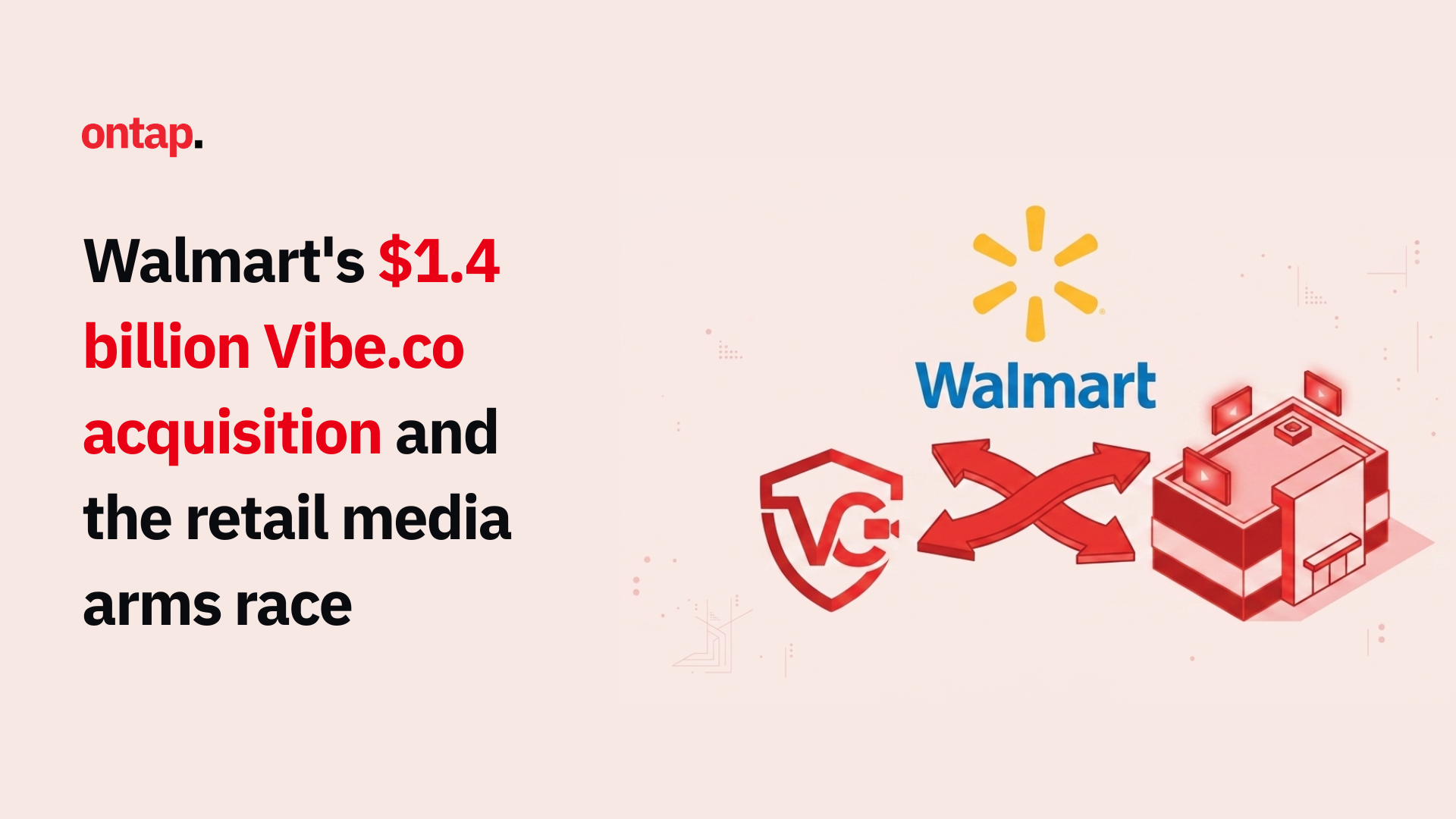
Walmart agreed on 24 June 2026 to acquire connected TV (CTV) advertising platform Vibe.co, reportedly for $1.4 billion, in a deal that underscores just how aggressively major retailers are investing in their advertising businesses. Coming just two years after Walmart's $2.3 billion acquisition of TV maker Vizio, this deal represents a strategic doubling-down on retail media as a profit centre, and a signal that every eCommerce merchant needs to understand.
The deal and its context
Vibe.co is a self-serve CTV advertising platform designed to simplify streaming TV ad buying for small and mid-sized businesses. As reported by The Wall Street Journal and covered by Retail Dive, the deal includes a $1.2 billion cash payout to Vibe.co plus approximately $180 million paid to top executives, with retention requirements of four years. By bringing Vibe.co into Walmart Connect, Walmart gains the technology infrastructure to offer advertisers a full-funnel advertising solution spanning from TV-screen awareness through to in-store and online purchase.
Vibe.co CEO Arthur Querou and CTO Franck Tetzlaff, both co-founders, are expected to join Walmart Connect along with the broader Vibe.co team. As Querou told AdExchanger: "Vibe.co was built as the self-serve platform for performance and eCommerce marketers to run streaming TV the way they run paid social: measurable, fast to launch, and optimised for better outcomes." The deal is expected to close by the end of Walmart's fiscal year 2027, subject to antitrust review.
The numbers behind this move are striking. Walmart's first-quarter global advertising business grew 50% year over year, with Walmart Connect in the US increasing 31%. As Walmart's corporate announcement stated, the acquisition advances the company's strategy to build "more accessible, full-funnel advertising solutions through Walmart Connect, its commerce media business." CEO John Furner noted during the last earnings call that advertising and membership together now represent approximately one-third of Walmart's operating income growth.
Retail media: The new profit engine
To understand why Walmart is spending billions on advertising infrastructure, you need to follow the margins. Traditional retail operates on razor-thin margins, often low single digits. Advertising revenue, by contrast, is largely incremental profit. When a brand pays Walmart to promote its products to Walmart's shoppers, the cost of delivering that ad is minimal compared to the revenue it generates.
This is why every major retailer is racing to build out their retail media capabilities:
-
Amazon's advertising services generated over $17 billion in Q1 2026 alone, growing 24% year over year
-
Target's advertising revenue jumped approximately 50% to roughly $246 million in Q1
-
Walmart's advertising business grew 50% globally in Q1
The Vibe.co acquisition specifically targets the CTV opportunity. Connected TV advertising spending continues to grow as consumers shift from linear TV to streaming. By owning both the hardware (Vizio) and the advertising technology (Vibe.co), Walmart can create a closed-loop advertising ecosystem: a shopper sees an ad on their Vizio TV, powered by Vibe.co's technology, targeted using Walmart's first-party purchase data, and the conversion is measured through actual purchase behaviour at Walmart's stores and website.
That level of attribution is extraordinarily valuable to advertisers and virtually impossible to replicate outside of a retail media context. As AdExchanger's analysis noted, Walmart has been methodically assembling the pieces: in March 2026, the company announced it would require Vizio device owners to log in using Walmart accounts, centralising its identity spine across the CTV ecosystem.
What this means for eCommerce merchants
For mid-market and smaller eCommerce brands, the rapid growth of retail media networks creates both opportunities and pressures.
The opportunity is that retail media platforms offer access to high-intent audiences with increasingly sophisticated targeting. If your products are sold through Walmart, Amazon, or Target, advertising on their platforms gives you access to shoppers who are already in a purchase mindset, with targeting based on actual purchase history rather than inferred interests. Vibe.co's self-serve model is specifically designed to make CTV accessible to brands without large media teams or enterprise ad budgets.
The pressure is that these platforms are becoming pay-to-play environments. As retail media networks grow more sophisticated and more competitive, organic visibility on marketplace platforms becomes harder to achieve. Brands that do not allocate budget to retail media advertising risk being buried beneath competitors who do.
The strategic question is how to allocate marketing budgets across an increasingly fragmented landscape. Ten years ago, the advertising decision was relatively simple: Google, Facebook, maybe some display. Today, merchants need to consider Google, Meta, TikTok, Amazon Ads, Walmart Connect, Target's Roundel, ChatGPT ads, and more. Each platform has different audiences, different targeting capabilities, and different measurement frameworks.
The convergence of AI and retail media
What makes this moment particularly interesting is the convergence of retail media growth with AI-powered advertising. On the same day as Walmart's Vibe.co announcement, Search Engine Land reported that OpenAI's ChatGPT ad dismissals have dropped 50% as relevance improves, suggesting that AI-powered ad platforms are getting better at showing people ads they actually want to see.
Meanwhile, a SimilarWeb study found that visitors arriving at brand websites via ChatGPT recommendations view nearly twice as many pages (12 vs. 6.5) and spend more than twice as long on site (11.8 minutes vs. 5.6 minutes). These are not window shoppers. They are high-intent visitors who have been primed by an AI recommendation.
The advertising landscape is bifurcating. On one side, retail media networks such as Walmart Connect leverage first-party purchase data to target ads within commerce environments. On the other, AI-powered platforms such as ChatGPT leverage conversational intent to deliver highly relevant recommendations. Smart brands will need to be present in both.
What eCommerce merchants should do
-
Give retail media its own strategy and budget. If your brand sells through major retailers, retail media advertising should have its own dedicated strategy and performance metrics, not be an afterthought lumped into your general paid advertising budget.
-
Invest in first-party data as your competitive moat. Walmart's advantage in retail media comes from its unparalleled first-party purchase data. For your own DTC business, this reinforces the importance of building your first-party data capabilities through loyalty programmes, email marketing, and direct customer relationships.
-
Prepare for full-funnel attribution to become the standard. The Vizio + Vibe.co combination allows Walmart to offer something approaching true full-funnel attribution, from TV ad exposure to online or in-store purchase. This will raise the bar for measurement across all advertising platforms. Brands that cannot demonstrate clear attribution will struggle to justify spend.
The bigger picture
The retail media arms race is accelerating. With $1.4 billion deals like Vibe.co following a $2.3 billion Vizio acquisition, it is clear that the largest players see advertising as the future of retail profitability. Amazon, Walmart, and Target are not building ad businesses as experiments. They are building them as core profit engines that subsidise the low-margin commerce operations underneath.
For eCommerce merchants, the strategic imperative is to understand these platforms, invest selectively, and ensure you are not leaving money on the table by ignoring channels where your customers are already shopping. The brands that diversify intelligently across retail media, AI-powered advertising, and traditional paid channels will capture disproportionate value. The ones that stand still will wonder where the visibility went.
About On Tap
On Tap is a growth-focused eCommerce consultancy helping mid-market and enterprise merchants navigate the increasingly fragmented advertising landscape. From retail media strategy and paid media diversification to first-party data activation and measurement infrastructure, On Tap helps merchants allocate budgets where they drive the most measurable returns.
If you want to understand where retail media fits in your growth strategy, get in touch.