 Best full-service eCommerce agency 2026


The Mage-OS project reached a major milestone on 18 May 2026, when the community-driven Magento distribution released Mage-OS 3.0.
Built on Magento Open Source 2.4.9, Mage-OS 3.0 introduces a new interactive installer, built-in RMA functionality, an Admin Activity Log, improved developer tooling, PHP 8.5 support and an opt-in Minimal Distribution for leaner installations.
Combined with Magento Open Source 2.4.9’s arrival on 12 May and Hyvä Theme’s compatibility update on the same day, May 2026 brought several significant releases across the wider Magento ecosystem.
What is Mage-OS 3.0?
For those who have not been tracking the project closely, Mage-OS is a community-driven distribution based on Magento Open Source.
Mage-OS 3.0 represents a significant step forward for the project. The release is built on Magento Open Source 2.4.9 and introduces a new interactive installer, built-in RMA (Return Merchandise Authorisation) functionality, Admin Activity Log, additional developer features, PHP 8.5 support and an opt-in Minimal Distribution for teams that want tighter control over the packages installed in their stack.
The move to version 3.0 also reflects genuine breaking changes and updated requirements.
Mage-OS 3.0 raises the minimum PHP version to 8.3, recommends PHP 8.4, supports PHP 8.5 and moves from Symfony 6 to Symfony 7. It also removes several older modules and dependencies, including Magento_Backup and a number of Adobe analytics modules.
That makes 3.0 a meaningful major release rather than simply a repackaging of the upstream Magento Open Source code.
The context: A convergence of upgrades
Mage-OS 3.0 arrived during a busy period for the Magento ecosystem.
Magento Open Source 2.4.9 was released on 12 May 2026, delivering PHP 8.5 support alongside Symfony 7.4 LTS, 580 core fixes and significant framework changes, including a native MVC implementation replacing Laminas MVC, HugeRTE replacing TinyMCE and Symfony Cache replacing Zend_Cache.
Adobe also lists regular support for the 2.4.9 release line through 31 May 2029.
Hyvä Theme 1.4.6 was also released on 12 May.
The purpose of that release was compatibility with Magento 2.4.9 and PHP 8.5. The functional changes were in the hyva-themes/magento2-theme-module package and included a Symfony Console signature update, a PHP 8.5 ReCaptcha fix and PHPUnit 12-compatible tests.
The Default Theme and Default Theme CSP packages themselves had no functional changes in 1.4.6.
For merchants using Hyvä, this gave development teams a compatible Theme Module path alongside the Magento 2.4.9 backend upgrade.
Mage-OS 2.3.0, released on 13 May, incorporated the upstream Magento Open Source 2.4.8-p5 security changes and added PHP 8.4 and 8.5 compatibility work across several Mage-OS add-on modules.
Mage-OS 3.0 followed five days later with the move to the Magento Open Source 2.4.9 foundation and a broader set of distribution-level features.
These releases happened close together, but they should be understood as separate release streams rather than evidence of a formally coordinated upgrade programme across Adobe, Mage-OS and Hyvä.
What merchants should care about
Performance improvements should be tested
Mage-OS 3.0 supports PHP 8.5 and also introduces PHP 8.4 lazy-object loading when the application is compiled.
Mage-OS describes this as a performance optimisation and provides a configuration option to disable it if an implementation encounters problems.
For merchants, that means there is potential for performance improvement, but the effect will depend on the store’s codebase, extensions, traffic profile and infrastructure.
Rather than assuming that moving to PHP 8.5 or enabling lazy-object loading will automatically make the storefront faster, teams should benchmark the upgraded environment against the existing production baseline.
Security still needs separate attention
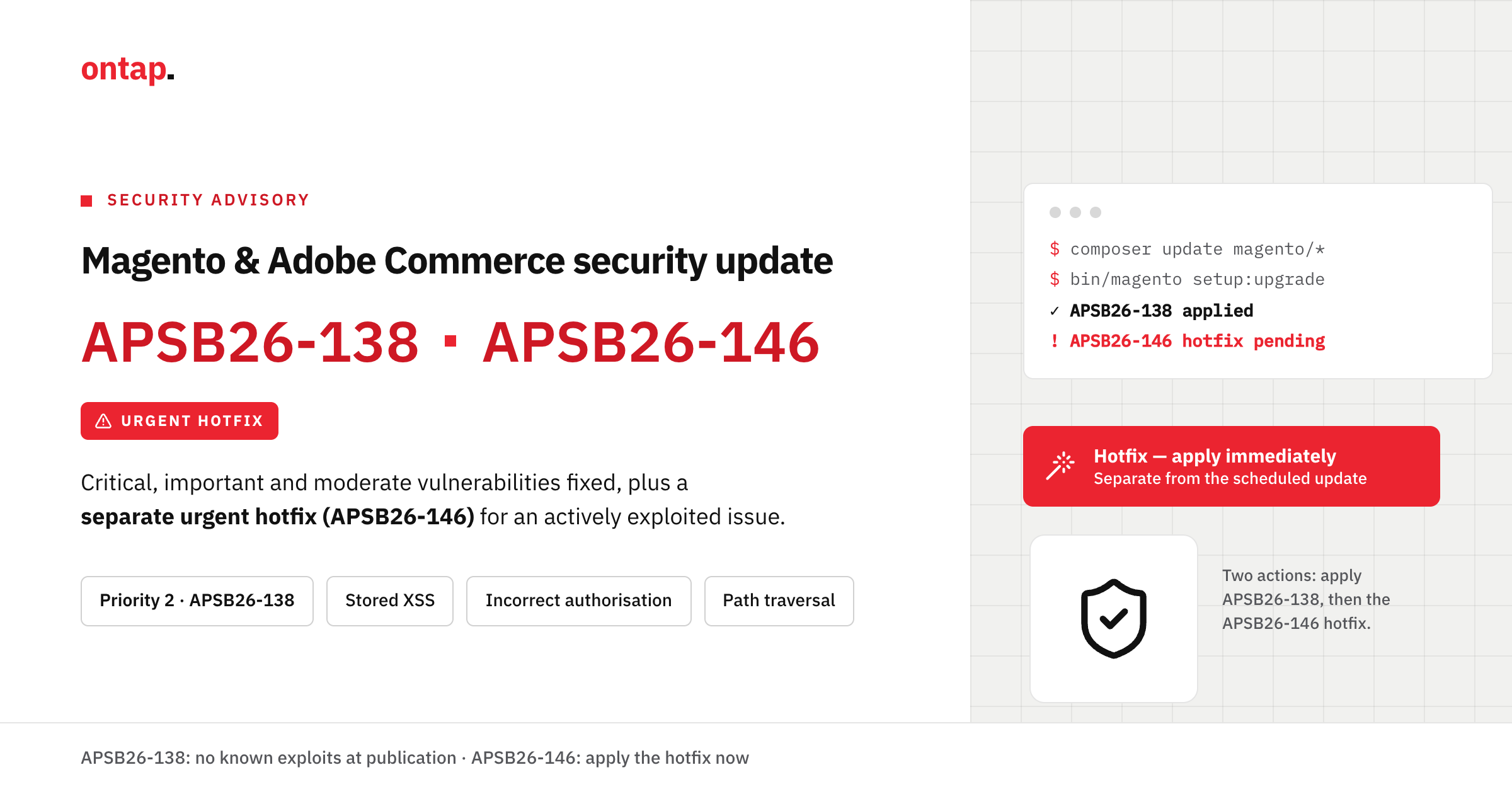
Adobe released APSB26-49 on 12 May 2026 for Adobe Commerce and Magento Open Source.
The bulletin addressed critical, important and moderate vulnerabilities, with potential impacts including arbitrary code execution, arbitrary file-system write, denial of service and security-feature bypass. Adobe said it was not aware of exploitation in the wild for the issues covered by the bulletin.
Mage-OS 2.3.0 incorporated the corresponding upstream 2.4.8-p5 security changes before Mage-OS 3.0 moved to the Magento Open Source 2.4.9 base.
Merchants should therefore keep security patching and major-version upgrades as related but separate considerations.
Adobe also released security updates for supported older Commerce and Magento Open Source lines alongside 2.4.9, so remaining secure did not require every merchant to move to 2.4.9 immediately.
Support timelines should be checked against the exact release line and product in use rather than reduced to a single August deadline.
The interactive installer changes the onboarding experience
One of Mage-OS 3.0’s headline features is an interactive installer:
bin/magento install
The guided workflow can detect common database, cache, search and message-queue services, walk users through store and Admin configuration, resume after a failed installation and optionally install Hyvä Theme during setup.
The existing:
bin/magento setup:install
command remains available, so existing automation does not need to change immediately.
For agencies, developers and hosting teams building new environments, the installer can make setup more structured. It does not remove the need for Magento technical knowledge or environment-specific configuration.
Built-in RMA functionality
Mage-OS 3.0 adds built-in Return Merchandise Authorisation through:
mage-os/module-rma
Once enabled, customers can request returns from their account, while merchants can review, approve and communicate about return requests from the Admin.
This is a useful addition for Magento Open Source merchants because return-management functionality can now be provided directly within the Mage-OS distribution.
However, it will not automatically replace every third-party or bespoke returns solution.
Merchants with warehouse integrations, carrier-label workflows, automated refunds, exchanges or region-specific returns processes should still assess whether the built-in RMA feature covers their operational requirements.
What this means for the broader ecosystem
Mage-OS 3.0 is significant because it adds distribution-level functionality while continuing to build on Magento Open Source upstream releases.
For agencies and merchants evaluating their platform strategy, that creates another option within the Magento codebase, with its own release process, support model and bundled functionality.
The differences are more useful when assessed in practical terms than as a competition between community and commercial approaches.
Adobe Commerce, Magento Open Source and Mage-OS serve different requirements around:
-
support
-
licensing
-
bundled functionality
-
release management
-
hosting
-
governance
-
development ownership
Mage-OS 3.0 may be particularly relevant to merchants that value its community-driven distribution model and additional open-source functionality.
That does not mean it is automatically the right choice for every Magento Open Source merchant, nor that Adobe Commerce is only relevant to a particular size of organisation.
The appropriate platform depends on the merchant’s requirements and operating model.
Practical next steps
If you are running Magento Open Source, evaluate whether a move to Mage-OS makes sense for your business.
The interactive installer, built-in RMA, Admin Activity Log, Minimal Distribution and bundled development tooling are genuine differences worth assessing against your current implementation.
Regardless of distribution, make sure your environment is on an applicable current security update.
For Adobe Commerce and Magento Open Source merchants, review APSB26-49 and the appropriate updated release for your existing version rather than assuming a Mage-OS or 2.4.9 migration is the only remediation path.
Plan your PHP upgrade as part of the wider platform assessment.
Mage-OS 3.0 requires PHP 8.3 or later, recommends PHP 8.4 and supports PHP 8.5. Test custom modules, third-party extensions and deployment tooling in staging before production deployment.
If you are running Hyvä and planning a Magento 2.4.9 upgrade, Hyvä Theme Module 1.4.6 provides the relevant Magento 2.4.9 and PHP 8.5 compatibility changes.
Do not treat 1.4.6 as a CSP feature release: the Default Theme and CSP packages themselves contained no functional changes in that version.
Review the Mage-OS 3.0 compatibility changes before upgrading.
In particular, check:
-
the PHP 8.3 minimum requirement
-
Symfony 7 compatibility
-
removed Adobe analytics modules
-
removal of
Magento_Backup -
removal of the default
ext-ftprequirement -
custom extensions that depend on affected Symfony components
These changes are more useful for upgrade planning than relying on the major version number alone.
May 2026 was an active release period across Magento Open Source, Mage-OS and Hyvä.
Mage-OS 3.0 is an important part of that picture because it combines the Magento Open Source 2.4.9 foundation with additional community-maintained functionality.
For merchants considering the open-source commerce path, the practical question is whether those features, the support model and the ongoing release process match the needs of the business.
How On Tap can help
At On Tap, we are a Magento and Adobe Commerce specialist agency helping merchants navigate upgrades, platform changes and the evolving open-source ecosystem.
If you need help assessing Magento 2.4.9, Mage-OS or Hyvä compatibility, get in touch with our team.