
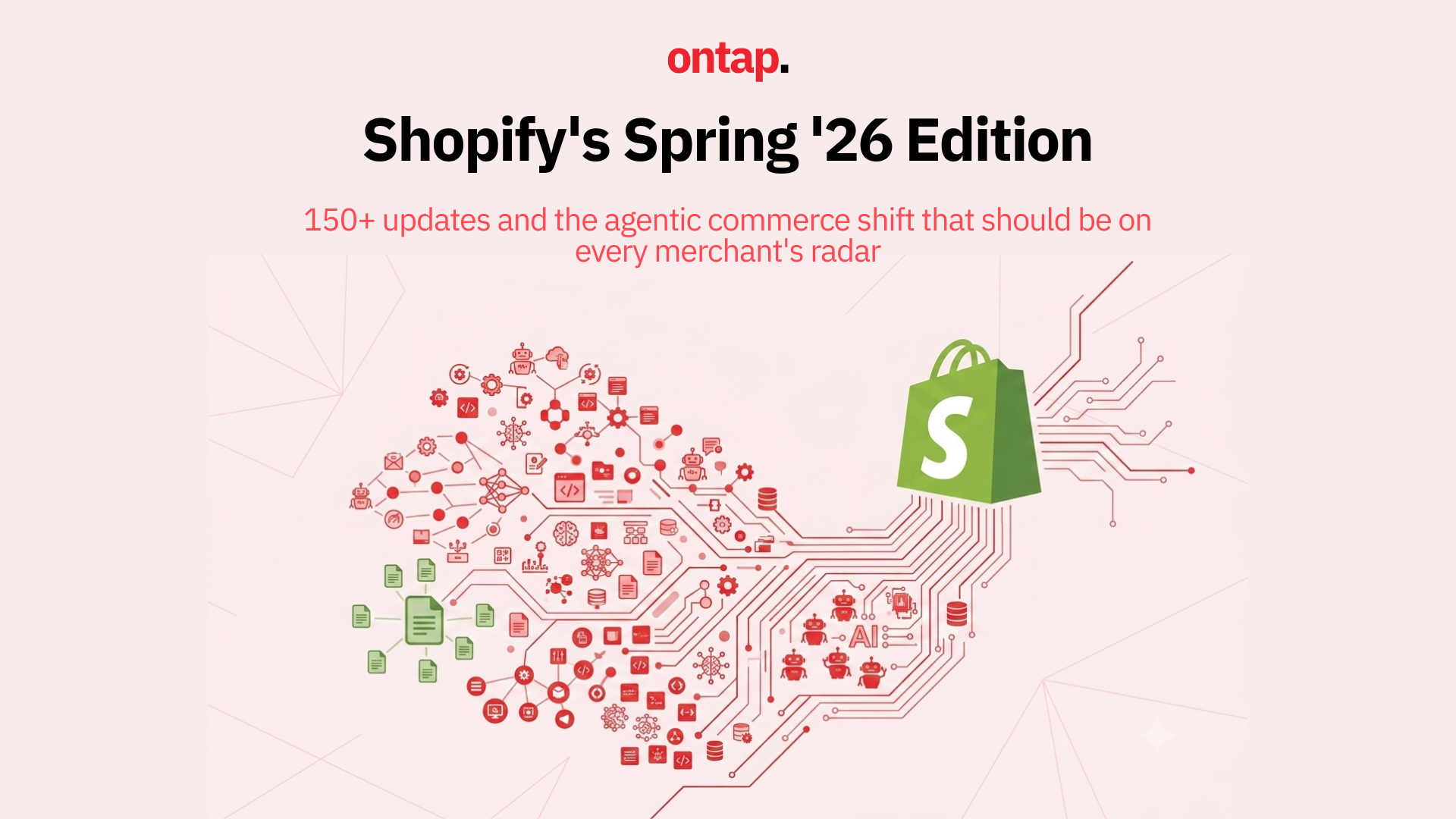
Shopify dropped its Spring '26 Edition on 17 June, and with over 150 updates packed into a single release, it would be easy to lose the signal in the noise. But beneath the headline number, there is a clear strategic direction emerging, and it has major implications for how merchants sell, manage international operations, and prepare for AI-driven commerce.
The agentic commerce infrastructure is real
The most significant development in this edition is not a single feature. It is the production-grade infrastructure for agentic commerce.
The Universal Commerce Protocol (UCP), co-developed by Shopify and Google and backed by Amazon, Meta, Microsoft, Salesforce, Stripe, Etsy, Target, and Wayfair, is now fully self-serve for every developer. UCP access previously required approval. That requirement is gone. Developers register their agent profile in the Developer Dashboard and call the public MCP endpoint. From there, they can build across the full flow, from product search to checkout.
Shopify Catalog, the structured product database that powers UCP, now supports image search, multi-modal queries, and bulk lookup of up to 50 products per request. As Shopify's developer announcement states, "AI searches powered by Shopify Catalog convert at 2x the rate of those using scraped data." Shopify merchants are included in Catalog by default.
What this means for merchants
Your store may soon be selling to AI agents as frequently as it sells to humans browsing on mobile. Customers can already check out inside Microsoft Copilot and pay with Shop Pay, with Meta ads named as a surface coming next. A new Agentic plan even lets businesses that are not on Shopify sync products to Catalog and sell across AI channels without migrating.
What to do now
Ensure your product data is rich, structured, and complete. AI agents rely on clean metadata to make confident purchasing decisions. Thin product descriptions and missing attributes make you invisible to these systems. As Coalition Technologies' analysis noted, "22 of 27 founders surveyed said their product data is not clean enough to win in AI channels yet."
EU compliance gets easier
Starting late June, Shopify now supports the EU's new €3 customs duty on qualifying low-value imports, offering two distinct implementation methods. This is a meaningful quality-of-life improvement for merchants selling into the EU, where compliance with evolving import duty regulations has been a persistent headache.
Alongside this, self-serve returns now support cancellations with market-specific configurability, a direct response to changing EU right-of-withdrawal regulations. Being able to set cancellation rules per market means merchants can maintain compliant policies across jurisdictions without manual intervention.
B2B gets first-class treatment
B2B discounts are now enabled by default for new B2B stores and eligible existing stores; no more contacting Shopify Support to flip a switch. This seemingly small change reflects Shopify's broader commitment to making B2B a core capability rather than an afterthought.
Combined with new purchase order workflows that use transfers to handle inventory movement (supporting partial deliveries and multi-location routing), Shopify is steadily closing the gap with dedicated B2B platforms. For merchants operating in hybrid B2C/B2B models, these capabilities reduce the need for separate systems.
Carrier service API: A breaking change to plan for
Developers and app partners should take note: starting with Admin API version 2026-10, creating a carrier service will no longer automatically add rates to the General shipping profile. This is a breaking change that requires explicit configuration after carrier service creation.
If you rely on apps that provide calculated shipping rates, verify with your app provider that they are prepared for this change. Merchants will not see rates from newly created carrier services at checkout unless the integration has been updated.
Scripts deadline: 30 June 2026
A critical reminder that sits alongside this edition: Shopify Scripts stops running on 30 June 2026. Any checkout customisations still built on Scripts will break after that date. The replacement is Shopify Functions, and the migration needs to happen before the deadline. If your store uses Scripts to apply discounts, control shipping options, or run any checkout logic, those customisations will silently stop working. Audit now.
POS and staff attribution improvements
Staff attribution in POS now defaults to on, with a faster assignment flow and performance reporting in POS analytics. For multi-staff retail environments, this means better visibility into individual sales performance without additional setup.
The bigger picture: Platform convergence
What ties these updates together is Shopify's accelerating convergence of channels: online, in-store, B2B, and now AI agents, into a single operational layer. The UCP infrastructure, the B2B defaults, the POS improvements, and the cross-border compliance tools all point towards the same vision: one platform that handles every transaction, regardless of the channel or the entity (human or AI) initiating it.
For merchants evaluating their platform strategy, the Spring '26 Edition reinforces that Shopify is not just adding features. It is building the unified commerce layer that makes channel-specific thinking obsolete.
Action items for merchants
-
Audit your product data completeness. Agentic commerce rewards structured, rich product information. AI agents convert at 2x when working with Shopify Catalog data vs scraped data.
-
Migrate from Scripts to Functions before 30 June if you have not already done so. Checkout customisations will break.
-
Review EU tax and returns settings if you sell cross-border into Europe.
-
Check with your shipping app providers about the 2026-10 carrier service API changes.
-
Enable B2B discounts if you sell wholesale. They may already be active on your store.
-
Turn on POS staff attribution and start tracking individual performance metrics.
About On Tap
On Tap is a growth-focused eCommerce consultancy helping mid-market and enterprise merchants navigate platform updates and build strategies that compound. From Shopify edition readiness assessments and product data audits to agentic commerce preparation and cross-border compliance, On Tap helps merchants turn platform capabilities into competitive advantages.
If you want to understand what the Spring '26 Edition means for your specific store, get in touch.