

Magento eCommerce merchants often face the choice between hiring a development agency vs a freelance developer to build or customise functions for their online stores. It's a bit like choosing between a big restaurant and a personal chef - both can produce great outcomes, but work very differently.
Before you decide, you should understand what each option offers, how much they cost, and which will work best for your online store. Let's look at the main differences to help you make the right choice that aligns with your business needs and goals.
Major differences between Magento development agency vs freelance developer
An agency and a freelance Magento developer primarily differ in cost, expertise, service coverage, and scalability. While agencies offer more comprehensive solutions with multiple specialists at a higher rate, freelancers provide more flexible, affordable and specialised services that are suited for smaller projects.
Here is a quick comparison to help you distinguish the two options:
| Criteria | Magento development agencies | Freelance Magento developers |
| Cost | Higher costs (£800 – £80,000+ for full projects) due to team structure and overhead expenses. | Lower price (£10 – £200 per hour), with total project costs typically £250 – £800. |
| Services received | Full service, encompassing everything from strategy, design, development, testing, hosting, and all technical aspects. | Limited and specialised services like website development, function customisation, or bug fixes. |
| Implementation time | 4 months to a year for full store development and integrations. | A week to several months for basic store development and setup. |
| Quality management | Structured quality control with dedicated QA teams and standardised processes. | Variable quality control depends entirely on freelance developers' standards and capacity. |
| Communication | Streamlined process with the involvement of a project manager. | Direct communication, but may require your technological understanding. |
| Reliability | High reliability with case studies, testimonials, and ratings from major brands/partners. | Less visible proof to showcase (client referrals, certifications, and work portfolios.) |
| Expertise | Wide range of experts with different skill sets. | Strong expertise in specific areas. |
| Scalability | Scalable team size and scalability-focused solutions with server capacity reservation. | Hard to handle traffic surges due to the lack of resources and proactive scalability planning for rapid business growth. |
| Post-project support | Comprehensive and dedicated support. | Limited support due to expertise areas and schedule conflicts. |
Let’s explore each criterion in detail:
1. Cost
The cost difference between hiring freelancers vs Magento development companies is significant. While agencies tend to charge more for complex projects, freelancers offer budget-friendly options for smaller scopes.
Common factors that influence the cost of hiring Magento developers, applicable for both agencies and freelancers, are:
- Project requirements
- Number of deliverables
- Service type
- Location (offshore vs onshore)
- Pricing model (hourly vs project-based)
- Additional fees (overhead costs, maintenance fees, etc.)
Specifically, a complete Magento website development project with an agency typically costs between £800 – £80,000+ ($1,000 – $100,000). Basic projects with standard features range from £800 – £10,000, while complex projects with advanced features and custom integrations can cost £10,000 – £80,000 or more.
Freelance Magento developers, on the other hand, generally charge between £10 – £200 ($15 – $250) per hour, and £250 – £800 ($300 – $1000) for each project. The cost of hiring freelancers varies from location, with onshore rates ranging from £15 – £200/hr and offshore cost per hour varying from £10 – £100.
Apart from development costs associated with hiring Magento developers, businesses building online stores on Magento should also be aware of some additional expenses. These encompass domain name registration, platform licensing, hosting solutions, SSL certificates, extensions, and payment gateway integration. Normally, these costs are not included in the quotes provided by freelancers, whereas agencies may incorporate them into their pricing. Therefore, it’s essential to inquire about these details before deciding between Magento development agencies and freelancers.
2. Services received
A Magento development agency typically provides a full suite of services, including consulting, UI/UX design, system integration, platform migration, hosting, and even ongoing support. A freelance developer, however, specialises in specific tasks like theme modification, back-end functionality, or custom eCommerce features.
What you will receive from a Magento development company ranges from:
- Research & discovery: They conduct in-depth market research to understand your business needs, target audience, and competitors, then create a roadmap for your project.
- Strategy development: Magento development agencies offer strategic consulting services that align your business goals while optimising for better performance and conversions.
- Magento store development: Companies are capable of building fully customised Magento stores with custom themes, modules and extensions that cater to your unique needs. Some large agencies even own their repositories of extensions and themes that they developed themselves, for you to choose from.
- UI/UX design: Magento businesses design user-friendly shopfronts that are mobile-responsive and optimised for easy navigation and checkout.
- Hosting: Agencies often offer Magento hosting solutions using dedicated or cloud servers, addressing the lack of a built-in hosting solution in Magento editions or resolving challenges with existing hosting.
- Third-party integrations: Magento development companies connect your store with essential tools like payment gateways, shipping methods, CRM/ERP systems, and marketing platforms.
- Platform migration: Developers from agencies can handle seamless data migration or re-platforming from Shopify or WooCommerce, ensuring all data is transferred safely.
- Performance optimisation: Magento enterprises optimise your store for speed, caching, and database efficiency to handle high traffic.
- Quality assurance & testing: Before launching the website, agencies will perform extensive testing to ensure your store is functional, secure, and bug-free.
- Training & documentation: To assist merchants in operating the platform effortlessly, businesses also provide comprehensive training, platform onboarding process, or user guides.
- Ongoing support & maintenance: They offer long-term support, including bug fixes, security patches, and version upgrades, often through retainer-based plans.
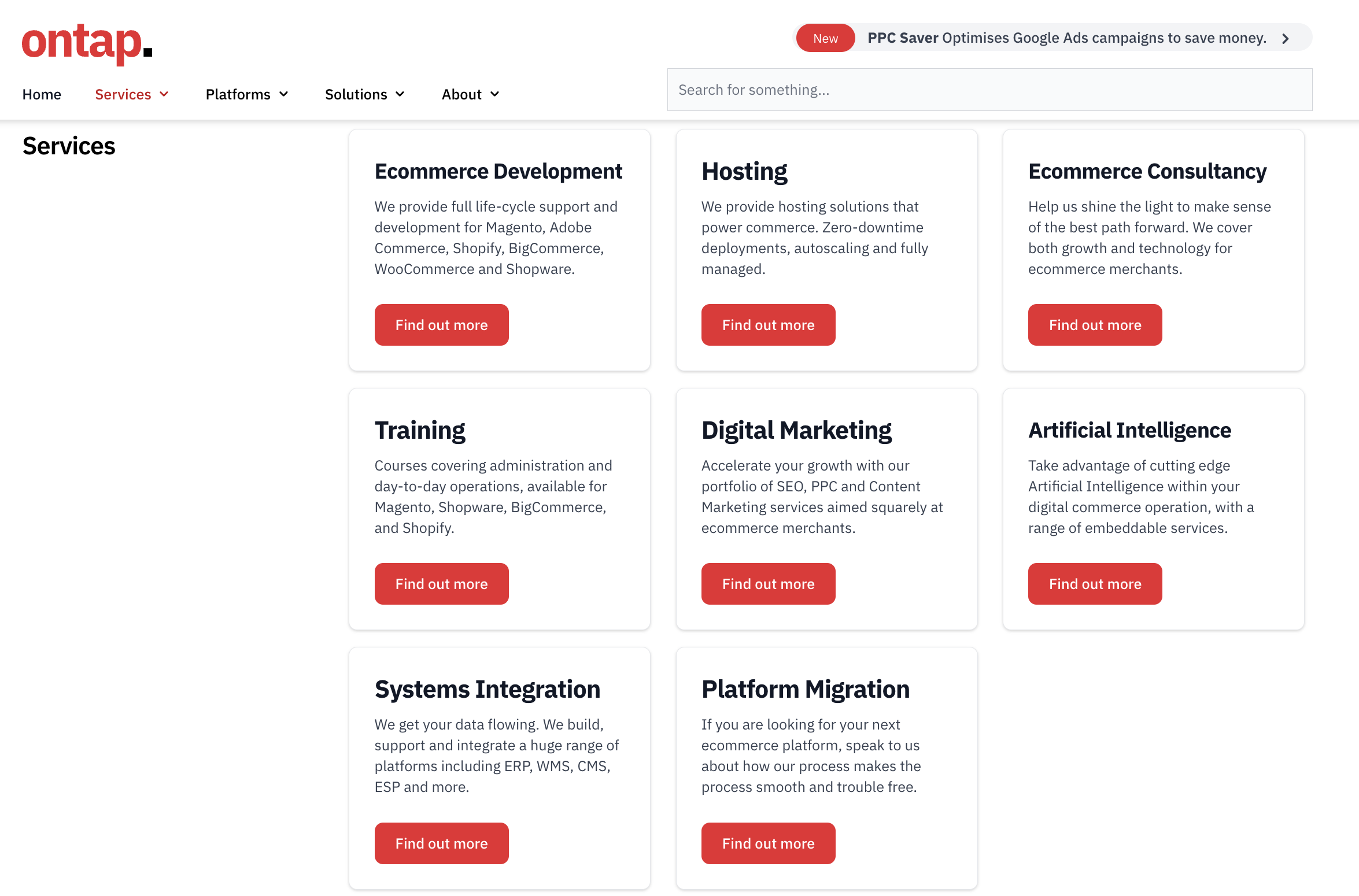
Learn more: On Tap full-cycle eCommerce services
As Magento freelance developers often work individually and have limited resources, you can rely on them for specific tasks. Here's a closer look at what you can expect from a freelancer:
- Theme modification: Magento development freelancers can modify existing themes to align with your demand and enhance the overall customer experience.
- Module development: They help extend the functionality of your Magento store with custom modules, including basic features or system integrations.
- Third-party integration: Individual developers connect essential applications like payment gateways, shipping providers, and marketing automation tools.
- Bug fixing: Freelance developers help diagnose and resolve issues before they damage your Magento store's performance or functionality.
- Performance optimisation: Freelancers analyse your store's performance, identify bottlenecks, and implement strategies to enhance loading times, reduce server load, and improve overall user experience.
- Technical support: Unlike agencies, Magento development freelancers offer technical support on an ad-hoc basis, with ongoing support for bug fixes and performance issues as a separate service.
- Training: As freelancers will not always be available for on-call services, they tend to provide basic training to help you manage your store independently.
Other Magento complete development services such as consulting, full-scale UI/UX design, and re-platforming which require a team of professionals with diverse skill sets are not commonly offered by freelancers.
3. Implementation time
The time-to-market for Magento projects differs between agencies and freelancers primarily due to factors such as team size and structured workflows. However, both scenarios are heavily influenced by the complexity and scope of the projects.
A Magento development agency usually has a team of experts specialising in different roles. This means tasks can be divided and tackled simultaneously, reducing bottlenecks and speeding up the process. This parallel approach saves a lot of time compared to working on one task at a time. Moreover, they also follow proven project management methods like Agile or Scrum, using tools like Jira to make sure everything follows as scheduled.
A typical timeline for a project delivered by an agency would be:
- Consulting and planning (1-2 months): The project begins with discussions with experts from the company to understand your business requirements and set a project goal.
- Website development (2-8 months): This phase consists of several steps, from basic store and server set-up, modules installation, payment and shipping integration to speed optimisation.
- Testing (3-6 weeks): Before launching, every part of the Magento website is thoroughly tested to ensure proper functionality, performance (bugs and compatibility issues), security, and user-friendliness.
- Launch (1 week): This final preparation phase involves deploying the website, conducting final checks, and executing marketing strategies to attract visitors. The agency will double-check that everything is set up for a smooth launch.
Meanwhile, a freelance Magento developer might take longer to complete a project as they often specialise in only one area, like front-end or back-end development. If they manage everything themselves—coding, testing, communication, and debugging, the project’s time-to-market becomes longer. In this case, hiring a team of freelancers might be necessary.
A freelance Magento developer typically takes at least 7 days to set up a basic store using a standard theme. However, the timeline can be significantly extended for more complex tasks, such as integrating additional extensions, migrating data, or connecting third-party APIs. These complexities require more time and effort, which can further prolong the project's time-to-market.
4. Quality management of development
Achieving consistency, efficiency, and high quality is paramount for any Magento development project. Though both agencies and freelancers manage quality during development, they differ significantly in their structural approach.
A Magento development agency typically offers a structured approach to quality management. Here’s how they ensure efficiency and quality expectations:
- Team management & leadership: Each project is managed by a designated team leader or manager, who oversees the workflow, assigns tasks, and makes sure that all deliverables meet the required standards. Clients receive the final output without getting involved in day-to-day project management.
- Quality assurance (QA) processes: Magento development companies often have a dedicated QA team responsible for testing and assuring the website functions smoothly, is bug-free, and meets performance benchmarks before launching.
- Standardised development methodologies: Agencies follow industry best practices, including Agile or Scrum methodologies, which help maintain consistent coding standards, documentation, and project timelines.
Meanwhile, freelancers work independently without the structure of a company, which can pose challenges in quality management from the client's perspective. Factors that cause quality management limitations when collaborating with freelancers are:
- Lack of centralised management: A single freelancer may only focus on specific areas of the Magento project based on their skills, such as front-end or back-end development. Consequently, clients must assume the role of project manager, overseeing resource allocation and quality management across multiple freelancers. This job requires your in-depth technical expertise, as Magento development is not a simple field.
- Quality control variability: Unlike agencies that have dedicated QA teams, quality control with freelancers depends on their abilities. This can increase the risk of errors and inconsistent coding practices.
5. Communication
Effective communication is crucial for achieving mutual success, whether you are working with a Magento development company or a freelancer. An agency may employ effective communication strategies to ensure they meet your expectations for project quality, whilst an freelance developer provides direct conversations to solve one-by-one concerns timely.
To illustrate, a Magento agency will work with you through a dedicated account manager as the main point of contact. This role acts as a liaison between you and the technical team, with responsibilities that include conveying your desired outcomes to the team and providing updates on project progress to you. What’s more, agencies would equip you with consistent communication as they provide multiple contact options. If your account manager is unavailable, you can reach out to the company directly for round-the-clock response.
Ideally, freelancers with ample availability and shared technical understanding can quickly resolve issues as they provide businesses with direct conversations. However, communication challenges may occur if you lack technical knowledge, work with offshore freelancers in different time zones, or cannot reach the freelancer when needed.
6. Reliability
Is it quite obvious that one needs to trust people before deciding to collaborate with them? A similar concept applies when a business evaluates a Magento development agency vs freelancer reliability before starting a project.
Magento agencies may be better positioned to establish their credibility due to the following factors:
- Strong partnerships: A trusted Magento development agency usually certified as Adobe Commerce Solution Partner and/or Adobe Technology Partner. Additionally, their partner ecosystem often includes prominent names in the industry, further fostering their reliability.
- Magento event participation and sponsorship: By attending or sponsoring Magento-related events, businesses showcase their innovative solutions, connect with a global network of professionals, and reinforce their position as industry leaders. This visibility and engagement contribute significantly to building trust and credibility among potential customers.
- Awards & certifications: Agencies that receive awards and certifications within the field demonstrate a high level of expertise and commitment to excellence, making them more trustworthy.
- Proven track record & reputation: Agencies typically have an established presence in the industry, with a portfolio of successfully completed projects and client ratings, and testimonials to back up their legitimacy.
However, does that mean freelancers aren’t reliable to collaborate with?
Not necessarily. Many freelance Magento developers are highly skilled and experienced, but they might not have the same visible proof of reliability as agencies. Freelancers tend to build trust through the following means:
- Client referrals: Customers who have had a positive experience with a freelance developer usually refer them to others. They share detailed information about their past projects, including the quality of work, adherence to timelines, and the level of support provided after launch.
- Work portfolios: Normally, during the assessment phase for freelancers, applicants will provide their resume and past Magento work to ensure they have relevant experience with projects similar to yours. This makes it easier for businesses to evaluate freelancers’ abilities.
- Magento certifications: Holding a Magento certification serves as a validation of a freelancer's expertise, making clients feel more confident working with them. Some notable Magento certifications to look for include Adobe Certified Expert, Adobe Certified Professional, or Adobe Commerce Architect Master.
7. Expertise
Both Magento development companies and freelance Magento developers bring unique skills to the table, but the main difference lies in the diversity of their expertise.
Magento development firms are generally larger in size with several roles of developers, designers, and project managers working together. Each position has extensive experience working on Magento projects across multiple industries. This broad exposure enables them to provide tailored advice and build Magento websites that are specifically suited to your business sector. In contrast, freelance Magento developers, while highly skilled, often lack cross-industry expertise.
In addition, firms may possess a team of experts in various areas of the platform, including front-end design, back-end development, UX/UI, marketing, and security. This team-based approach ensures that all facets of Magento development are comprehensively covered. Meanwhile, freelancers typically have specialised knowledge in certain niches of the eCommerce platform. Therefore, they are well-suited for smaller projects or specific tasks where their expertise can be fully leveraged.
8. Scalability
Magento development businesses and their solution are designed with high scalability due to their extensive resources and strategic approach to project development. Conversely, freelancers typically lack the resources and infrastructure to support large-scale scalability.
To clarify, Magento development agencies employ scalability-centric approaches in several key areas:
- Website scalability: These firms build scalable infrastructures for Magento stores that can handle sudden spikes in traffic without affecting performance. They utilise advanced techniques like autoscaling to ensure your Magento store remains fast and reliable even during peak periods.
- Project scalability: Magento development agencies have a larger team ready to tackle various aspects of your project. They can quickly allocate additional developers, designers, or strategists when you need to expand the project scope by adding more feature customisations or complex integrations.
Freelance engineers, who understand data structures and algorithms, may also provide the same level of scalability when developing your eCommerce site. Although they are able to optimise performance for small projects, they don’t have the resources or expertise to manage traffic surges for larger businesses effectively. Furthermore, they often focus on completing specific tasks within the original project scope, without considering future expansion needs.
9. Post-project support
Due to Magento's emphasis on customization, ensuring the platform's continued stability, performance, and security post-development presents a significant challenge. In that stage, both Magento development agencies vs freelance developers support after launch, but the level of service offered can vary significantly.
Magento development agencies usually provide structured ongoing support and timely assistance when issues arise, with these terms clearly outlined in their contracts. Their dedicated support teams specialise in customer support, upgrading Magento websites for their clients, with organised workflow and service-level agreements (SLAs). Agencies also implement robust security measures, including encryption, multi-layer authentication, and regular audits, to safeguard against cyber threats and ensure regulatory compliance. This level of protection is critical for businesses handling large amounts of sensitive customer data.
Independent Magento developers may also offer post-project support, but cannot match the same level of service as an agency. Since they frequently juggle multiple projects simultaneously, they might not be available or take longer to respond when you need immediate assistance. Additionally, their support may be limited to their specific areas of expertise and knowledge.
In terms of security management for long-term growth, freelancers only rely on standard security practices and may hardly handle complex cybersecurity requests, putting your store at higher risk.
Magento development agency vs. Freelance developer: Which is best for your business?
There is no one-size-fits-all answer—the most suitable choice depends on your business preferences and budget, project complexity, timeline, and support requirements. To make the right decision, you must carefully assess your business's long-term goals and each option’s potential benefits.
A Magento development agency will be the right choice if your business needs:
- A full-cycle Magento solution: If your project requires a custom build, complex integrations, or large dataset migration, an agency has the expertise to handle it.
- Access to a diverse skill set: Agencies provide a team of designers, developers, testers, and project managers with a comprehensive approach.
- A structured workflow: They work with established methodologies (Agile, Scrum) and service-level agreements (SLAs) to maximise transparency and efficiency.
- Higher levels of scalability and security: Agencies implement robust scaling strategies to handle high traffic volumes. Moreover, they typically have dedicated resources focused on implementing the best security practices, such as regular audits, vulnerability assessments, and compliance with industry standards.
- Strategic consulting: Magento agencies prioritise the actual usage and sustainable growth of their clients, thus providing strategic consulting from seasoned professionals.
-
Ongoing support and maintenance: Agencies offer dedicated support after launch, including security updates, performance monitoring, and troubleshooting.
On the other hand, businesses select Magento freelance developers if their focus is on:
- Smaller project budget: Hiring a freelancer is typically more cost less than an agency, making it a better option for startups and small-sized businesses.
- Minor customisations or enhancements: Freelancers are a good fit for fixing bugs, less complex design tweaks, or certain functionality improvements.
- Direct communication with a single developer: Working with a freelancer, businesses get a more personalised approach for easier collaboration.
Final thoughts
In general, a Magento development agency offers a full-service solution with expert teams, structured workflows, and ongoing support. In contrast, a freelance Magento developer excels in handling minor customisations, bug fixes, or simple integrations, allowing for direct communication without intermediaries.
Before opting for Magento development companies vs freelance developers, you must evaluate your project scope, financial plan, and support requirements. If you prefer a more budget-friendly option for quick, one-time projects that do not necessitate long-term commitments or structured workflows, a freelancer is an ideal choice. However, if your project scope is complex or at the enterprise level that requires scalability and robust security measures, consider a trusted Magento development agency like On Tap.
As one of the world’s first agencies to be certified as a Magento Solution Partner, On Tap possesses an in-depth understanding of the platform and is able to deliver high-quality solutions for businesses with unique needs. Our offerings include:
- Magento website design and development for B2B and B2C businesses.
- Magento migration and upgrade services to keep your store up to date.
- Performance optimisation to improve site speed and user experience.
- Third-party integrations to enhance store functionality.
- Ongoing support and maintenance with dedicated SLAs.
Contact us to discuss your specific challenges and goals, and receive expert consultation for the ideal Magento development solution tailored exclusively for your business.
Key takeaways
Magento development agencies offer structured workflows, full-scale development, and ongoing support, making them ideal for complex projects. On the contrary, freelancers provide more affordable services, flexible timelines and personal and direct communication approaches, suitable for smaller, less complex tasks.
The choice between a Magento development agency vs freelance developer depends on your project scope, complexity, and long-term needs.
Choosing a Magento development agency if you require:
- An end-to-end Magento solution with strategy, UI/UX, integrations, and ongoing support.
- A team of experts with certified Magento developers.
- A structured workflow with project managers and quality assurance.
- A suitable solution for a complex or enterprise-level project.
- The ability to scale resources quickly and securely.
- Long-term support and maintenance with guaranteed SLAs.
Meanwhile, a freelance Magento developer is an ideal alternative for those who need:
- A low-cost and cost-effective solution.
- Solutions for minor customisations, bug fixes, or simple integrations.
- Direct communication with the developer without intermediaries.
- A quick, one-time project completed without a long-term commitment.
- A project coordination that does not require structured workflows or a dedicated project manager.