
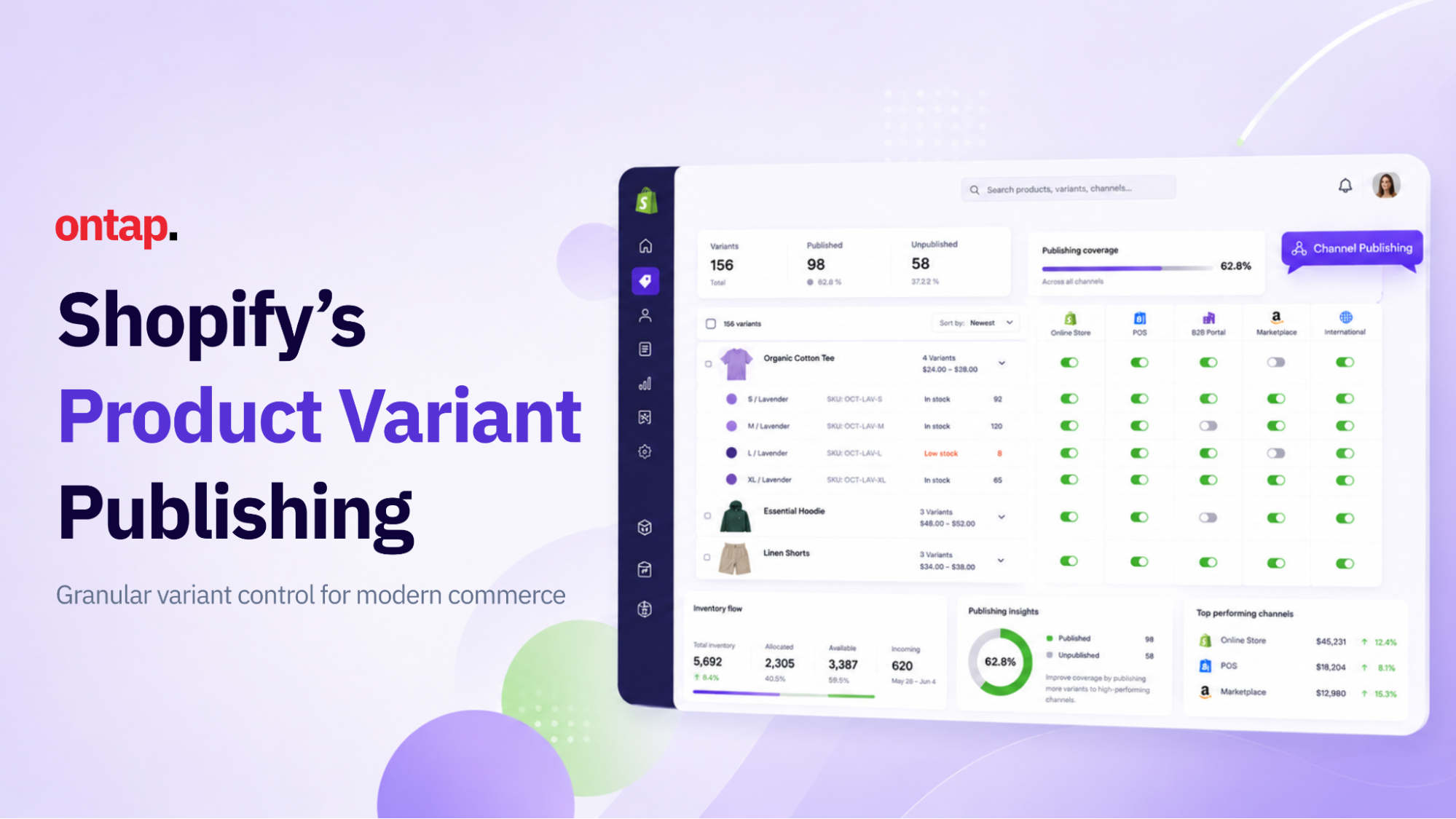
If you have ever duplicated a product just to hide one variant from your B2B catalogue, or built a workaround to stop a limited-edition colourway appearing on the wrong channel, you already know the problem. Shopify's publishing model has always worked at the product level, meaning every variant went wherever the product went. That changes with Product Variant Publishing, released on 7th May. For the first time, merchants can publish or unpublish individual variants per sales channel and per catalogue, natively, without workarounds.
What changed
From the Shopify admin, merchants can now control variant visibility at the channel and catalogue level. Instead of publishing every variant everywhere a product appears, merchants can choose exactly which variants are available across the online store, POS, B2B catalogues, and other connected sales channels.
If you have a T-shirt in twelve colours and only want four of them visible to wholesale buyers, you can now manage that directly within the product editor. The same applies to regional assortments, channel-exclusive launches, or limited-edition variants that should only appear in specific contexts.
The feature itself is relatively simple. The significance is operational: Shopify merchants can now manage more complex merchandising strategies without relying on duplicate products, custom workarounds, or third-party apps.
Historically, Shopify optimised for simplicity over merchandising granularity. Product-level publishing worked well for smaller catalogues and simpler storefront structures, but became increasingly restrictive as merchants expanded across B2B, retail, international markets, and multiple sales channels. Variant-level publishing reflects Shopify’s broader shift towards supporting more operationally complex commerce environments.
Why this matters for multi-channel strategy
The real value of variant-level publishing is not the feature itself, but the operational flexibility it gives growing merchants.
-
B2B and DTC assortments can now coexist more cleanly. Wholesale-only configurations, trade-exclusive options, or bulk-pack variants no longer require duplicate product listings simply to keep them out of the consumer storefront. For merchants managing both wholesale and direct-to-consumer channels, this significantly reduces catalogue fragmentation.
-
Market-specific merchandising becomes easier to scale. Combined with Shopify Markets, merchants can now control which variants appear in different regions without splitting products across multiple records. This is particularly valuable for brands managing localised assortments, regional inventory constraints, or market-specific demand patterns.
-
Channel-exclusive launches become more practical. Limited-edition variants, app-only drops, loyalty exclusives, or pre-order releases can now be published selectively without affecting the visibility of the wider product range. That gives brands more flexibility in how they structure channel-specific campaigns and launches.
-
Operational inventory management becomes cleaner. If certain variants are unavailable in physical retail locations, merchants can remove them from the POS channel while keeping them live online. Individually, this is a relatively small operational improvement, but across large catalogues, it reduces ongoing merchandising maintenance.
Where this fits in Shopify's broader direction
Product Variant Publishing did not arrive in isolation. The same 7th May release also introduced market-specific discounts and a full inventory adjustment audit trail, both aimed at giving merchants more granular operational control.
Taken together, these updates reflect a broader shift in Shopify's direction. Historically, Shopify prioritised simplicity over operational depth. As merchants expanded across B2B, retail, international markets, and multiple sales channels, however, that simplicity increasingly became a limitation. Features such as variant-level publishing suggest Shopify is now building more deliberately for operationally complex commerce environments.
Practical recommendations
If you are running a Shopify store with any multi-channel complexity, here is where to start.
Audit your current product catalogue for consolidation opportunities. Look for products where you have created duplicates or relied on workarounds to manage channel-specific assortments. These are the first candidates for consolidation using variant-level publishing controls.
Review your B2B catalogues. If you are on Shopify's B2B features, variant-level publishing could significantly simplify how your catalogues are structured. Test it with a small selection of products before rolling it out across your full range.
Combine variant publishing with market-specific discounts. These two features work well together as a localisation toolkit. If you are selling across multiple markets, map out which variants and which promotions should be market-specific, then set them up within a single product record.
Enable and review the inventory audit trail. If you have experienced inventory discrepancies without being able to trace the source, this feature addresses that gap directly. Walk through your inventory adjustment workflows with your team and make sure everyone understands what is now being tracked.
The bigger picture
Shopify's thesis has always been that the best eCommerce platform is one that removes reasons for merchants to leave. For a long time, the gap between Shopify's elegantly simple admin and the operational depth that scaling brands need gave those merchants a reason to look elsewhere. Product Variant Publishing, alongside market-specific discounts and the inventory audit trail, is Shopify's answer to that criticism.
These are not headline features. They are the operational infrastructure that determines whether a platform can genuinely scale with your business, rather than becoming a constraint on it. For merchants evaluating their platform strategy, that distinction matters more than any surface-level comparison.
If you are unsure how these changes affect your specific setup, or want to support auditing your current channel architecture, the team at On Tap Group can help. Get in touch with us now!