
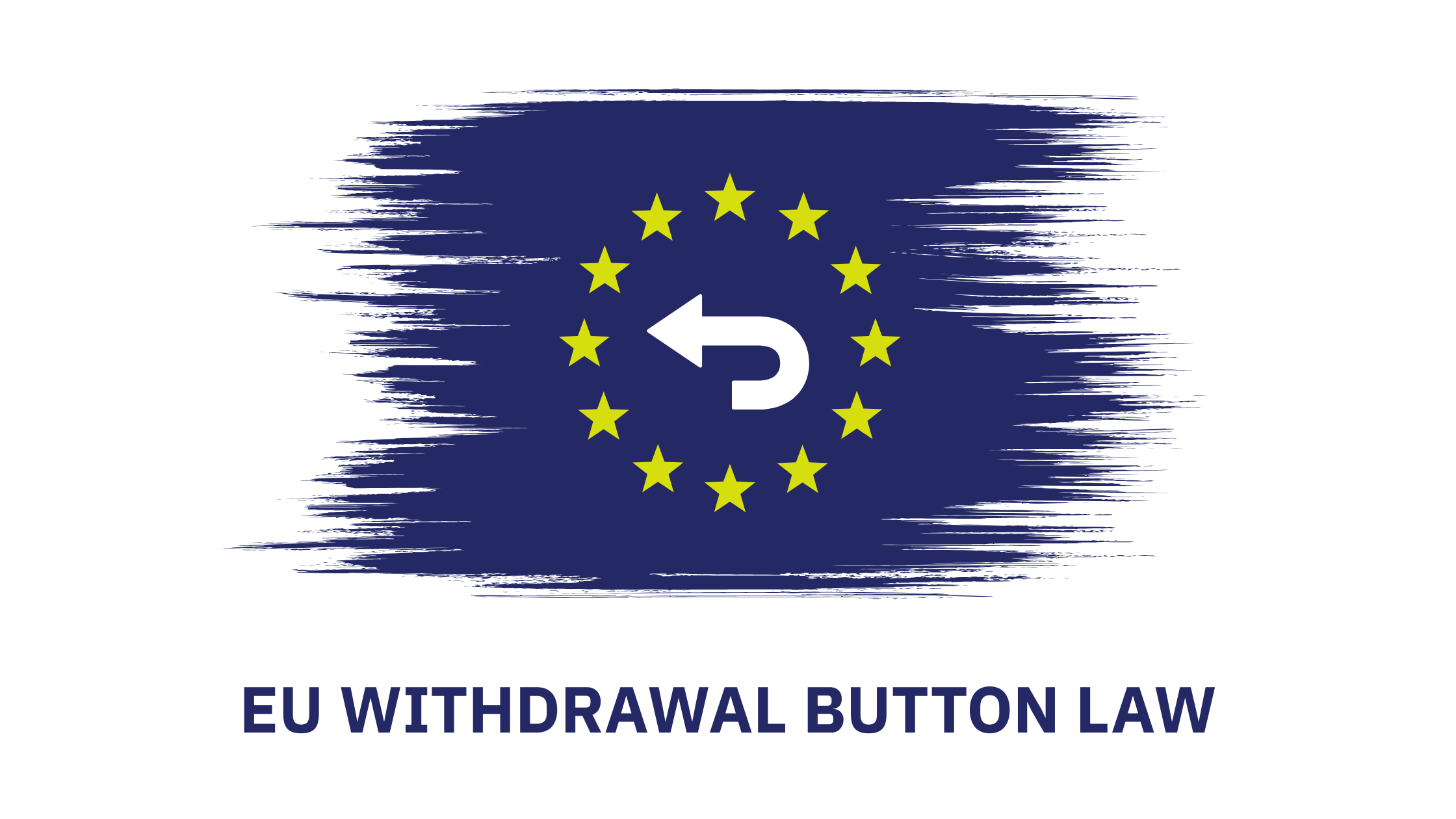
A significant new EU consumer rights directive is about to change online checkout and post-purchase experiences across Europe, and it applies to UK-based merchants whether they realise it or not. Directive (EU) 2023/2673 requires every online store selling to EU consumers to provide a clearly labelled, digital withdrawal function - a "Cancel my contract" button - by 19 June 2026.
If you're running a Magento, Adobe Commerce, or Shopify store and selling into any EU member state, this article explains what's required, what the pitfalls are, and how to get compliant.
Why this matters for UK merchants
Post-Brexit, it's easy to assume that EU directives don't apply to you. They do. The obligation follows the consumer, not the trader's jurisdiction. If your store accepts orders from EU addresses, displays prices in euros, offers EU shipping options, or uses an EU country-code domain, you are almost certainly in scope.
EU consumers already have a 14-day "cooling-off" right to withdraw from most online purchases without giving a reason. What's changed is *how* they exercise that right. Today, most stores handle withdrawals via email, PDF forms, or a buried support page. From 19 June 2026, that's no longer sufficient.
What the directive requires
The requirements are specific and more involved than simply adding a button:
1. A clearly labelled withdrawal function
A button or equivalent interactive element must be available on the online interface where the contract was concluded. It must be labelled "Withdraw from contract" or an equivalent unambiguous phrase in the local language.
2. A structured withdrawal form
Behind the button, consumers must be able to provide their name, email address, order/contract identification, a clear statement of withdrawal, and (for partial withdrawals) which goods or services they're withdrawing from. Crucially, this form must be pre-filled with any information the trader already holds.
3. A two-step confirmation process
After completing the form, the consumer sees a summary and a second confirmation button labelled "Withdraw from contract now." This prevents accidental withdrawals and is explicitly required.
4. An immediate durable-medium acknowledgement
Once confirmed, you must send an email containing the date and time of withdrawal and the details submitted without undue delay.
5. Pre-contractual information
Before the consumer clicks "Place order" at checkout, you must inform them that the withdrawal function exists.
6. Guest and logged-in support
The function must work for both registered customers (via their account) and guest buyers (typically via order-number and email lookup).
How major eCommerce platforms are getting ready
Magento/Adobe Commerce
The open-source module Zwernemann/magento2-withdrawl has been built specifically for this directive, referencing both the German §356a BGB transposition and Directive 2023/2673. It provides a front-end withdrawal form for both logged-in and guest customers, sends automatic confirmation emails, and includes a backend admin grid for managing requests.
It's a community module with a small but active contributor base. Review the code carefully before deploying to production, and plan for customisation if you need multi-language support or deeper OMS integration. On Adobe Commerce Cloud, the module should be installable via Composer but needs staging environment testing.
For merchants needing a more robust or enterprise-grade solution, a custom implementation integrated with your existing returns/RMA workflow is the pragmatic route. Adobe Commerce's built-in RMA module can be extended to serve as the backend for the withdrawal flow.
Shopify
Several purpose-built apps are already available on the Shopify App Store:
-
EU Withdrawal Button: offers a lightweight compliance tool with withdrawal request management, configurable eligibility rules, and simple Shopify integration.
-
Revoq: provides order verification, guest support, automated confirmation emails, and a processing dashboard.
-
BOO EU Withdrawal Compliance: focuses on multilingual withdrawal handling with customisable storefront widgets and Shopify order verification.
All three are designed for quick installation. Evaluate them against the directive's specific requirements, particularly the two-step confirmation, pre-filled fields, and durable-medium acknowledgement before committing. Check language support for your target EU markets.
Common pitfalls to avoid
- Assuming Brexit exempts you. It doesn't. The directive applies based on where your customers are, not where your business is incorporated.
- Hiding the button. A withdrawal link buried in your footer or accessible only via your returns portal is unlikely to satisfy the requirement for a "clearly labelled" and "easily accessible" function. Think of it like cookie consent; it needs to be prominent.
- Skipping the two-step confirmation. A single-click cancellation without a confirmation summary and a second "Withdraw now" button is non-compliant. The directive explicitly requires both steps.
- Forgetting guest buyers. Many implementations only serve logged-in customers. Guests must also be able to withdraw, typically via an order-number plus email verification flow.
- Not sending a durable-medium confirmation. An on-screen confirmation message isn't enough. The directive requires an email acknowledgement sent automatically on withdrawal submission.
What you need to do before 19 June 2026
With less than five weeks until the 19 June 2026 deadline, here's a realistic timeline:
-
Audit your current withdrawal process and confirm your EU exposure. List the EU member states you actively sell into and check analytics for EU traffic and orders.
-
Run a gap analysis against the six requirements. Update terms and conditions and privacy notices with legal input. This is especially important for Germany and France, where enforcement is expected to be strictest.
-
Design and build the withdrawal function. Install and configure your chosen app (Shopify) or module (Magento), or build a custom implementation. Add the pre-contractual disclosure at checkout. Configure the acknowledgement email template.
-
Test the end-to-end flow as both logged-in and guest customers. Verify pre-filled data, two-step confirmation, email delivery, and OMS integration. Test in all supported languages.
-
Brief your customer-service team and update internal SOPs. Go live with monitoring.
The bigger picture
This directive reflects a broader trend in EU consumer protection: making digital rights as easy to exercise as they are to agree to. The EU is systematically eliminating dark patterns and friction that discourage consumers from exercising their legal rights. Merchants who build compliant, user-friendly withdrawal processes now will be ahead of the curve as similar regulations inevitably spread.
It's also worth noting that a smooth, transparent withdrawal process can actually improve customer trust and lifetime value. Consumers who know they can easily return a product are more confident buying in the first place.
How On Tap can help
We've been building and maintaining EU-compliant eCommerce stores for over a decade, across both Magento/Adobe Commerce and Shopify. For this directive, we can audit your current withdrawal process, implement the compliant withdrawal function on your platform, and integrate it with your existing OMS and returns workflow so you're ready well before the deadline.
Get in touch to discuss what's needed for your store.
---
*This article is intended as practical guidance, not legal advice. We recommend consulting a lawyer familiar with the EU Consumer Rights Directive for your specific circumstances, particularly if you sell into multiple EU member states.*