 Best full-service eCommerce agency 2026


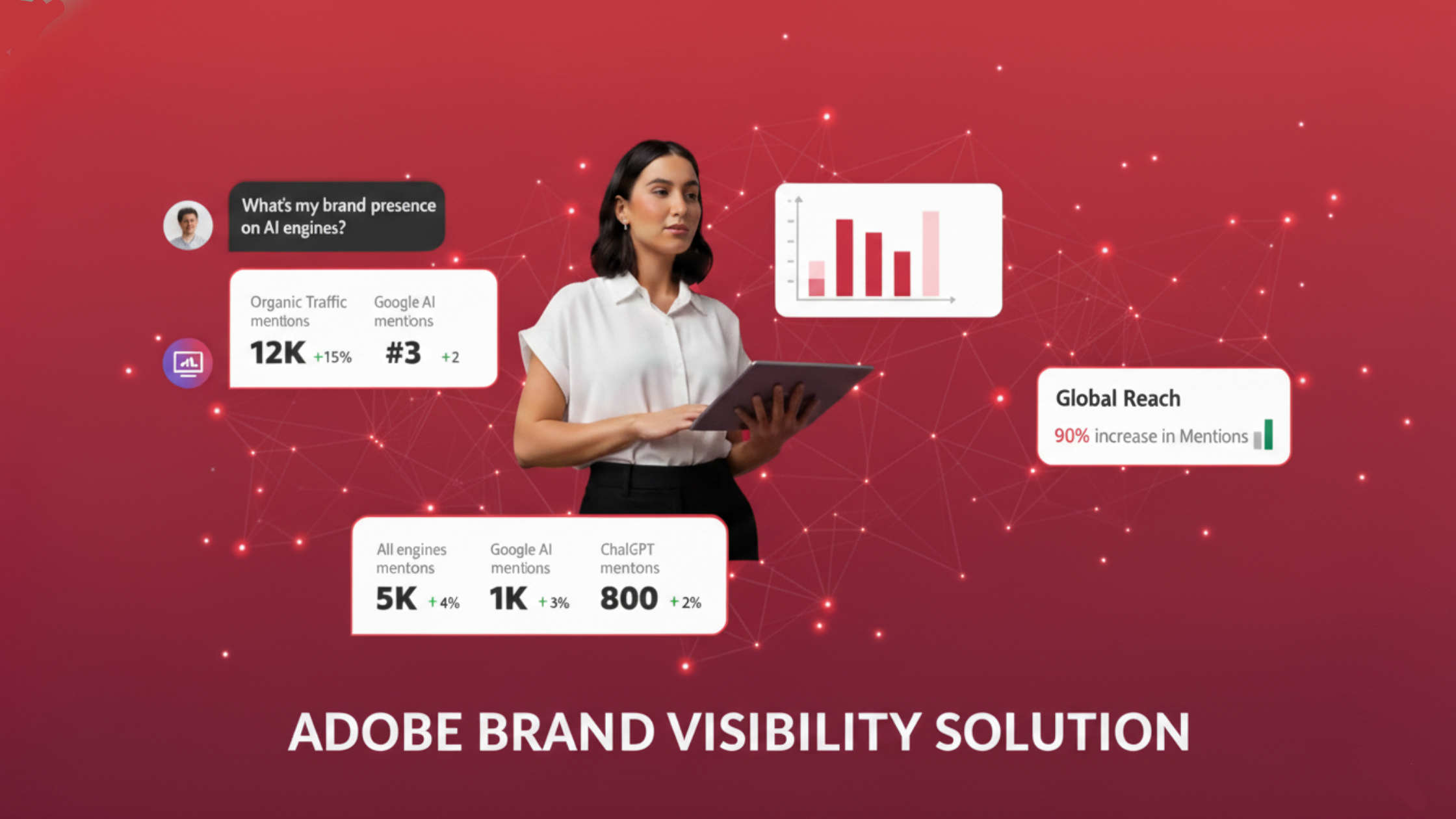
At Adobe Summit on 20 April, Adobe announced a brand visibility solution designed to help businesses understand how they appear in AI-driven discovery and improve engagement when customers reach their own digital properties.
The backdrop is substantial, although the figures are specific to the US market. Adobe’s data shows that traffic from AI sources to US retail sites increased 269% year on year in March 2026. Adobe also found gaps in how readily AI systems could read retail pages. For merchants, the question is how accurately their products and brand are represented as customers use these services to research purchases.
What Adobe announced
The announcement included an expansion of Adobe Experience Manager (AEM), adding a contextual layer to help teams and AI agents build and optimise digital experiences. Adobe also described developments across Adobe Commerce, Adobe LLM Optimizer and Adobe Brand Concierge. Three parts are particularly relevant to merchants:
Adobe LLM Optimizer
How does your brand appear when someone asks an AI service about your category? Adobe LLM Optimizer helps businesses assess how AI-driven discovery surfaces represent their content, products, and brand. It can help teams identify visibility gaps and measure how their presence changes. Unlike a conventional search ranking report, an AI response can vary with the question and context, so the results need careful interpretation.
Adobe Brand Concierge
Adobe Brand Concierge supports conversational experiences on a brand’s own digital properties. Adobe’s April announcement described updates intended to bring real-time product information and checkout into those conversations. The aim is to help customers move from a question to relevant product details and, where supported, a purchase.
Contextual Content Management
Adobe’s AEM expansion focuses on the content sources, permissions, and brand policies that teams and agents use when creating experiences. As Loni Stark explained in Adobe’s announcement, businesses need to manage the context behind their content as well as the content itself. In practical terms, that means making approved product and brand information available to the people and systems producing customer experiences.
Why this matters for eCommerce merchants
Several points in Adobe’s research and announcement deserve attention:
-
Traffic from AI sources to US retail sites grew 269% year on year in March 2026. That figure describes referrals to the sites Adobe measured, not all retail traffic or the UK market.
-
In the same US dataset, visits from AI sources converted 42% better than non-AI visits in March 2026. That is an observed comparison, not a promised result for an individual store.
-
Adobe’s assessment found that some retail pages were less readable by machines than others, with product pages scoring below homepages on its measure.
-
Brands can improve the information they publish and monitor how they appear, but they cannot control every answer produced by a third-party AI service.
For eCommerce merchants, the strategic question is: when customers use AI to compare products in your category, can they find accurate, useful information about yours?
On Tap recommends approaching this through three connected areas:
-
Product and content accuracy: Keep descriptions, specifications, availability and other customer-facing information correct and easy to find.
-
Consistency across channels: Review material differences between your website, product feeds, and other places where customers encounter your brand.
-
Measurement: Check the questions customers ask, how your brand appears in relevant AI responses and whether referred visitors find what they need.
These are practical priorities, not a guarantee that an AI service will cite or recommend a particular brand.
The practical implications
If you run an eCommerce store, these are sensible starting points:
-
Audit your AI presence: Test a representative set of customer questions in services such as ChatGPT, Perplexity, and Google’s AI features. Record inaccuracies and missing product information. Treat the findings as a sample: answers can change between queries and over time.
-
Review your product data: Check that important attributes and specifications are present, consistent, and accessible on your pages and in relevant feeds. Use appropriate structured data that matches the visible page content. Google says there is no special schema or additional technical requirement for appearing in AI Overviews or AI Mode.
-
Create useful, original content: Answer the questions customers bring to product and category pages, including suitability, differences between options, and practical use. Avoid relying on generic descriptions where they leave those questions unanswered.
-
Monitor and improve: Recheck important queries and review traffic and conversion alongside the quality of the information customers see. Adobe LLM Optimizer is one option for measuring visibility; a defined manual review can also reveal specific content gaps.
The bigger picture
Adobe’s April announcement reflects growing business interest in how brands appear during AI-assisted discovery. Its approach connects visibility in external AI services with the content and conversational experiences a business manages on its own properties.
For On Tap’s clients and the broader eCommerce community, the immediate task is practical: make product information dependable, keep important content accessible, and measure whether AI-referred visitors can make informed decisions. Those improvements serve customers regardless of how quickly AI discovery grows in a particular market.
Update, 29 September 2026: This article covers Adobe’s 20 April Summit announcement. On 17 June, Adobe introduced Adobe Brand Visibility as a named offering, combining Adobe LLM Optimizer with Semrush AI visibility capabilities. The June offering is a later development, rather than a product that was announced in its final form in April.