 Best full-service eCommerce agency 2026


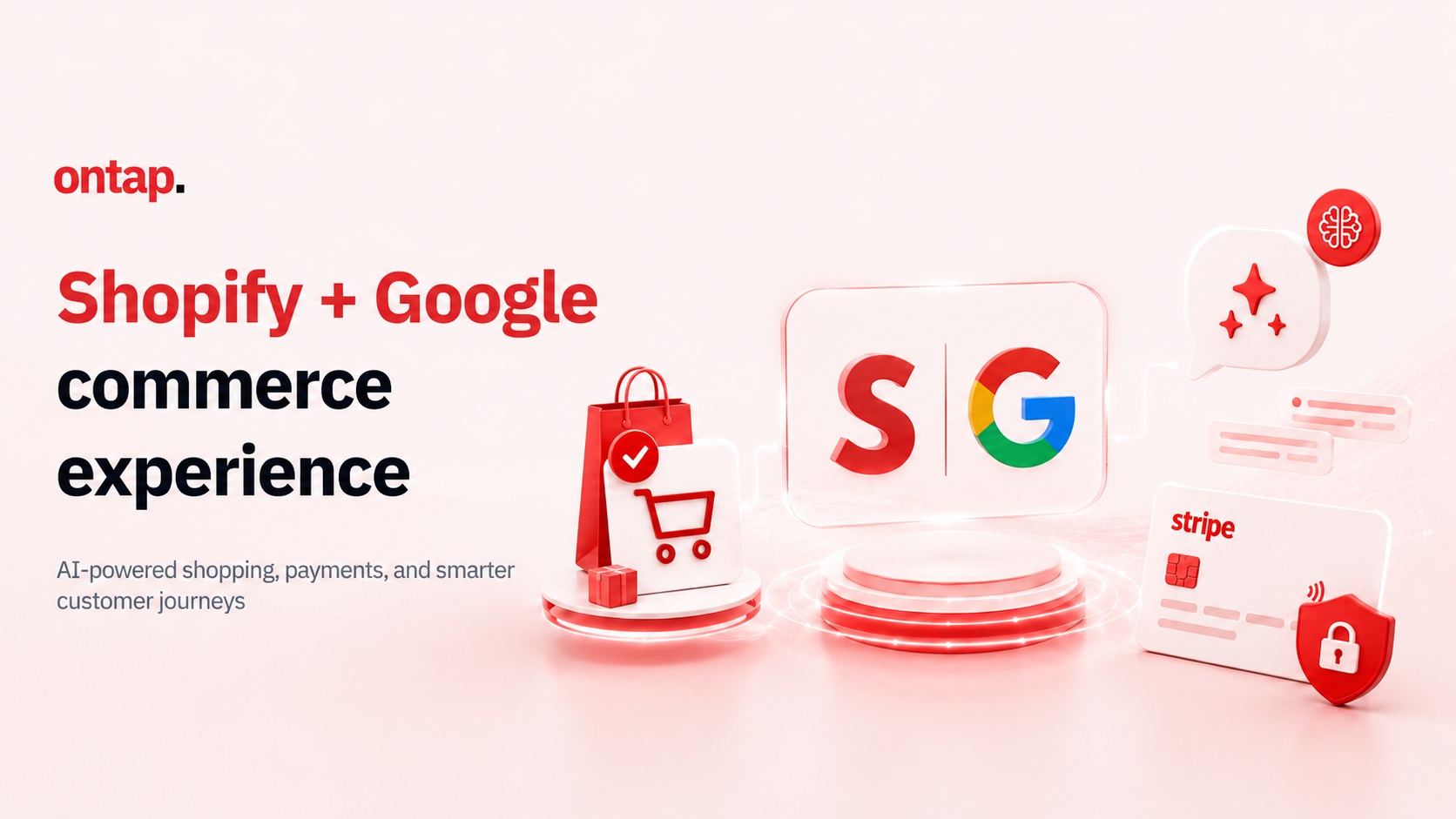
On 13th May, Stripe and Google announced a partnership that allows merchants to sell products directly within Google's Gemini AI app and AI Mode search. This is not a concept demo or a developer preview - it is a production integration that adds Google to Stripe's growing agentic commerce network alongside OpenAI's ChatGPT, Meta's Facebook, and Microsoft's Copilot.
If you sell things online, this is a fundamental shift in how products get discovered and purchased, and it is happening faster than most merchants realise.
What actually happened
At Stripe Sessions in late April, the company previewed its Agentic Commerce Suite - a set of tools that lets merchants upload product catalogues and enable AI agents to handle discovery, checkout, and payment on behalf of consumers. The Google partnership means that consumers using Gemini can now discover and purchase products without ever visiting your website.
Stripe CEO Patrick Collison described a "parabolic rise" in new businesses being created on the payment network, driven by AI. Stripe's President of Technology, Will Gaybrick, was more direct: "It's easy to underestimate the implications of a near future where agents are autonomous economic actors responsible for most Internet transactions."
Google described agentic commerce as being at the early stages - but that framing itself is telling. Google does not invest partnership resources in things it considers experimental.
Why this matters more than you think
To understand the significance, consider how product discovery has worked for the past decade. A consumer has a need, types a query into Google, sees a list of results and ads, clicks through to your website, browses your catalogue, and completes a purchase. Every step in that journey allows you to influence the decision - through your site design, your product descriptions, your reviews, your checkout experience.
Agentic commerce compresses or eliminates most of those steps. The consumer tells an AI agent what they need. The agent searches product catalogues, evaluates options based on the consumer's preferences and history, and either recommends a product or completes the purchase autonomously. Your website may never be visited. Your brand experience may never be seen. The entire interaction happens inside the AI platform.
This creates both an opportunity and a threat.
The opportunity: if your product data is clean, structured, and available through the right channels, you can reach consumers at the exact moment of intent - inside a conversational interface where trust in recommendations is high.
The threat: if your product data is not in these systems, you do not exist in the agentic commerce world. There is no equivalent of page two of Google results. You are either recommended or you are invisible.
The practical implications
-
Product feed quality becomes everything
If you're running Google Shopping campaigns, you already have structured product data. But agentic commerce demands a higher standard. Your product titles need to be descriptive enough for an AI to understand and recommend them in conversation. Your descriptions need to answer the questions a consumer would ask a knowledgeable salesperson. Attributes like material, use case, compatibility, and target audience become critical differentiators that determine whether an AI agent selects your product.
-
Stripe becomes a strategic infrastructure choice
With ChatGPT, Meta, Microsoft Copilot, and now Google Gemini all connected through Stripe's Agentic Commerce Suite, Stripe is positioning itself as the universal distribution layer for AI commerce. If you're on Stripe, you have a pathway to all four platforms through a single integration. If you're not, you'll need to evaluate platform-by-platform integrations as they emerge.
-
The timing with Google Marketing Live is not coincidental
Google Marketing Live 2026 is scheduled for May 20 - less than a week from now. The Stripe partnership was announced ahead of GML, which strongly suggests Google will use the event to unveil broader agentic commerce capabilities, potentially including how ads work within AI Mode and Gemini. Merchants should be paying close attention to the GML announcements because the advertising model for agentic commerce is still being defined, and early movers will have an advantage.
-
This accelerates the "zero-click" commerce trend
We've been tracking the shift from click-based to intent-based commerce for over a year. Agentic commerce is the natural conclusion of that trajectory. When an AI agent handles the entire purchase journey, traditional metrics like click-through rate, time on site, and conversion rate become less relevant. New metrics - recommendation rate, agent selection frequency, feed match quality - will need to emerge.
What you should do this week
-
Audit your product feeds. Specifically, check whether your product titles and descriptions would make sense when read aloud in a conversation. If your product title is "BLK-WDG-001 Widget Black 10pk," an AI agent can't meaningfully recommend it to a consumer. Natural language matters in conversational commerce.
-
Evaluate your payment infrastructure. If you're already on Stripe, explore the Agentic Commerce Suite documentation. If you're not, start a conversation with your payment provider about their AI commerce roadmap.
-
Watch Google Marketing Live on May 20. The advertising model for agentic commerce will likely be outlined there. Understanding how paid placement works within AI recommendations will be critical for your Q3 and Q4 marketing strategy.
-
Think about brand authority. In a world where AI agents make recommendations, the signals that determine which products get recommended include reviews, brand reputation, consistency of information across the web, and structured data quality. These aren't new priorities - but in agentic commerce, they become the primary selection mechanism rather than a supporting factor.
The bigger picture
Stripe and Google's partnership is a milestone, but it's part of a larger convergence. OpenAI launched product feed ads inside ChatGPT. Stripe is building a universal agentic checkout layer. Google is preparing to monetise AI Mode. The infrastructure for AI-mediated commerce is being built right now, in real time, by the companies that control the platforms consumers use.
For eCommerce merchants, the message is clear: the way products are discovered and purchased is about to change as fundamentally as it did when mobile commerce overtook desktop. The merchants who adapt their product data, their payment infrastructure, and their marketing strategy now will be positioned to capture demand in this new channel. Those who wait for it to mature first will find they've been optimising for a world that no longer exists.
The agentic commerce era isn't coming. It's here. The question is whether your business is ready.
About On Tap
On Tap is an eCommerce agency helping merchants build organic and commercial strategies fit for the AI era. From product feed optimisation to platform strategy, we work with brands navigating the shift to AI-mediated commerce. To find out how we can help your business get ready for agentic commerce, get in touch with our team.