 Best full-service eCommerce agency 2026


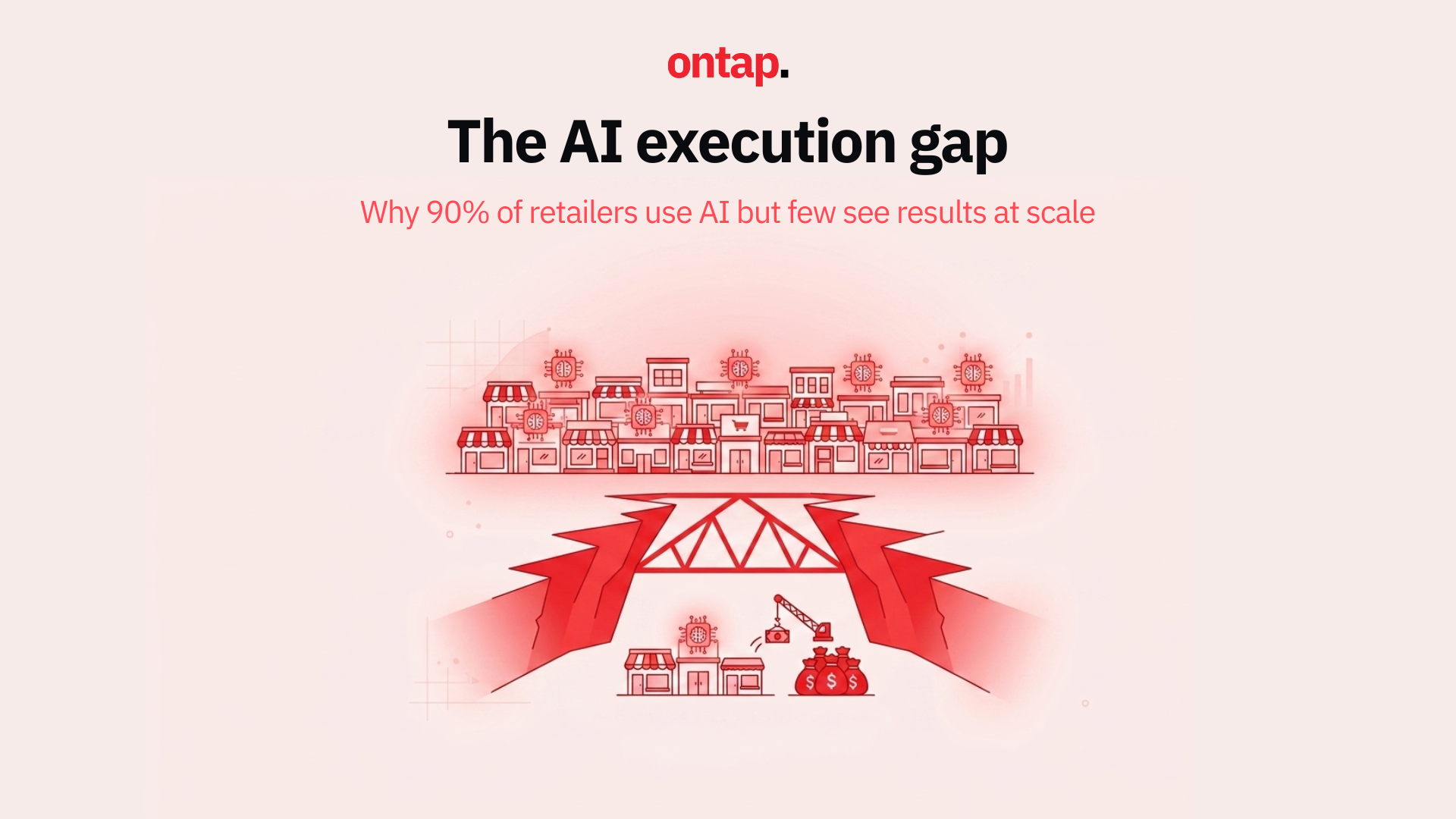
A striking statistic emerged from retail industry research highlighted by Retail Dive this week: nearly 90% of retailers are actively using or piloting artificial intelligence, and 87% report positive revenue impact from those initiatives. Yet only about one quarter have managed to operationalise AI at scale. The gap between AI adoption and AI execution is becoming the defining challenge of retail technology in 2026, and it has direct implications for every eCommerce merchant, regardless of size.
The pilot trap
The numbers paint a deceptively optimistic picture. Almost every major retailer has an AI initiative. Demand forecasting. Personalisation. Computer vision for loss prevention. Associate enablement tools. Chatbots. Recommendation engines. The list grows monthly.
But there is a fundamental difference between running a successful AI pilot in a controlled environment and deploying that same system reliably across hundreds of stores, thousands of SKUs, and millions of customer interactions. As the Retail Dive analysis makes clear, breakdowns most often occur at the operational edges, in stores and distribution centres where devices, connectivity, and data reliability matter most. The retail "edge," where stores, mobile devices, sensors, cameras, and associates intersect, is where AI either succeeds or fails.
This resonates with what we see in eCommerce specifically. A merchant might successfully pilot an AI-powered product recommendation engine on their homepage and see conversion rates improve by 15% during testing. But scaling that to every product page, every category, every customer segment, across every device type and market, while maintaining data freshness, handling edge cases, and keeping the system performant under load, is an entirely different engineering and operational challenge.
Tractor Supply: A case study in practical AI
One of the more instructive examples this week comes from Tractor Supply, the speciality retailer that is using AI to scale its last-mile delivery network. As reported by Supply Chain Dive, the company began expanding its private delivery fleet in early 2025 and has since seen double-digit year-over-year increases in delivery volume. By the end of 2026, Tractor Supply plans to operate roughly 375 delivery hubs covering more than half its stores, reaching over 15 million customers.
The AI application here is not glamorous or headline-grabbing. There are no generative AI chatbots or computer vision systems in the story. Instead, Tractor Supply is using AI tools to help territory managers build efficient delivery routes, replacing what was previously a manual process handled by drivers themselves.
What makes this example valuable is its pragmatism. The company identified a specific operational bottleneck (route planning becoming too complex as volume scaled), applied AI to that bottleneck (algorithmic route optimisation), and freed up human workers (drivers) to focus on what humans do best (building customer relationships).
Kyle Langley, Tractor Supply's VP of Final Mile, described at Home Delivery World 2026 how the growth in delivery volume also increased customer service calls, requiring the company to build better communication systems. As Langley told the conference: "We quickly realised we were solving the wrong problem by trying to reduce inbound volume, when really the problem was we hadn't armed our store team members with the right information, which can also be used and powered by AI."
The AI implementation was not a silver bullet. It solved one problem while revealing others that needed human-centred solutions. This is the pattern that separates retailers who successfully operationalise AI from those stuck in the pilot trap. Successful implementers start with a specific, measurable operational problem, not with the technology looking for a problem to solve. They accept that AI solves bottlenecks, not everything. And they invest in the operational foundations that AI depends on: reliable data, consistent connectivity, maintained hardware.
The infrastructure reality check
The Retail Dive analysis highlights a critical insight that is often overlooked in AI discussions: the real challenge is not the algorithm; it is the operational environment that sustains it. Inventory distortions driven by poor shelf visibility alone cost the global retail industry an estimated $1.7 trillion annually. AI systems designed to address these gaps fail when the cameras, mobile devices, or networks they depend on are unreliable.
For eCommerce merchants, the equivalent infrastructure challenges include:
Data quality and consistency. AI-powered personalisation is only as good as your product data, customer data, and behavioural data. If your product catalogue has inconsistent attributes, missing images, or outdated descriptions, no algorithm can compensate.
Integration reliability. AI tools that connect to your platform, your ERP, your CRM, and your marketing stack need those integrations to be robust and real-time. A recommendation engine working with yesterday's inventory data will recommend products that are out of stock.
Performance under load. AI features that work beautifully during normal traffic can collapse during peak events like sales or seasonal rushes, precisely when they are most valuable.
What eCommerce merchants should do
-
Audit your AI initiatives honestly: If you are running AI-powered tools, including personalisation, search, pricing, or customer service, assess whether they are actually performing at scale or just producing impressive demo results. Look at performance during peak traffic, across your full product catalogue, and for edge-case customer segments.
-
Invest in data infrastructure before AI features: The most impactful thing most merchants can do right now is not adding another AI tool. It is cleaning their product data, unifying their customer data, and ensuring their integrations are reliable. This foundational work makes every AI tool you deploy more effective.
-
Learn from Tractor Supply's approach: Identify specific operational bottlenecks in your business. Where do manual processes break down as you scale? Where are your team members spending time on tasks that algorithms could handle? Apply AI to those specific bottlenecks rather than pursuing broad, impressive-sounding AI initiatives.
-
Set clear success metrics before deployment: Define what success looks like in specific, measurable terms before you turn on any AI feature. Then measure rigorously, including during high-stress periods and edge cases, not just during normal operations.
The bigger picture
The 90% adoption figure tells us that the retail industry has moved past the question of whether AI matters. The 25% operationalisation rate tells us that most have not figured out how to make it work reliably. The merchants who bridge this gap in 2026, by investing in foundations, focusing on specific problems, and measuring honestly, will build genuine competitive advantages. The rest will have impressive pilot results and disappointing P&L statements.
The AI execution gap is not a technology problem. It is an operations problem, a data problem, and ultimately a leadership problem. The technology is ready. The question is whether your operational foundations are ready to support it.
About On Tap
On Tap is a growth-focused eCommerce consultancy helping mid-market and enterprise merchants close the gap between AI adoption and AI execution. From data infrastructure audits and integration reliability to personalisation strategy and performance optimisation, On Tap helps merchants build the operational foundations that make AI investments deliver measurable returns.
If you want to move your AI initiatives from pilot to production, get in touch.