

Magento is known as one of the most flexible eCommerce platforms on the market. Over the years, it has evolved into a suite of solutions, from free, open-source editions to fully managed, cloud-native Adobe Commerce.
However, this flexibility also brings complexity. With multiple editions, deployment models, and a layered versioning system, it’s not always clear which versions are supported, what features they include, or how they differ from one another.
This guide is designed to clarify that landscape. It will help you:
-
Understand how Magento’s editions have evolved, from early open-source roots to today’s on-premises and cloud-native Adobe Commerce offerings
-
Decode Magento’s versioning system and what each number represents
-
See the full version history from Magento 1.0 to 2.4.9, including patch and security releases
-
Evaluate key improvements in recent versions, from both technical and business perspectives
-
Prepare for future upgrades with insight into Adobe’s roadmap and architectural direction
Whether you’re maintaining an existing Magento store or planning for replatforming, this article will give you the clarity and strategic context needed to navigate Magento’s evolving ecosystem.
Magento editions explained: Past and present
Magento’s edition structure has undergone several major shifts since its first release in 2008. These changes reflect the platform’s growth from an open-source cart solution into a set of scalable, enterprise-grade offerings under Adobe’s ownership. Today, there are multiple editions and deployment models in use, each with different capabilities, pricing models, and strategic value.
To understand what you’re running (or evaluating), it’s essential to distinguish between legacy names, current offerings, and Adobe’s evolving product roadmap.
Historical Magento editions
|
Edition name |
Period |
Description |
Current status |
|
Magento Community Edition (CE) |
2008–2017 |
Free, open-source version maintained by the community. Widely adopted by developers and SMEs. |
Renamed to Magento Open Source. Still maintained and widely used. |
|
Magento Professional Edition |
2009–2011 |
A mid-tier licensed edition positioned between Magento Community Edition (CE) and Magento Enterprise Edition (EE), aimed at growing merchants. Offered some support and features beyond Community Edition |
Discontinued prior to Magento 2; functionality merged into later Enterprise releases |
|
Magento Enterprise Edition (EE) |
2009–2017 |
Paid/licensed version offering additional features, support, and scalability options. |
Rebranded as Adobe Commerce (on-premises) after Adobe’s acquisition. |
|
Magento Go |
2011–2014 |
A cloud-hosted SaaS version of Magento aimed at small businesses with limited technical needs. |
Discontinued in 2014; merchants were encouraged to migrate to other Magento 1 editions. |
|
Magento Commerce |
2017–2021 |
The transitional name used after Adobe’s acquisition. Included both on-prem and cloud-hosted options. |
Fully replaced by the Adobe Commerce branding, though some admin panels and documentation still reference it. |
Many online resources still refer to “Magento CE” or “Magento EE”, but these terms are now outdated and may misrepresent the edition in use.
Current Magento editions and deployment models
|
Product name |
Overview |
Hosting model |
Key use cases |
|
Magento Open Source |
Free version with essential commerce capabilities. Requires merchant-managed infrastructure and technical expertise. A community-maintained fork of Magento Open Source, Mage-OS shares the same Magento 2 core and aims to preserve long-term open governance while remaining compatible with most extensions and tools. |
Self-hosted |
Ideal for developer-led businesses with low-cost hosting and basic customisation needs. |
|
Adobe Commerce (on-premises) |
Licensed version with access to advanced features (e.g., B2B suite, Page Builder, Live Search). Installed on infrastructure managed by the merchant or partner. |
Self-hosted |
Suitable for businesses needing full backend control, extensibility, and enterprise workflows. |
|
Adobe Commerce on Cloud Infrastructure |
Same licensed platform as above, but hosted on Adobe’s infrastructure (AWS or Azure). Includes Fastly CDN, CI/CD tools, autoscaling, and Adobe-managed uptime. |
Adobe-managed cloud (PaaS) |
Recommended for merchants who want advanced capabilities without managing servers directly. |
|
Adobe Commerce as a Cloud Service |
Adobe’s modern, cloud-native delivery model. API-first, modular, and designed for composable commerce. Supports Edge Delivery Services and App Builder. |
SaaS-like (modular, service-based) |
Best suited to enterprise brands investing in headless, multi-service architecture and faster iteration cycles. |
|
Adobe Commerce Optimizer |
Frontend performance layer built on Adobe Edge Delivery Services. Enables headless storefronts without replatforming the backend. |
Edge-hosted storefront layer |
Ideal for brands seeking faster frontend performance and composability without migrating backend logic. |
Key takeaways:
-
Magento Open Source remains a fully supported option for businesses with in-house developers, but lacks enterprise features, SLAs, or cloud tooling.
-
A community-led fork called Mage-OS offers an alternative path for merchants and developers who want to preserve Magento 2’s open-source model while maintaining compatibility with existing extensions and workflows.
-
Adobe’s future direction is focused on cloud-native, service-based delivery, with tools like App Builder, Commerce Drop-ins, and Edge Delivery Services shaping its long-term roadmap.
This article covers the version history of both Magento Open Source and Adobe Commerce, including the on-premises and cloud-hosted variants, with a focus on support status, key feature changes, and upgrade considerations.
Before diving into the timeline, we’ll first clarify how Magento’s versioning system works, and how your edition type influences which features, services, and support options are available to you.
Understanding Magento versioning: How to read version numbers
Magento uses a structured versioning system to communicate the nature of changes introduced in each release. This system applies to both Magento Open Source and Adobe Commerce, regardless of whether it’s deployed on-premises or on Adobe’s cloud infrastructure.
How Magento version numbers work
Magento follows semantic versioning using the format: [Major].[Minor].[Patch]
Example: 2.4.6
However, Magento doesn’t follow SemVer strictly (Semantic Versioning - a versioning system where major, minor, and patch numbers indicate the level of change). Minor releases can introduce changes that affect custom code, and even patch releases may include updates that influence store stability. As such, it’s essential to consult official Magento release notes and test thoroughly before deploying any update.
|
Component |
Purpose |
Example |
|
Major |
Introduces major architectural changes or a platform-wide rework. Usually not backward-compatible. |
2.4.6 → “2” = major version (platform generation) |
|
Minor |
Adds new features, enhancements, or changes to existing functionality. While core architecture remains intact, minor releases can still impact third-party modules or custom code. |
2.4.6 → “4”= The fourth minor release family in Magento 2. |
|
Patch |
Delivers bug fixes, security updates, and regression fixes. Patch versions are intended to be safe, maintenance-focused updates without adding new features. |
2.4.6 → “6” = The sixth patch release within the 2.4 branch |
All Magento editions, including Open Source and Adobe Commerce (both on-premises and cloud-hosted), share the same core versioning system. For example, both use version numbers like 2.4.6 and 2.4.7, and follow the same release cadence for updates and patches.
However, the feature scope differs significantly between the two. Magento Open Source includes only the essential components for eCommerce operations, such as the storefront, checkout, and admin dashboard. In contrast, Adobe Commerce builds on that foundation by adding advanced enterprise features, including B2B functionality, Page Builder for visual content management, Live Search powered by Adobe Sensei, and deep integrations with other Adobe services.
Additional suffixes are used for specific release types:
-
Security patch releases (e.g. 2.4.6-p2): Address urgent vulnerabilities without introducing new features or breaking changes. These patches may also include compliance updates and critical hotfixes.
-
Beta releases (e.g. 2.4.8-beta1): Pre-release builds shared with Adobe Commerce customers and partners for early testing before General Availability (GA).
A note on newer patch naming: Since Adobe moved to a monthly security patch cadence in January 2026, new patches are labelled by release month rather than a sequential "-pN" number, for example 2.4.9-2026-jul for the bundle released in July 2026. Both naming formats work the same way in practice; always check Adobe's bulletin for the exact version string to install.
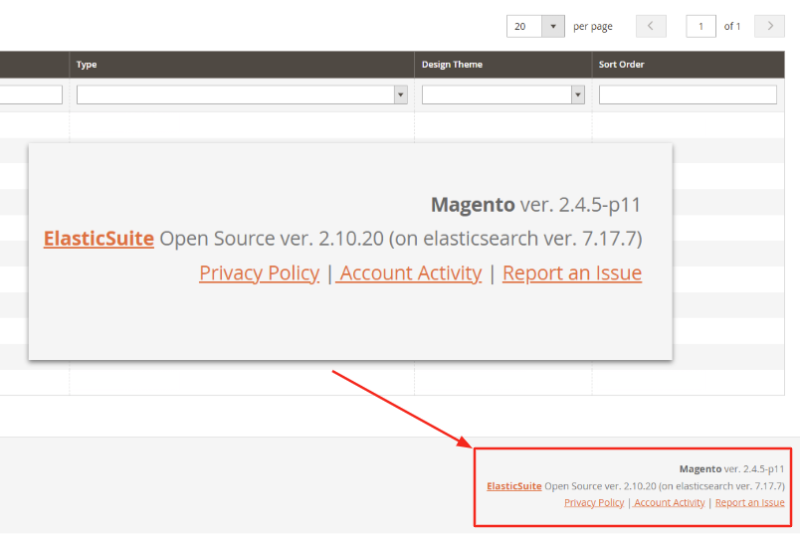
To check which version of Magento your store is currently running and what it means for support and security, see our detailed guide: How to check your Magento version
Why versioning matters
Knowing your current Magento version and how far it is from the latest release, affects more than just development planning:
-
Security & compliance: Staying current ensures PCI compliance and protects against known exploits (XSS, CSRF, SQLi).
-
Infrastructure compatibility: Newer versions support updated PHP, MySQL, Redis, and Elasticsearch requirements, critical for cloud hosting and DevOps compatibility.
-
Performance & scalability: Features like asynchronous order processing, bulk product import speed, and checkout improvements are only available in recent releases.
-
Upgrade effort & cost: Skipping multiple versions increases technical debt. Delaying upgrades often results in higher testing, refactoring, and downtime risks later.
Next, we’ll walk through the complete version history, from Magento 1.0 to 2.4.9, including the business context behind each major release milestone.
Magento version history: Major, minor, patch & security releases
Magento’s release history reflects the platform’s evolution from a modular open-source framework to an enterprise-grade commerce solution. This timeline covers both Magento Open Source and Adobe Commerce, which share the same core codebase and version numbering system. Understanding this timeline is essential for planning upgrades, maintaining compatibility, and aligning with Adobe’s long-term roadmap.
This section outlines Magento’s version progression from its earliest days to the current release cycle, including major, minor, patch, and security-only releases, with a focus on what each milestone has meant for merchants and technical teams.
Magento 1.x era (2008-2020)
Magento 1 introduced the core architectural principles: modular codebase, theme engine, and multi-store support that laid the foundation for future innovation. However, the platform became increasingly difficult to scale and maintain in modern environments.
|
Version |
Release date |
End of support |
Notable advancements |
Business implications |
|
1.0 |
March 2008 |
— |
First release with modular architecture, theming, and multi-store capabilities |
Enabled low-cost entry for SMEs with complex catalogue structures |
|
1.4 – 1.7 |
2010–2012 |
— |
CMS improvements, promotional rules, and tax engine updates |
Supported basic marketing and custom workflows |
|
1.9 |
May 2014 |
30 June 2020 |
Added responsive theme and tax calculation updates |
Final 1.x release; improved mobile UX but no architectural changes |
All 1.x versions are fully unsupported. Using them creates severe PCI risk, hosting limitations, and no compatibility with payment providers. Migration is essential.
Magento 2.x launch and modernisation
Magento 2.0 was released in November 2015 as a full re-platform of the Magento ecosystem. It introduced a modern tech stack with a modular backend, Dependency Injection (DI), Composer for package management, and a redesigned admin panel aimed at improving scalability, performance, and developer efficiency.
This release also marked the beginning of a dual-edition product strategy that would shape Magento’s evolution over the following decade:
-
Magento Community Edition (CE), later renamed Magento Open Source, remained free and self-hosted, focused on core commerce functionality.
-
Magento Enterprise Edition (EE), later Magento Commerce, now known as Adobe Commerce, offered advanced features and commercial support, including cloud deployment options, visual content tools, and eventually, native B2B functionality.
While both editions continued to share the same 2.0 core codebase and versioning system, Magento 2.0's modern architecture laid the technical foundation for this split.
Version |
Release date |
End of support |
Notable advancements |
Business implications |
2.0.0 |
November 2015 |
31 March 2018 |
Modular backend, Dependency Injection, Composer, new admin panel |
Required full replatform from 1.x; introduced Magento's modern architecture |
As Magento 2.0 was a complete architectural overhaul, Adobe released a rapid series of patch versions (2.0.1 to 2.0.18) to address early stability, security, and compatibility issues, all reaching end of support on 31 March 2018.
|
Version |
Release date |
End of regular support |
|
2.0.0 |
November 17, 2015 |
31 March 2018 |
|
2.0.1 |
January 20, 2016 |
31 March 2018 |
|
2.0.2 |
January 28, 2016 |
31 March 2018 |
|
2.0.3 |
March 30, 2016 |
31 March 2018 |
|
2.0.4 |
March 31, 2016 |
31 March 2018 |
|
2.0.5 |
April 28, 2016 |
31 March 2018 |
|
2.0.6 |
May 17, 2016 |
31 March 2018 |
|
2.0.7 |
May 24, 2016 |
31 March 2018 |
|
2.0.8 |
July 19, 2016 |
31 March 2018 |
|
2.0.9 |
August 10, 2016 |
31 March 2018 |
|
2.0.10 |
October 12, 2016 |
31 March 2018 |
|
2.0.11 |
December 14, 2016 |
31 March 2018 |
|
2.0.12 |
February 7, 2017 |
31 March 2018 |
|
2.0.13 |
February 21, 2017 |
31 March 2018 |
|
2.0.14 |
May 31, 2017 |
31 March 2018 |
|
2.0.15 |
June 21, 2017 |
31 March 2018 |
|
2.0.16 |
September 14, 2017 |
31 March 2018 |
|
2.0.17 |
November 7, 2017 |
31 March 2018 |
|
2.0.18 |
February 27, 2018 |
31 March 2018 |
Magento 2.1 to 2.3: Early maturity & B2B capabilities
Magento 2.3 was a turning point for extensibility, with long-term support for headless and omnichannel retail.
|
Version |
Release Date |
End of Support |
Notable advancements |
Business implications |
|
2.1 |
June 2016 |
30 June 2019 |
Magento Open Source: Admin UX improvements, PayPal checkout updates Adobe Commerce: First release of Magento Commerce Cloud (AWS), content staging and preview tools |
Enabled non-technical users to schedule content and price updates, while introducing Adobe’s first cloud deployment model, laying the foundation for DevOps-managed Magento projects. |
|
2.2 |
September 2017 |
31 December 2019 |
Magento Open Source: Checkout and indexing improvements Adobe Commerce: Native B2B features — company accounts, quotes, shared catalogues, credit limits |
Enabled structured B2B selling for mid-sized and enterprise users without third-party modules |
|
2.3 |
November 2018 |
8 September 2022 |
Magento Open Source: Multi-Source Inventory (MSI), GraphQL API, declarative schema Adobe Commerce: Page Builder (drag-and-drop CMS), support for PWA Studio. |
Expanded headless options and multi-channel inventory management |
Each of these minor versions received multiple patch releases during their respective support cycles. These patches included security updates, dependency upgrades, and incremental enhancements across checkout, indexing, and API layers.
Magento 2.1 patch releases
| Version | Release date | End of regular support |
| 2.1.0 | June 23, 2016 | June 30, 2019 |
| 2.1.1 | August 30, 2016 | June 30, 2019 |
| 2.1.2 | October 12, 2016 | June 30, 2019 |
| 2.1.3 | December 14, 2016 | June 30, 2019 |
| 2.1.4 | February 7, 2017 | June 30, 2019 |
| 2.1.5 | February 21, 2017 | June 30, 2019 |
| 2.1.6 | April 11, 2017 | June 30, 2019 |
| 2.1.7 | May 31, 2017 | June 30, 2019 |
| 2.1.8 | August 9, 2017 | June 30, 2019 |
| 2.1.9 | September 14, 2017 | June 30, 2019 |
| 2.1.10 | November 7, 2017 | June 30, 2019 |
| 2.1.11 | December 12, 2017 | June 30, 2019 |
| 2.1.12 | February 27, 2018 | June 30, 2019 |
| 2.1.13 | May 2, 2018 | June 30, 2019 |
| 2.1.14 | June 27, 2018 | June 30, 2019 |
| 2.1.15 | September 18, 2018 | June 30, 2019 |
| 2.1.16 | November 28, 2018 | June 30, 2019 |
| 2.1.17 | March 26, 2019 | June 30, 2019 |
| 2.1.18 | June 25, 2019 | June 30, 2019 |
Magento 2.2 patch releases
| Version | Release date | End of regular support |
| 2.2.0 | September 26, 2017 | June 30, 2019 |
| 2.2.1 | November 7, 2017 | June 30, 2019 |
| 2.2.2 | December 12, 2017 | June 30, 2019 |
| 2.2.3 | February 27, 2018 | June 30, 2019 |
| 2.2.4 | May 2, 2018 | June 30, 2019 |
| 2.2.5 | June 27, 2018 | June 30, 2019 |
| 2.2.6 | September 18, 2018 | June 30, 2019 |
| 2.2.7 | November 28, 2018 | June 30, 2019 |
| 2.2.8 | March 26, 2019 | June 30, 2019 |
| 2.2.9 | June 25, 2019 | June 30, 2019 |
| 2.2.10 | October 8, 2019 | June 30, 2019 |
| 2.2.11 | January 28, 2020 | June 30, 2019 |
Magento 2.3 patch releases
| Version | Release date | End of regular support |
| 2.3.0 | November 28, 2018 | September 8, 2022 |
| 2.3.1 | March 26, 2019 | September 8, 2022 |
| 2.3.2 | June 25, 2019 | September 8, 2022 |
| 2.3.3 | October 8, 2019 | September 8, 2022 |
| 2.3.4 | January 28, 2020 | September 8, 2022 |
| 2.3.5 | April 28, 2020 | September 8, 2022 |
| 2.3.6 | October 15, 2020 | September 8, 2022 |
| 2.3.7 | May 11, 2021 | September 8, 2022 |
Magento 2.4.x series: Current lifecycle and feature growth
Magento 2.4.x represents the current and only actively supported version family across both Magento Open Source and Adobe Commerce. Released in July 2020, this version line marked a shift toward performance optimisation, API maturity, and service-based extensibility, particularly for merchants using Adobe Commerce’s cloud-native services.
Unlike earlier versions that focused on stabilising Magento 2’s architecture or introducing B2B features, 2.4.x continues to evolve through regular patch releases. These updates address infrastructure compatibility (e.g., PHP 8.x, Redis 7, OpenSearch), security compliance (PCI, OWASP), and operational scalability (bulk indexing, asynchronous processing).
All Magento 2.4.x versions follow Adobe’s defined support lifecycle and are regularly updated with patch releases that include security fixes, performance enhancements, and integration-level refinements.
Magento 2.4.x patch releases
| Version | Release date | End of regular support |
| 2.4.0 | July 28, 2020 | September 8, 2022 |
| 2.4.1 | October 15, 2020 | September 8, 2022 |
| 2.4.2 | February 9, 2021 | September 8, 2022 |
| 2.4.3 | August 10, 2021 | September 8, 2022 |
| 2.4.4 | April 12, 2022 | April 12, 2025 |
| 2.4.5 | August 9, 2022 | August 9, 2025 |
| 2.4.6 | March 14, 2023 | August 11, 2026 |
| 2.4.7 | April 9, 2024 | April 9, 2027 |
| 2.4.8 | April 8, 2025 | April 11, 2028 |
| 2.4.9 | May 12, 2026 | May 2029 |
As of August 2026, every actively supported line in this table has been patched under security bulletin APSB26-92 (released August 11, 2026) to a version ending in '-2026-aug'.
These patch releases apply to both Magento Open Source and Adobe Commerce. Adobe Commerce merchants additionally receive access to service-based enhancements, B2B suite features, Page Builder, and security-only patches.
Key takeaways: What this history tells you
- Magento 1 is fully unsupported - any store still running it should migrate immediately.
- Magento 2.0 - 2.3 are also end of life - they lack security updates, modern PHP support, and compatible third-party modules.
- Magento 2.4.x is the only actively maintained branch - with full support for headless commerce, cloud infrastructure, and modern storefront performance.
Next, we’ll explore what’s actually in each recent 2.4.x release, and what those changes mean for your business.
Key feature changes in recent Magento releases: When to upgrade
Magento’s 2.4.x release line represents the current foundation for both Magento Open Source and Adobe Commerce. While all editions share a common core, each version introduces incremental improvements that can significantly impact store performance, scalability, and day-to-day operations. This section outlines recent release changes across both editions, with clear explanations of what the updates mean for your business.
Note: This section focuses on versions from 2.4.4 onward, as earlier 2.4.x releases (e.g., 2.4.0 - 2.4.3) are no longer officially supported and have been largely superseded by more stable and secure updates.
Magento Open Source: Version highlights and business implications
|
Version |
Feature improvements |
Security enhancements |
Business implications |
|
2.4.4 |
|
|
Futureproofs backend; protects form and frontend integrity across checkout and CMS workflows |
|
2.4.5 |
|
|
Increases mobile checkout conversion and trust; improves overall UX under load |
|
2.4.6 |
|
|
Enables stable hosting upgrades; reduces integration risk during high-volume syncs |
|
2.4.7 |
|
|
Reduces admin bottlenecks; improves storefront responsiveness for headless/PWA builds |
|
2.4.8 |
|
|
Supports price accuracy at scale, modern stack compatibility, and reduced cart delays during promotions |
|
2.4.9 |
|
|
Prepares stores for long-term platform stability, modern infrastructure compatibility, and stronger API security across enterprise deployments |
Adobe Commerce: Enterprise enhancements and business implications
| Version | Enterprise features | Security & platform updates | Business implications |
| 2.4.4 | Async order processing (up to 60,000/hour); improved support for PWA Studio and CI/CD tools | PHP 8.1 support; OpenSearch integration; deprecated legacy components | Ideal for flash sales and large-scale campaigns; prepares teams for composable frontends and cloud automation |
| 2.4.5 | B2B pricing in Live Search, enhanced checkout and payment workflows | Updated Google, DHL modules; Composer 2.2; 3× throughput in order handling | Improves speed-to-sale during high-volume periods; increases buyer satisfaction |
| 2.4.6 | B2B v1.4.0: admin-initiated quotes, line-item discounts; supports imports of over 100k products/min | Redis 7, Elasticsearch 8, MariaDB 10.6; advanced session protection | Supports seasonal product expansions and large catalogues; reduces admin error rates |
| 2.4.7 | Maintenance updates to B2B quotes and admin features; improved filtering and partial indexing | PHP 8.3 support, Redis stability fixes, updated logistics modules | Reduces time to quote approval and improves navigation in catalogue-heavy B2B stores |
| 2.4.8 | B2B v1.5.0 with multi-company storefront switching and quote templates; improved category and EAV caching | PHP 8.4, MariaDB 11.4, Varnish 8; performance enhancements across cart and admin workflows | Enables faster buyer journeys and sales rep efficiency in multi-region or enterprise accounts |
| 2.4.9 | Enhanced API stability, updated admin tooling, and improved support for modern storefront integrations | PHP 8.5 support; Symfony 7.4 upgrades; dependency and CVE security updates; strengthened CAPTCHA and OAuth protections | Helps enterprise merchants maintain long-term platform compatibility, improve integration reliability, and strengthen security for large-scale B2B operations |
If your store is still running Magento 2.3.x or earlier, upgrading to a supported 2.4.x release is essential. These older versions are now outside of Adobe’s security patch cycle, lack support for modern PHP versions, and are incompatible with key hosting and integration technologies. Delaying an upgrade increases your exposure to security vulnerabilities, module conflicts, and performance bottlenecks.
Even within the 2.4.x family, choosing the right version depends on your operational priorities:
- Choose 2.4.9 if you require the latest platform support, advanced B2B features like multi-company storefront switching and quote templates, and performance stability across large catalogues. It’s the most future-ready release for merchants with complex infrastructure or custom frontend needs.
- Choose 2.4.7 or 2.4.6 if you're seeking a balance between long-term support and proven reliability. These versions offer high-speed import capabilities, faster PLPs for configurable products, and robust B2B enhancements, ideal for maturing stores scaling their catalogue or sales team structure.
- Upgrade from 2.4.4 or earlier if your store depends on features like Apple Pay, GraphQL performance for PWA integration, or efficient reindexing for large updates. Earlier releases do not support modern PHP runtimes and may introduce friction in checkout or integration flows.
As a best practice, stay within one to two patch versions of the latest release. This helps you maintain PCI compliance, preserve compatibility with third-party modules and infrastructure providers, and ensure timely access to Adobe’s latest security patches and cloud-native services.
Future version release schedule
Adobe maintains a public release calendar to help merchants and partners plan for upcoming updates. Since January 2026, this follows a monthly isolated security patch cadence, with one major (.0) version release each May and aggregated patch bundles expected in May and November.
Recent and upcoming releases:
- March 10, 2026: Adobe Commerce 2.4.9-beta1, alongside security patches for 2.4.8, 2.4.7, 2.4.6, and (Adobe Commerce only) 2.4.5 and 2.4.4, under bulletin APSB26-05.
- May 12, 2026: Adobe Commerce and Magento Open Source 2.4.9 general availability, alongside security bulletin APSB26-49 patching 2.4.8, 2.4.7, and 2.4.6.
- July 14, 2026: APSB26-73, the latest bulletin, patching every supported line including 2.4.9 itself. See the section above for details.
- August 11, 2026: APSB26-92, patching every supported line including 2.4.9 itself, plus Adobe Commerce B2B.
- November 2026 (tentative): Adobe has indicated a further aggregated security patch may land around this date, subject to confirmation closer to the time.
Exact features for these releases will be confirmed closer to each date. Merchants should allow time for regression testing and module compatibility checks within 2-4 weeks of GA. You can follow the official Adobe Commerce release calendar here: Adobe Commerce Release Schedule
Adobe may also issue security-only patches or beta builds outside these dates, depending on vulnerability disclosures or compliance needs.
What's next for Magento: Roadmap insights and platform evolution
Magento is no longer just a monolithic commerce platform. Under Adobe’s ownership, it is evolving into a modular, cloud-optimised ecosystem that supports composable architecture, headless commerce, and AI-driven personalisation.
While the core version numbering system (Magento 2.x) remains intact, Adobe is steadily moving away from feature delivery through platform upgrades — instead favouring decoupled, service-based enhancements that can be rolled out independently. This shift is already underway and will define Magento’s next phase.

No Magento 3, just modular evolution
A common question in the ecosystem is whether Magento 3 will ever be released. The answer, according to Adobe’s roadmap, is No - at least not in the traditional sense.
There are no current plans for a Magento 3.0. Instead, Adobe is investing in incremental transformation through:
-
Headless and composable architecture
-
Cloud-native feature services
-
Frontend modernisation via Edge Delivery Services
This approach allows Adobe to deliver faster innovation without requiring full replatforming or breaking changes to the core.
For merchants, this means that Magento upgrades are becoming more manageable, with less need for disruptive full-version jumps.
Mage-OS: Community-led future for Magento Open Source
Mage-OS is a community-led fork of Magento Open Source that aims to preserve the platform’s original open-source vision, even as Adobe shifts focus toward enterprise and cloud-native delivery.
Mage-OS maintains full compatibility with Magento 2 and shares the same codebase, but is governed independently. Its mission includes:
-
Ensuring long-term stability and backward compatibility
-
Promoting open governance and transparency
-
Supporting self-hosted and low-cost deployment options
-
Maintaining compatibility with existing extensions, tools, and developer workflows
For merchants, developers, and agencies who rely on Magento’s flexibility, but prefer to avoid Adobe’s commercial roadmap Mage-OS provides a future-proof path. It enables continued use of Magento in traditional setups, while giving the community a stronger voice in its direction.
Frontend modernisation: From Luma to Edge Delivery Services
Adobe is actively deprecating the Luma theme in favour of faster, more modular frontend layers.
Key initiatives include:
|
Modern Frontend Tools |
Purpose |
Benefits for Merchants / Store Admins |
|
Adobe Commerce Optimizer |
Headless storefront layer delivered via Edge Delivery Services (EDS). |
|
|
Commerce Drop-ins |
Micro frontend components (e.g. product cards, carts) that can be embedded into any headless frontend |
|
|
App Builder |
Serverless, low-code framework for backend customisations, API orchestration, and microservices using Adobe infrastructure. |
|
These tools are part of Adobe’s composable commerce strategy, designed to give merchants greater flexibility, faster deployment cycles, and improved performance.
Merchants still on Luma should begin planning a migration toward PWA Studio, Hyvä, or Edge Delivery–based frontends.
Service-based feature delivery
Adobe is moving many new features out of the core Magento release cycle and into decoupled services that can be enabled independently.
Notable examples:
|
Cloud-native feature |
Available in |
Use case |
|
Adobe Payment Services |
Adobe Commerce |
PCI-compliant, multi-method payment gateway with fraud tools |
|
Adobe I/O Events |
Adobe Commerce |
Event-driven architecture for integrating with ERPs, OMS, and custom workflows |
|
Live Search |
Adobe Commerce |
AI-powered, real-time search with merchandising rules |
|
Commerce Dashboards (Beta) |
Adobe Commerce |
Unified analytics built on Adobe Experience Platform (AEP) |
These services follow SaaS-like delivery and are increasingly being prioritised in Adobe’s roadmap over core platform features.
Adobe's focus: Enterprise-led roadmap
Magento’s future is closely tied to Adobe’s broader enterprise commerce strategy, particularly:
-
B2B innovation (e.g., quote workflows, role-based buying, requisition lists)
-
Cloud performance and stability
-
Composable integrations with Adobe Experience Cloud (e.g. Real-Time CDP, AEM, Journey Optimizer)
-
AI-powered personalisation through Adobe Sensei and Firefly (generative content and merchandising)
Adobe Commerce is increasingly positioned for mid-market to enterprise brands seeking long-term platform extensibility, not SMBs seeking simplicity.
Conclusion
Magento’s evolution has been shaped by more than a decade of innovation, from its open-source beginnings to Adobe’s enterprise-grade, cloud-optimised ecosystem.
Understanding the relationship between Magento’s edition and version is more than a technical detail; it directly impacts your store's security, scalability, and long-term viability. Unsupported versions increase operational risk, limit access to new features, and complicate future integrations.
This guide has helped clarify:
-
The evolution of Magento editions, from legacy product lines like Magento CE and EE to Adobe’s current cloud-first architecture
-
How version numbers relate to features, patching, and support timelines
-
The full Magento version history from 1.0 to 2.4.9
-
What’s included in recent releases, and what it means for your business
-
Adobe’s future direction toward modular, cloud-native commerce
At On Tap - A trusted Magento development company, we’ve helped hundreds of merchants successfully upgrade Magento, whether you're moving from Magento 1, replatforming from another solution, or modernising a legacy 2.x build.
We specialise in:
-
Secure upgrade paths for Adobe Commerce and Magento Open Source
-
Frontend replatforming with Hyvä or PWA
-
High-performance hosting, DevOps, and testing support
Moreover, our free lifetime upgrades model is designed to keep your Magento store secure, compliant, and always up to date, ensuring long-term stability and lower total cost of ownership.
Need help upgrading?
Contact On Tap to explore your upgrade options and get tailored guidance for your store.