
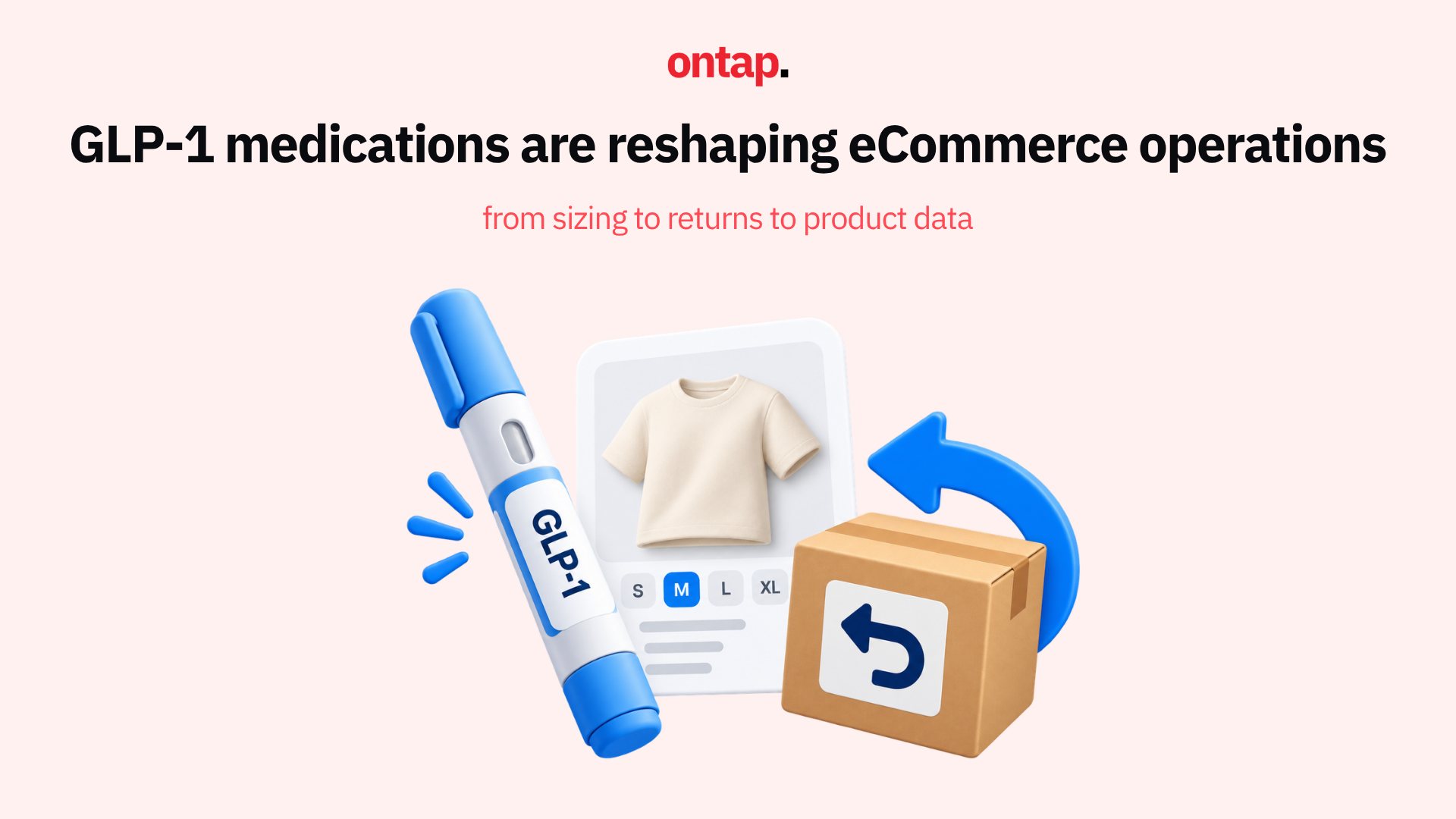
A customer’s last purchase tells you what size they bought then, not necessarily what fits them now. Measurements and fit preferences can change, making previous purchases a less reliable guide to the next order. For apparel eCommerce merchants, that creates practical questions about size demand, product information and returns.
GLP-1 use is one example bringing those questions into focus. Retail Dive reported on 5 October that US retailers, including David’s Bridal and DXL, are responding to changing sizing needs and purchase timing. For UK merchants, these examples are a reason to review their own data before peak season: does current size demand still match inventory assumptions, and does fit guidance help customers choose based on their measurements today?
The sizing problem is already here
David’s Bridal CEO Kelly Cook told Retail Dive that the company’s average dress size has shifted from between US sizes 12 and 14 towards 6 to 8 or 8 to 10. At the end of 2025, the company noticed that rush alteration orders had doubled. Customers whose size is changing, including some using GLP-1 medications, were delaying purchases until closer to the event because they were less certain what size they would need.
For eCommerce merchants, changing sizing needs can create a cascading problem:
-
Size distribution in inventory can become misaligned: If you ordered inventory based on historical size curves while demand is shifting, you can end up with too much stock in some sizes and too little in others. This becomes a margin problem when slower-moving sizes require discounting while in-demand sizes sell out.
-
Previous purchases become a less reliable guide to fit: A customer who bought a size 12 three months ago cannot necessarily rely on that size today. Clear measurement instructions, fit descriptions, and fitting tools help customers reassess what they need, rather than defaulting to their previous purchase.
-
Fit uncertainty can increase returns and bracketing: Bracketing means ordering the same item in multiple sizes with the intention of returning those that do not fit. In a survey of 500 US adults currently using, or having used within the previous 12 months, a GLP-1 medication, ReturnPro found that 65% bracketed, while 43% said their apparel return frequency had increased since starting treatment. These findings describe the surveyed group, rather than all apparel shoppers.
Why this changes product data strategy
Changing sizing needs affect more than inventory and returns. They also change what product information needs to communicate.
Apparel product pages typically provide a size chart, perhaps a fit recommendation, and customer reviews that mention sizing. Those resources are useful, but customers also need to understand how to measure themselves and how a particular product fits. When their previous size becomes a less reliable reference point, the product data needs to do more work.
Merchants adapting to this shift can focus on:
-
Improving fit guidance: Rather than relying on static charts alone, merchants can use current measurements, clearer fit descriptions, video, and digital fitting tools to help customers make a better-informed choice.
-
Enriching product data with fit flexibility: Products with stretch fabrics, adjustable waistbands or relaxed silhouettes give customers more flexibility when their size is changing. Surfacing these attributes prominently helps customers assess whether a product suits their current needs.
-
Adding fit assurance programmes: David’s Bridal has introduced a Fit Guarantee designed to give customers more confidence about fit. For eligible dress and gown purchases, it offers in-store alterations or an exchange where alterations are not feasible. Standard alteration charges apply, along with shipping, handling and rush charges where relevant. Available options depend on the gown, time before the event, and exchange conditions.
The goal is to help customers choose based on their current measurements, rather than relying solely on a previous purchase.
The returns cascade
Research from ReBound Returns and Advanced Supply Chain shows how difficult it is for retailers to recover full value from returned merchandise. The Circularity Index, based on a survey of 150 senior retail leaders across the UK and Europe, found that only 9% of surveyed retailers resell more than half of their returned products at full price.
Uncertainty about current fit can add another layer to that problem:
-
Fit-related returns create cost even when the product is not defective: Sizing and fit remain major reasons for online apparel returns, and each return can add shipping, inspection, repackaging, and restocking costs.
-
Bracketing multiplies the logistics volume per completed sale: When a customer orders three sizes and returns two, the merchant processes three outbound items and two potential returns for one final purchase.
-
The timing can compress the operational cycle: At David’s Bridal, customers delaying purchases while their size changes contributed to doubled rush alteration orders, creating shorter windows for fulfilment and fitting work.
That makes sizing volatility more than a merchandising problem. It can affect fulfilment, returns processing, inventory recovery, and margin at the same time.
What eCommerce merchants should do now?
Audit your size distribution data
Compare your current sales-by-size and return-by-size data against your inventory allocation. If you are seeing a shift towards different sizes, even a modest one, review your remaining Q4 replenishment and allocation rather than relying only on historical size curves.
Evaluate your fit guidance for size volatility
Does your size guide assume the customer already knows their current size? If so, strengthen it with measurement instructions, clearer fit descriptions, videos or fit tools that give shoppers more confidence when their usual size is less certain.
Model bracketing impact on your returns economics
If you are seeing an increase in multi-size orders followed by multi-item returns, calculate the true cost per completed sale, including fulfilment, shipping, inspection, restocking and markdown exposure. That may change which products you promote, how you structure your return policy, and where better fit guidance could reduce unnecessary returns.
Update your product data to surface fit flexibility
Products with stretch, adjustability, and forgiving fits should have those attributes prominently featured. This is more than a merchandising improvement. It gives customers clearer information when deciding whether a product can accommodate some variation in fit.
Consider the AI discovery implication
As AI-powered shopping experiences use structured product information to match products with customer queries, detailed fit attributes can become useful beyond the product page. Google Merchant Center’s optional product detail attribute allows merchants to submit additional product characteristics in their feeds. Google says this information can support discovery across traditional search and AI-driven surfaces, including AI Mode.
A customer asking for “a dress with an adjustable waist” or “a jacket with a more forgiving fit” is giving an AI shopping system a more specific requirement. Merchants whose product data clearly describes those characteristics give the system more information to work with. That does not guarantee a recommendation, but it improves the product context available to AI-powered discovery.
The broader lesson
A previous purchase records what a customer chose at a particular point in time. It does not always tell you what fits them now. The broader lesson for eCommerce businesses is to combine purchase history with current measurements, clear product information and ongoing analysis of demand and returns.
This applies most directly to sizing. It also applies more broadly to preference data and purchase history as predictors of future behaviour. Customer data tells you what was true at a particular point in time. It does not always tell you what the customer needs next.
The merchants who build for change, treating customer behaviour as something that needs continuous measurement rather than a static profile, will be better positioned to respond when buying patterns change.
Peak season is the worst time to discover that your sizing assumptions no longer match current demand. Review your sales, returns and fit guidance before peak volumes make the gaps more expensive to fix.
About On Tap
On Tap is a growth-focused eCommerce consultancy helping mid-market and enterprise merchants improve their digital commerce operations. From product data and storefront experience to analytics, returns and performance, we help businesses identify friction and make better-informed commerce decisions.
To review how your product data, fit experience and returns operations are performing ahead of peak season, get in touch.