
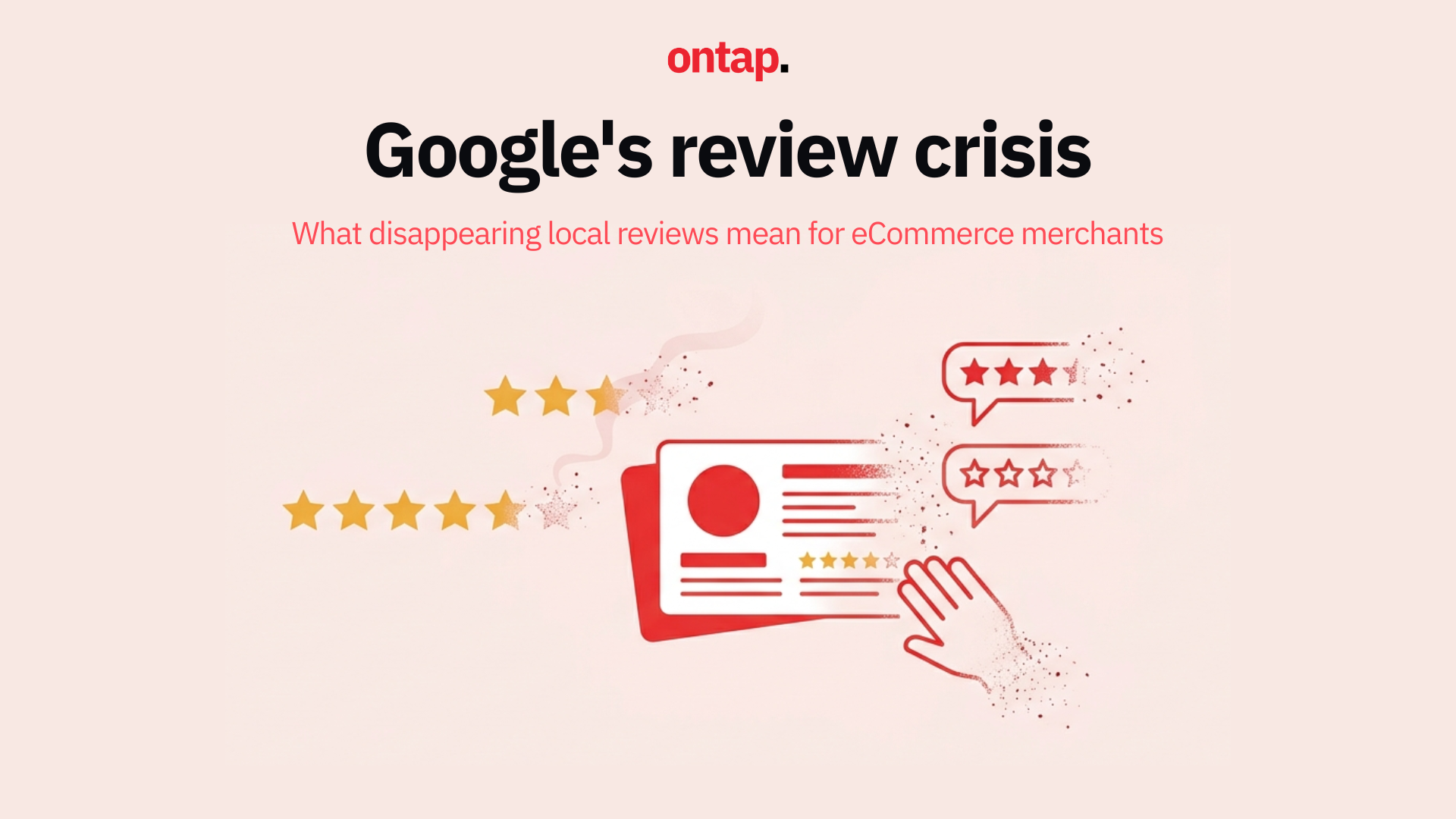
Google has confirmed it is investigating reports of reviews going missing from Google Business Profiles, a problem that has been simmering since late 2025 but escalated sharply in early July. As reported by Barry Schwartz at Search Engine Land on 3 July, businesses across multiple industries are seeing reviews disappear and new reviews being paused on local listings.
A Google spokesperson told Search Engine Land: "When our systems detect suspicious reviews, we take a range of actions including removing reviews and temporarily pausing reviews on the profile to prevent further abuse. We are investigating the issue and will restore any reviews that were incorrectly removed."
For eCommerce merchants who rely on Google Business Profiles for local visibility, customer trust, and click-through rates, this is a story worth understanding in detail.
What is actually happening
The symptoms are widespread and varied. Some businesses report losing individual reviews, while others have seen total review counts collapse. As documented on Search Engine Roundtable, one business owner reported losing 4,588 of 4,651 legitimate reviews within 24 hours, dropping to just 63. Another reported losing over 1,200 reviews overnight with their rating falling to zero.
Amy Toman, a volunteer Google Product Expert, reported on LinkedIn that the pattern often begins after a business reports fake reviews on their profile: Google's automated systems then remove not just the suspected spam but sweep legitimate reviews as well, in some cases pausing the listing's ability to receive any new reviews entirely.
The issue is not new. As Kodegrid's timeline documents, Google confirmed a review display bug in October 2025, partially fixed it, but business owners continued reporting disappearances through early 2026. The July escalation appears to be a separate, more aggressive automated sweep that is catching legitimate profiles in its net.
Update: Google has since indicated via the Business Profile forums that the issue has been resolved and missing reviews should now be visible. However, many business owners report that restoration is incomplete.
Why this matters beyond local search
The immediate impact is obvious: businesses lose social proof. A restaurant that drops from 4.5 stars with 200 reviews to 4.2 stars with 150 reviews will see measurable declines in click-through rates and foot traffic. But for eCommerce merchants specifically, the implications extend further.
Multi-channel brands that operate both online and physical retail rely on Google Business Profile reviews as a trust signal across their entire customer journey. A shopper researching a brand online will often check Google reviews even if they ultimately purchase through the brand's website. Disappearing reviews erode that trust at a critical moment.
Local SEO visibility is directly influenced by review signals, both review quantity and review velocity (how frequently new reviews arrive). If new reviews are being paused, even temporarily, businesses are losing ground in local pack rankings relative to competitors who are not affected.
AI discovery is amplifying the stakes. According to BrightLocal's 2026 Local Consumer Review Survey, AI tools have jumped from 6% to 45% of local business discovery in a single year. AI systems pulling from Google's review data to make recommendations are working with incomplete or distorted signals during this incident, potentially directing customers away from affected businesses.
The bigger pattern: platform dependency risk
This incident is the latest in a series of Google platform issues that have directly impacted merchants in 2026. In the same week, Search Engine Land also reported that Google's indexing report in Google Search Console had been delayed for three weeks before being fixed, meaning site owners were flying blind on their indexation status for the better part of a month.
These incidents illustrate a fundamental risk that every eCommerce business faces: platform dependency. When your reviews live on Google's servers, your indexation data comes from Google's console, and your ad spend flows through Google's systems, you are exposed to that platform's operational reliability with zero control over it.
This does not mean abandoning Google. It means building resilience.
What merchants should do?
-
Diversify your review presence. Do not rely exclusively on Google Business Profile reviews. Maintain active review collection on Trustpilot, industry-specific platforms, and your own site. First-party reviews on your product pages serve double duty: they build trust with visitors and create structured data that AI systems can cite independently of Google.
-
Archive your reviews. Maintain an off-platform record of your reviews. Screenshots, monthly exports, and CRM notes all help. If Google reviews disappear due to a technical issue, having documentation speeds recovery requests and ensures you do not lose the customer feedback data itself.
-
Monitor review counts proactively. Do not wait to discover missing reviews when you notice a traffic drop. Tools such as Google Business Profile Insights or third-party monitoring services can alert you to sudden changes in review counts.
-
Build direct customer relationships. Email lists, SMS subscribers, loyalty programme members: these are channels where your relationship with the customer does not depend on a third party's infrastructure. Every review crisis reinforces the value of owned audience channels.
-
Ask customers to save confirmation of their reviews. If a review disappears, a customer's screenshot or confirmation email speeds verification and recovery. This is a simple request that costs nothing and provides insurance.
The bigger picture
The merchants who will weather this best are the ones who already have robust review strategies across multiple channels, who collect and display first-party reviews on their own sites, and who have built enough brand equity that a temporary Google review fluctuation does not fundamentally change how customers perceive them.
The merchants who will be hurt most are those who have invested exclusively in Google Business Profile as their review strategy, who check their review counts rarely, and who do not have alternative trust signals in place.
No single platform should be a single point of failure for your social proof. This is not theoretical advice. It is an operational lesson playing out in real time.
About On Tap
On Tap is a growth-focused eCommerce consultancy helping mid-market and enterprise merchants build platform-resilient strategies that do not depend on any single channel or infrastructure. From review diversification and trust signal architecture to local SEO strategy and first-party data activation, On Tap helps merchants ensure that no single platform failure can cripple their business.
If you want to build a review and trust strategy that is resilient to platform disruptions, get in touch.