 Best full-service eCommerce agency 2026


Sansec's discovery of a pre-authentication Shopware vulnerability that enables full administrator account takeover and remote code execution is a reminder that the threat landscape for self-hosted eCommerce platforms is intensifying, and that most merchants do not have the monitoring infrastructure to detect these attacks before damage is done.
What happened
On 25 August 2026, Sansec published research revealing a critical pre-authentication vulnerability in Shopware's Store API. The flaw allows an attacker to take over an administrator account without valid credentials and execute arbitrary code on the server. As Sansec described it: "The vulnerability sits in the Store API's payment handling logic. A crafted request can reset an admin password without authentication." Shopware has released patches in versions 6.6.10.18 and 6.7.10.1.
The term "pre-authentication" is what makes this especially dangerous. Unlike vulnerabilities that require some level of access, a customer account, an API key, or a logged-in session, pre-authentication flaws can be exploited by anyone who can reach the storefront. No credentials needed. No prior relationship with the store. Just a crafted request to a publicly accessible API endpoint.
Why this matters beyond Shopware
While this vulnerability is specific to Shopware, the pattern should concern every eCommerce business running a self-hosted platform, whether Magento, WooCommerce, Shopware, or any other.
Sansec found it, not Shopware. Third-party security researchers continue to discover critical vulnerabilities in production eCommerce platforms. Merchants who rely solely on their platform vendor for security are carrying unacknowledged risk.
The attack surface is the Store API. The vulnerability sits in the same API endpoint that handles legitimate customer interactions: payments, orders, cart operations. This means blocking it without disrupting normal store operations requires surgical precision, not broad firewall rules. Merchants without a web application firewall (WAF) tuned for eCommerce traffic patterns would have had no protection between the vulnerability's existence and the patch release.
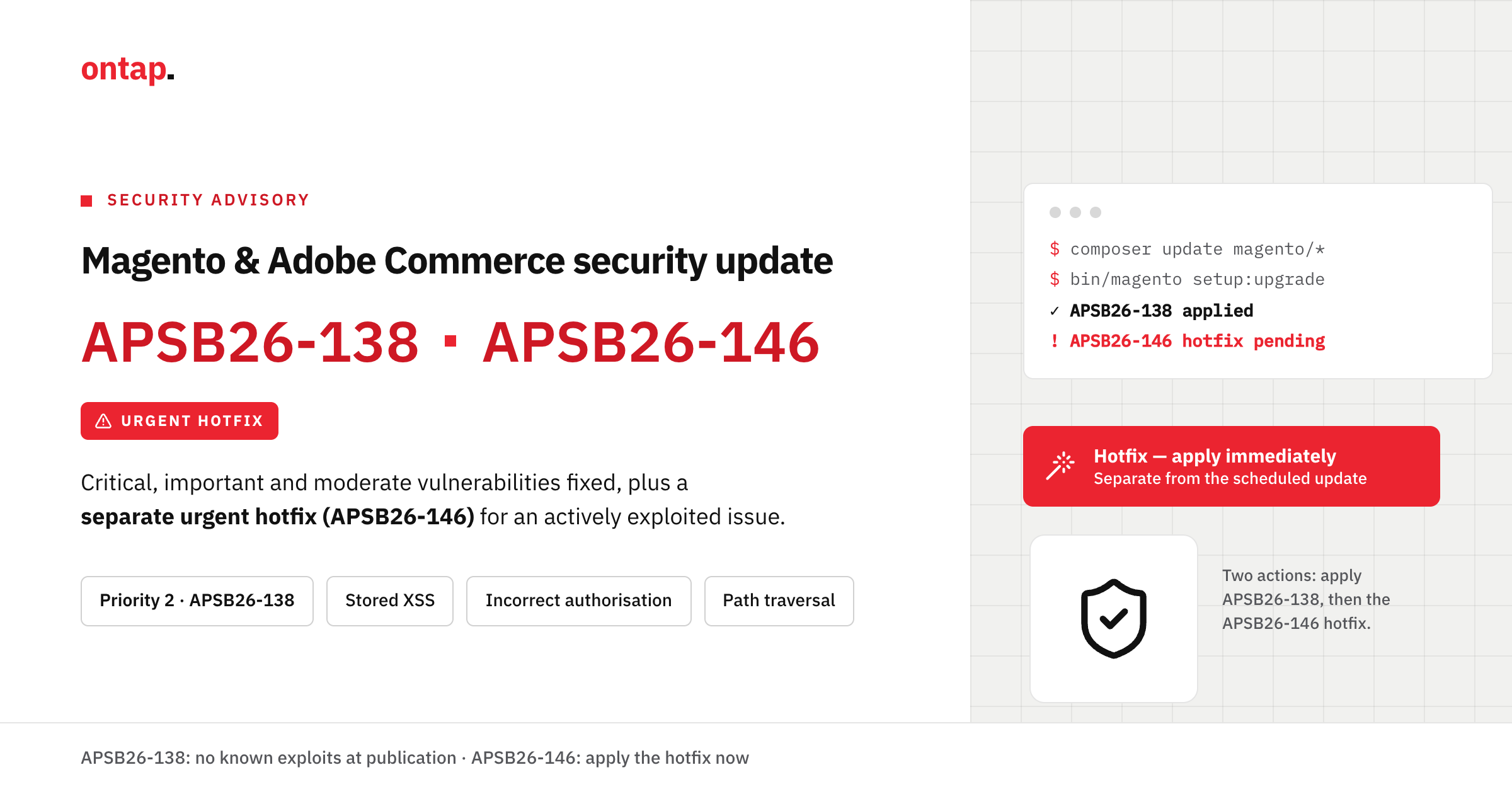
This is the second critical eCommerce account takeover vulnerability in three weeks. Adobe's APSB26-92 patch on 11 August fixed a CVSS 9.1 account takeover in Adobe Commerce and Magento Open Source. Sansec confirmed active exploitation attempts against that vulnerability. Now Shopware merchants face the same class of attack. The pattern is clear: attackers are systematically targeting eCommerce admin panels through authentication bypass flaws.
As Hypernode's security bulletin noted, Hypernode deployed blocking rules within hours of the Sansec disclosure, and all Shopware 6 stores with outdated versions should be considered at risk until patched.
What eCommerce leaders should do
The immediate action for Shopware merchants is straightforward: update to version 6.6.10.18 or 6.7.10.1 immediately. But the broader lesson applies to every eCommerce operation.
-
Audit your patching cadence. If your team takes more than 48 hours to apply critical security patches, you are operating with known vulnerabilities in production during the window when exploitation is most likely, immediately after disclosure.
-
Invest in runtime protection. Sansec's eComscan and similar file integrity monitoring tools detect malicious code injection even when a vulnerability has not been patched yet. For the Adobe Commerce account takeover, blocking rules were deployed within hours of disclosure. Merchants without this layer of protection were exposed.
-
Understand your API exposure. Most eCommerce merchants cannot name every API endpoint their store exposes to the public internet. The Store API, GraphQL endpoints, REST APIs, and webhook receivers all represent attack surface. If you do not know what is exposed, you cannot protect it.
-
Build security into your peak season preparation. With the Golden Quarter approaching, the commercial pressure to avoid downtime creates exactly the conditions where security patches get delayed. This is backwards. The busiest trading period is when you can least afford a security incident, and when attackers know merchants are most reluctant to make changes.
The bigger picture
The frequency of critical eCommerce vulnerabilities in 2026, including Adobe Commerce's account takeover, the Shopware Store API flaw, and over 200 PrestaShop stores with exposed installers, points to a structural challenge. eCommerce platforms are complex, API-rich applications handling financial transactions, and they are prime targets.
The total cost of ownership for a self-hosted eCommerce platform includes not just hosting and development, but ongoing security monitoring, patching discipline, and incident response capability. Platforms that abstract away infrastructure shift this responsibility to the platform vendor. Platforms that give merchants full control also give them full responsibility.
Neither approach is inherently better. But every eCommerce leader should understand which model they are operating in and whether they have the operational capability to match the responsibility.
Patch now. Monitor continuously. And if you are heading into peak season without runtime security monitoring on your eCommerce platform, that is a risk you are choosing to carry, whether you realise it or not.
About On Tap
On Tap is a growth-focused eCommerce consultancy helping mid-market and enterprise merchants build secure, well-maintained stores across Shopify, Magento, and Adobe Commerce. From security patch management and runtime monitoring to WAF configuration and peak season readiness, On Tap helps merchants ensure that security discipline keeps pace with commercial ambition.
If you want to assess your platform's security posture before peak season, get in touch.