
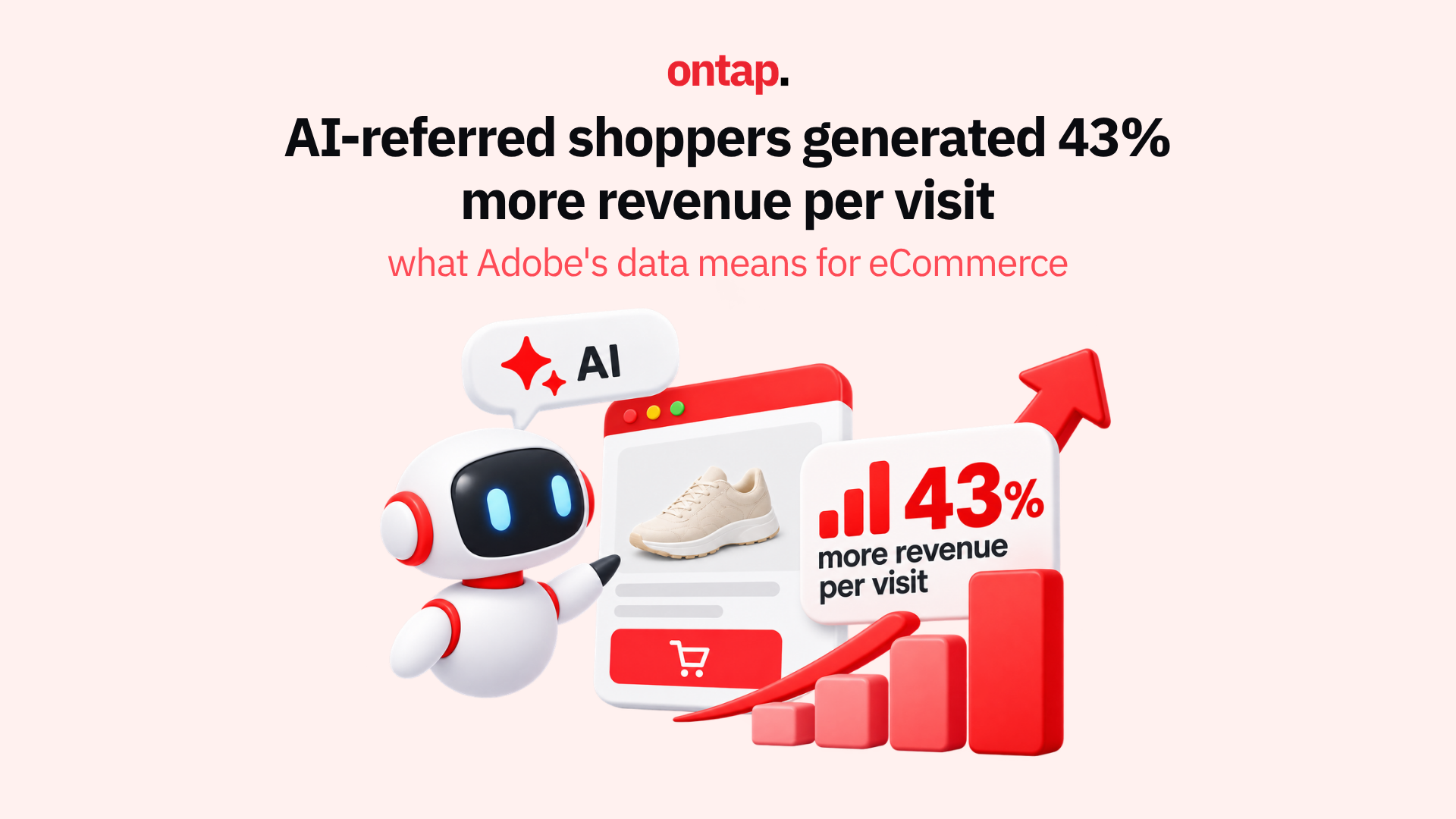
Adobe’s 2026 holiday shopping forecast, released on 28 September, includes a data point merchants should note. In August 2026, AI-referred visits to US retail sites generated 43% more revenue per visit than non-AI traffic.
That represents a substantial reversal. In March 2025, Adobe’s data showed that non-AI visits generated 128% more revenue per visit. AI referrals have since become a commercially valuable source of traffic across the US retailers Adobe measures.
This shift is happening against a backdrop of weakening US consumer confidence. For UK merchants, it offers a reason to examine AI-referred traffic more closely and understand what it contributes to their own stores.
The data that changes the conversation
Adobe’s forecast draws on analysis covering more than one trillion visits to US retail sites, 100 million SKUs and 18 product categories. A separate survey of 5,000 US consumers, conducted in July 2026, explores shoppers’ experiences with AI.
The key findings are:
-
Holiday traffic: Adobe forecasts that AI-referred traffic to US retail sites will rise 130% year on year during November and December 2026;
-
Cart activity: AI-referred visitors added items to their carts at a 32% higher rate than non-AI visitors in August 2026;
-
Revenue per visit: AI-referred visits generated 43% more revenue per visit in the same month;
-
Purchase confidence: 77% of respondents who had used AI for online shopping reported feeling more confident in their purchase;
-
Return expectations: 69% said they were less likely to return an item bought with an AI assistant’s help.
The full Adobe holiday forecast provides the underlying traffic comparisons.
The revenue and cart figures show the commercial potential of AI referrals. The returns finding adds a useful question for merchants to investigate: does greater purchase confidence translate into fewer completed returns?
What could explain the reversal?
AI assistants can support several stages of a shopping journey, from exploring products to comparing options and deciding what to buy. That gives merchants a potential route to shoppers who have already considered their needs before reaching a store.
Three factors could contribute to stronger AI referral performance.
-
First, AI-assisted research can help shoppers narrow their choices: Comparing specifications, suitability, and prices before visiting a retailer can produce a clearer shortlist. A shopper arriving with that shortlist has fewer decisions left to make.
-
Second, consumers are using AI to support purchase decisions: Adobe’s confidence findings suggest that shoppers find value in this assistance. Product research and comparison can help them assess whether an item meets their needs before committing to an order.
-
Third, accessible product information supports discovery: Clear descriptions, accurate attributes, and current prices give discovery services useful information to assess and present products. For merchants, the quality of that information is a practical area they can improve.
Adobe’s research tracks the change in performance rather than isolating its causes. These factors provide useful starting points for understanding the behaviour of AI-referred shoppers in your own store.
The consumer confidence paradox
Strong AI referral performance is emerging while US consumers are becoming more cautious about the economy.
In its September 2026 consumer confidence release, The Conference Board reported:
-
Consumer confidence: The index fell to 81.9 from 88.6 in August;
-
Inflation expectations: Median expectations for inflation over the next 12 months rose by 0.3 percentage points to 5.1%;
-
Interest rate expectations: 68.4% of respondents expected higher interest rates over the next year.
Separately, in remarks delivered on 29 September, New York Fed President John Williams forecast that inflation would reach the Federal Reserve’s 2% target in 2028.
For price-conscious shoppers, AI assistance could offer a way to compare options and assess value with less effort. A cautious consumer can still be ready to purchase when they find a product that meets their needs at an acceptable price.
That is one possible explanation for the combination of weaker confidence and stronger AI referral performance. For merchants, the practical opportunity is to make value easy to assess through clear specifications, transparent pricing and useful product comparisons.
Both datasets concern the US. UK merchants should assess these signals alongside local demand and their own customer behaviour.
What this means for eCommerce merchants
The strategic implication is clear: AI-referred traffic deserves separate measurement and a place in acquisition planning.
On Tap recommends starting with product information, traffic reporting, and commercial outcomes. Your store’s results should determine the scale of investment.
Your product data supports AI discovery
AI discovery services need accessible, useful information to assess a product’s relevance. Thin descriptions, missing attributes, and outdated prices make that task harder.
Audit the information shoppers and discovery services rely on:
-
Product content: Use clear titles, specific descriptions, and relevant attributes, including sizes, materials, compatibility, and intended use;
-
Price and availability: Keep product feeds and pages accurate and consistent;
-
Technical access: Make important product information available in text and check that relevant discovery services can access it;
-
Structured data: Use appropriate product markup that matches the information visible on the page.
These improvements support SEO and shopping discovery together. Google’s guidance on AI features and websites confirms that established SEO practices remain relevant to AI Overviews and AI Mode, with no special AI schema required.
Treat product data as a customer acquisition investment. Prioritise the information that helps your customers find, compare and choose products.
Segment AI traffic before peak season
If you are not already reviewing identifiable AI referrals separately, include this in your peak season preparation.
As of October 2026, Google Analytics 4’s default channel definitions include an AI Assistant channel covering recognised assistant sources. Traffic from Google’s AI Overviews and AI Mode is included in Organic Search.
Use your reporting to:
-
Identify sources: Review the AI Assistant channel and source/medium data to understand which services send visitors;
-
Compare performance: Measure revenue per visit, conversion rate, cart activity and share of total traffic;
-
Assess consistency: Compare results across products and periods, allowing sufficient visit and order volumes before making investment decisions.
Adobe’s findings provide a benchmark. Your own reporting will show where AI referrals contribute value and which products attract those visitors.
Rethink your channel attribution
AI can influence a purchase before a measurable website visit occurs. A shopper could research a product with an assistant, then reach your store through search, a saved link or another channel.
Understanding that journey requires attention to both traffic classification and attribution. GA4 uses different reporting scopes for session acquisition and purchase attribution, with data-driven attribution as its default model for key events.
Before peak season:
-
Check classification: Confirm how recognised AI sources appear in your reports;
-
Review attribution: Understand the model and reporting scope used to assess purchases;
-
Add customer insight: Use post-purchase questions or customer research to learn how shoppers discovered your products, keeping those responses separate from measured referrals.
Together, these sources can provide a fuller picture of AI’s contribution to acquisition and purchase decisions.
Track returns from AI-referred orders
Adobe’s survey suggests that shoppers feel more confident about purchases made with AI assistance. Whether that confidence produces fewer returns is a commercially useful question to test.
Where your data allows, compare orders associated with identifiable AI referrals against other acquisition sources:
-
Actual returns: Measure completed returns and refunds, allowing comparable time after purchase;
-
Comparable orders: Account for differences in product category, order value and promotional activity;
-
Commercial contribution: Assess retained revenue, margin and fulfilment and return costs.
Linking acquisition data with order outcomes will help you understand whether AI referrals deliver more profitable sales as well as higher revenue per visit.
Prepare before the holiday season
Adobe’s forecast covers 1 November to 31 December 2026. October provides a preparation period to review product information and reporting ahead of that window, with priorities guided by your own peak trading calendar.
Start with accurate product data, clear traffic reporting and a practical way to compare commercial outcomes. These foundations will help you identify where AI referrals add value and where further investment makes sense.
Adobe’s findings give merchants a strong reason to take the channel seriously. Understand what those shoppers need, measure what they contribute, and use the results to guide your next investment.