
On 21 July, Search Engine Land published a cluster of articles that, taken together, paint a picture of a fundamental shift in how eCommerce brands need to think about search visibility. The convergence of research on ChatGPT topic ownership, category framing in AI recommendations, schema markup for AI search, and Google's rollout of Gemini 3.5 Flash-Lite into Search makes one thing clear: the rules of discovery are being rewritten, and most eCommerce merchants are not ready.
The research: AI brand visibility is unstable and hard to earn
Semrush published its 2026 AI Visibility Index, scaling from 2,500 prompts in the original September 2025 study to 126 million US AI search prompts analysed from January through April 2026. As Search Engine Land's coverage summarised, only 15.2% of the 1,094 ChatGPT topic categories analysed had a clear brand owner. Another 31.2% had an emerging leader. The remaining 53.7% were entirely unsettled, with no brand appearing consistently.
The definition of "owner" was strict: the brand with the highest share of mentions, named in at least four of five related buyer prompts, with at least a five-percentage-point lead over the runner-up. What is striking is that the top half of categories by AI search volume, which accounted for 98% of all tracked queries, were more likely to be unsettled. The biggest topics are the most contested.
Traditional SEO metrics had limited predictive value, as Kevin Indig wrote in the Semrush analysis: "Traditional SEO metrics aren't enough to explain who owns a topic. While they play their role, there's more to it." Owners had higher branded search volume in only 55.7% of comparisons, higher organic traffic in 48.4%, and a higher Authority Score in 52.5%. Only branded search volume reached statistical significance.
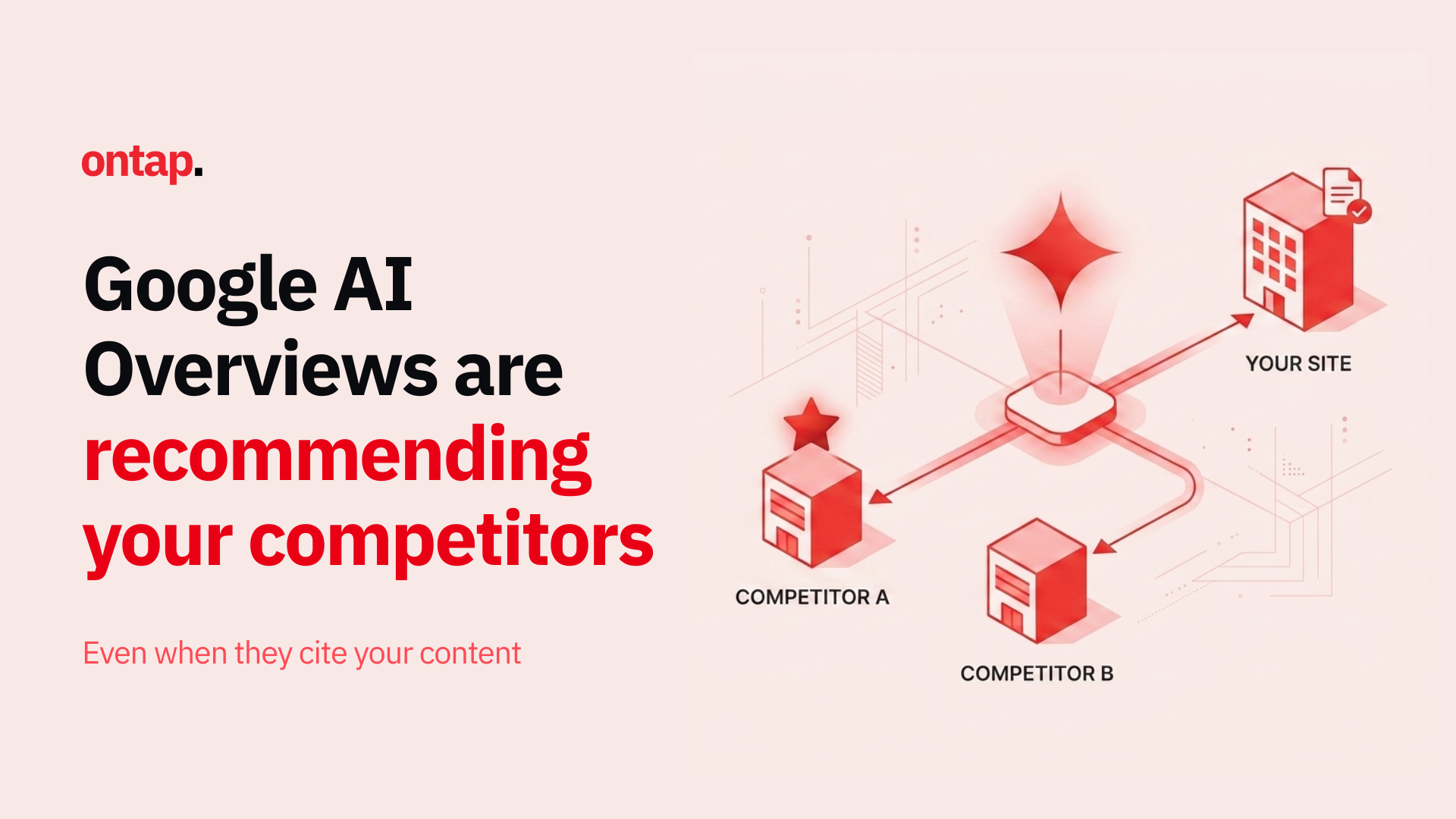
Perhaps the most important finding: as MarTech's coverage highlighted, only 21% of the most-cited domains within a category were also the brand mentioned most frequently. Citations and mentions are not the same signal. Being cited as a source does not mean being recommended as a brand.
The good news: once a brand earned clear category ownership, it was durable. Clear category owners stayed in first place in 90.4% of month-over-month comparisons. The hard part is getting there. The staying part is easier.
Category framing: The words your customers use reshape AI recommendations
Complementing the topic ownership research, Search Engine Land also covered new findings on "category framing," how the specific language customers use to describe what they are looking for changes which brands AI models recommend.
This is a subtle but powerful insight. When a customer asks an AI "what is the best running shoe?" versus "what is the best athletic footwear for marathon training?", the AI may recommend entirely different brands, not because one brand is objectively better, but because different brands have built authority around different category frames in their content and product data.
For eCommerce merchants, this means your product descriptions, category pages, and content marketing need to align with the actual language your target customers use when talking to AI assistants. It is not enough to optimise for keywords. You need to own the category frames that your ideal customers think in.
The schema gap: Your knowledge graph has blind spots
A third article laid out a practical framework for identifying and prioritising "entity gaps" in schema markup. The premise is straightforward: schema markup does more than power rich search results. It builds a knowledge graph that AI systems use to understand your brand, products, and relationships. If your schema is incomplete or inconsistent, AI systems develop an incomplete picture of your business, and they will recommend competitors who have done a better job of making themselves machine-readable.
As the Semrush press release noted, each AI platform draws on different source patterns: "ChatGPT cites an average of 15 sources per response and frequently relies on community and reference platforms such as Reddit and Wikipedia, while Gemini cites an average of 3 sources per response." If your structured data is incomplete, you are absent from both deep and shallow citation pools.
Google's infrastructure move: Gemini 3.5 Flash-Lite in Search
Underlying all of this, Google confirmed that Gemini 3.5 Flash-Lite is rolling out in Google Search. Flash-Lite is designed for low-latency tasks and high-throughput developer workflows, including what Google describes as "agentic search," search experiences where AI agents are autonomously performing research on behalf of users.
This infrastructure move matters because it tells you the scale at which AI is being embedded into search. Google is not experimenting with AI in search anymore. They are deploying purpose-built models optimised for speed and efficiency across their search infrastructure.
What this means for eCommerce merchants
Audit your AI visibility, not just your search rankings
Traditional rank tracking tells you where you appear in blue links. It does not tell you whether AI assistants mention your brand when customers ask for recommendations in your category. The Semrush data shows 85% of categories are unsettled. That is the opportunity window.
Map your category frames
Identify the specific phrases your target customers use when describing what they are looking for. These are not always the same as your keyword targets. Use customer service transcripts, review language, and social media conversations to understand how real people describe your products, then ensure your content uses that language naturally.
Close your schema gaps
Conduct a structured data audit across your product catalogue. Ensure every product page has complete schema markup including price, availability, reviews, brand, and product relationships. If you sell electronics, specification schemas matter. If you sell fashion, material and style schemas matter.
Build mention-worthy content
The Semrush research demonstrates that mentions matter more than citations for AI visibility. Creating content that gets referenced, quoted, and discussed, including expert guides, original research, and unique perspective pieces, is more valuable for AI visibility than traditional link-building content.
Optimise product data everywhere
Your product data feeds need to be excellent not just for Google Merchant Centre, but across every surface where AI systems might encounter your products. ChatGPT draws from 15 sources per response. The more consistent and complete your product data is across the web, the stronger your entity presence becomes.
The bigger picture
We are at an inflection point where the merchants who invest in machine-readable excellence will pull ahead of competitors who are still optimising primarily for human-readable content. Both matter, but the balance is shifting. 85% of AI search categories have no clear brand owner. That is not a warning. It is an invitation. The merchants who claim those positions now, while the landscape is still forming, will have a compounding advantage that late movers will struggle to overcome.
About On Tap
On Tap is a growth-focused eCommerce consultancy helping mid-market and enterprise merchants build visibility across traditional search, AI summaries, and direct chatbot discovery. From schema audits and AI readiness assessments to content strategy and product data architecture, On Tap helps merchants earn the category ownership that AI systems increasingly reward.
If you want to understand how your brand appears in AI recommendation systems and where the gaps are, get in touch.