 Best full-service eCommerce agency 2026


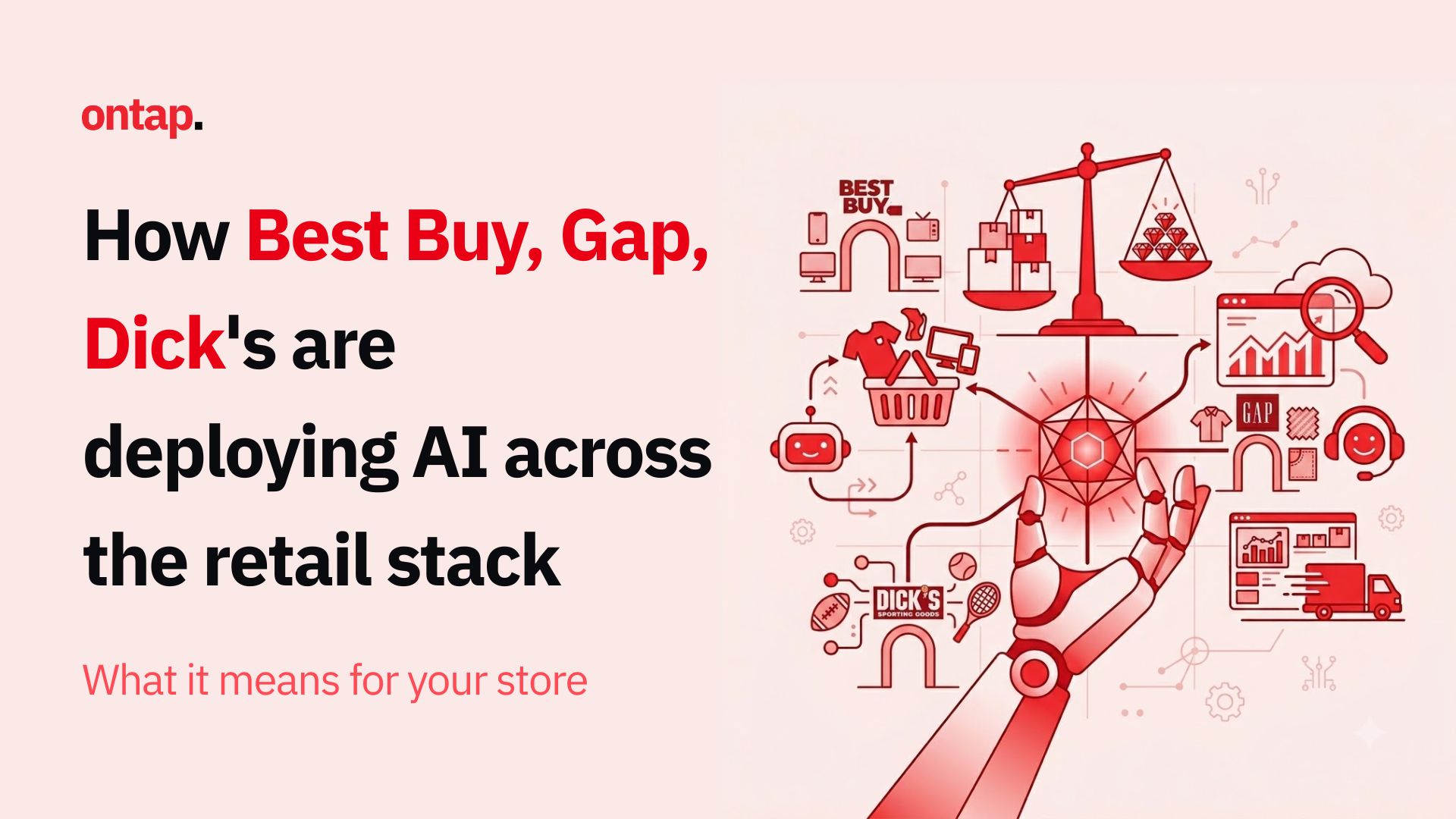
Three major retailers just described, in unusually specific terms, how AI is reshaping their businesses from the inside out. During their Q1 2026 earnings calls, Best Buy, Gap, and Dick's Sporting Goods each detailed AI investments that go well beyond chatbots and product recommendations. For eCommerce merchants evaluating their own AI roadmaps, these case studies offer concrete signals about where the technology is delivering genuine returns, and where the real lessons lie.
What the retailers actually said
The clearest signal came from Best Buy's incoming CEO, Jason Bonfig, who told analysts the company is no longer positioning itself as a pure retailer. "We are advancing Best Buy as a retail media, advertising and technology company," Bonfig said. The company reported enterprise revenue of $8.9 billion, with 2% comparable sales growth, and is actively building AI partnerships with both OpenAI and Google to embed AI across the customer experience. (Retail Dive, 29 May 2026)
At Gap, CEO Richard Dickson framed the strategy succinctly: "We are a fashion company that is brand-led and intelligence-powered." Gap is deploying AI across merchandise design, buying, and allocation workflows, with a broader rollout planned across corporate productivity in the coming quarters. The company posted its ninth consecutive quarter of comparable sales growth, up 2%. (CIO Dive, 4 June 2026)
Dick's Sporting Goods went furthest on the customer-facing side. In May, the company launched Coach by Dick's, an agentic AI assistant built with Adobe Brand Concierge, delivering personalised sport and product guidance directly inside its mobile app. Dick's posted 6% comparable sales growth in the DICK's business segment, with CEO Lauren Hobart noting that strength was "broad-based" rather than driven by any single factor. (TIKR, 4 June 2026)
Why this matters beyond the headlines
These are not aspirational press releases. Each of these retailers is reporting specific business outcomes against specific AI investments. That is a meaningful shift from where the industry was 18 months ago, when AI in retail was still largely positioned as a future-state capability.
According to a December 2025 National Retail Federation report, 39% of retailers anticipate AI will account for more than 10% of their technology spend within three years. Today, 77% allocate 5% or less of their tech budget to AI. The direction of travel is clear, and the gap between early movers and the rest of the market is widening. (NRF Centre for Digital Risk and Innovation, December 2025)
What is instructive across all three case studies is the consistent philosophy. Bonfig described Best Buy's approach as "human-focused," enabling employees to deliver better customer experiences rather than replacing them. Dickson framed Gap's AI as empowering teams "to make decisions that drive greater consistency and efficiency." This is augmentation, not automation, and it is the framing that characterises the implementations actually generating returns.
The practical implications for mid-market merchants
The obvious response to reading about Best Buy's OpenAI partnership or Dick's agentic AI assistant is to conclude that these investments are out of reach for mid-market eCommerce operators. That conclusion is wrong. The principle behind each deployment is entirely replicable at a fraction of the scale.
Start with your data, not your technology
Every successful AI deployment described in these earnings calls rests on clean, structured, first-party data. Best Buy's AI partnerships with OpenAI and Google are only as useful as the customer and behavioural data feeding them. Gap's merchandising AI works because its product and sales data are well-structured.
Before evaluating any AI tool, audit your data quality. Are your product attributes complete and consistent? Is your customer segmentation based on actual behaviour? Are your analytics capturing the right events at the right granularity?
Target boring, high-impact applications first
The retailers getting real value from AI are not building futuristic shopping experiences from scratch. They are making existing processes faster and more accurate. Gap is using AI to reduce merchandising errors. Dick's is using it to optimise inventory allocation. These are unglamorous, high-ROI applications.
For mid-market merchants, the equivalent might include AI-powered site search that understands synonyms and intent, automated product descriptions generated from structured attribute data, predictive inventory management that reduces stockouts and overstock, or dynamic pricing rules informed by competitive intelligence.
Think about AI as a customer lifecycle tool
Dick's Coach assistant is notable not because it is technically impressive, but because it is positioned to drive retention between purchase cycles. The insight is that AI's highest-leverage role is not converting a browser into a first-time buyer. It is deepening the relationship with customers who already know and trust the brand. That logic applies directly to post-purchase communication, replenishment flows, and loyalty programme engagement for merchants of any size.
Use the first-party data tools already available to you
One of the most underutilised tools available to every merchant right now is Google Ads Customer Match. With privacy regulations making third-party tracking less effective, your first-party data becomes the signal that gives Google's AI a meaningful advantage in finding your best prospects. This is not a complex integration. If you have an email list and a Google Ads account, you can start today.
The bigger picture
The gap between enterprise and mid-market AI adoption is narrower than the investment figures suggest. The retailers making earnings calls about AI are not doing anything conceptually inaccessible. They are applying structured data, clean analytics, and focused automation to well-understood business problems.
The merchants who will fall behind are not those who lack AI budgets. They are the ones who treat AI as a feature to bolt on rather than a capability to build towards. The right starting point is not a tool evaluation. It is a data audit. That costs nothing, and it determines the ceiling of everything that follows.
About On Tap
On Tap is a growth-focused eCommerce consultancy helping mid-market and enterprise merchants navigate technology decisions with pragmatic, ROI-focused guidance. From data infrastructure and AI tool evaluation to platform optimisation and conversion strategy, On Tap works across the full eCommerce stack to help merchants build capabilities that compound over time.
If you are evaluating AI tools for your store and want to understand where to start, get in touch.