
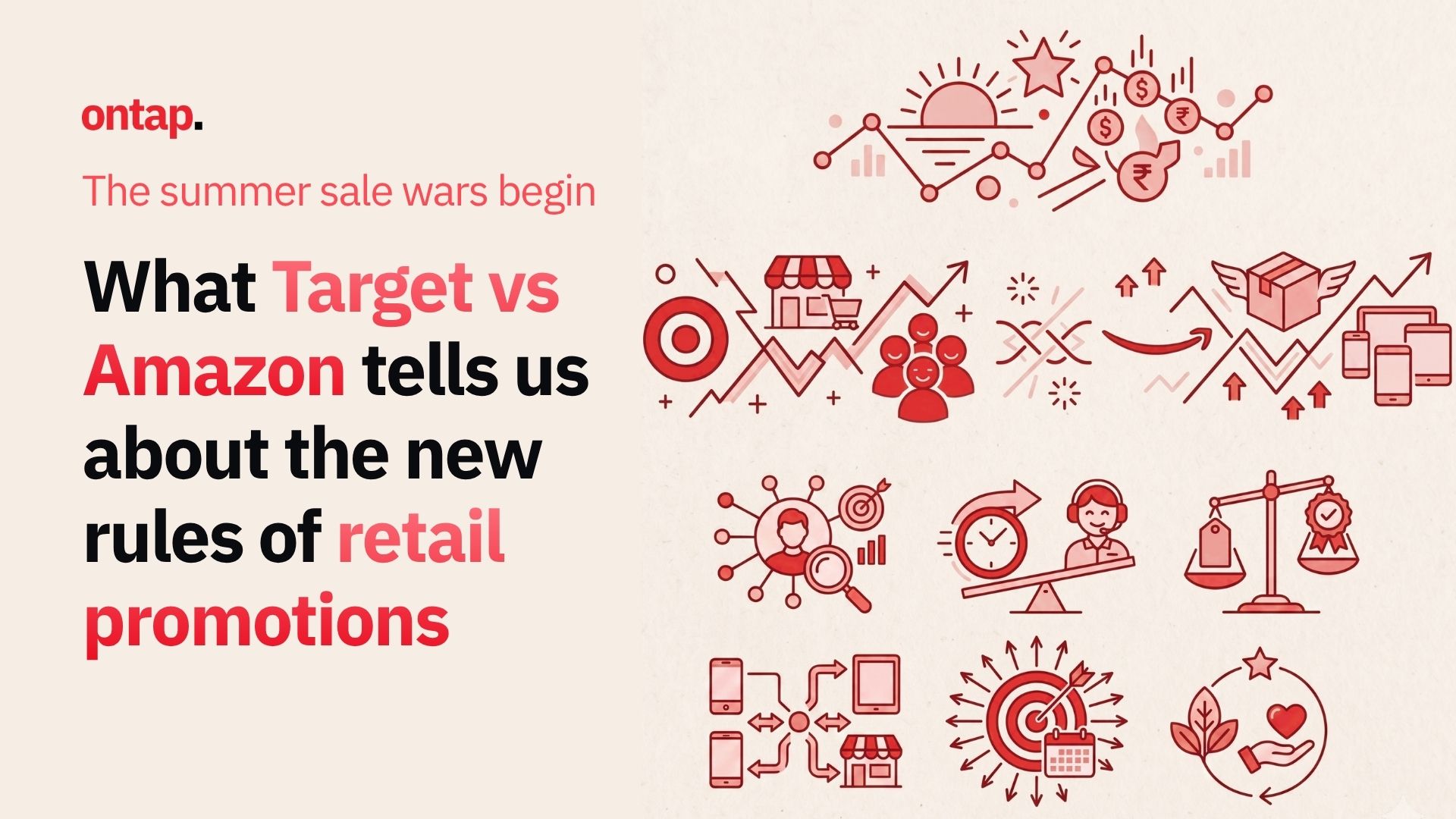
Target just confirmed that its Target Circle Deal Days will run from 23 to 26 June, the exact same dates as Amazon Prime Day 2026. This is not a coincidence. It is a deliberate strategic choice, and one that reveals how fundamentally the economics of retail promotions have shifted. For mid-market eCommerce merchants, the implications extend well beyond a fight between two of the world's largest retailers.
The calendar move that changes everything
Both Amazon and Target shifted their summer sales from July to June this year. Amazon moved Prime Day to June for the first time since 2021, and Target followed within 24 hours of Amazon's announcement. Target Circle 360 members get early access starting 22 June, with discounts of up to 45% across apparel, beauty, home, toys, and essentials. (Retail Dive, 3 June 2026)
Sarah Travis, Target's EVP and Chief Digital and Revenue Officer, positioned the move around consumer need: "Busy families are looking for ways to save money as they balance summer plans with back-to-school and college prep." (Retail Dive)
The real driver is competitive positioning. By occupying the same calendar slot, Target is forcing a direct comparison and betting that its physical store network, drive-up convenience, and own-brand private labels can hold their own against Amazon's marketplace breadth and Prime logistics.
Best Buy has also announced a competing sale launching on 22 June, a day ahead of the main event. The counter-programming playbook is no longer the exclusive territory of the very largest retailers. (9to5Toys, 2 June 2026)
Why mid-market merchants cannot afford to sit this out
If you are running an independent or mid-market eCommerce business, the temptation is to treat this as a spectator sport. It is not. Three dynamics make this promotional window directly relevant to your business.
Purchase intent spills across the market. Prime Day and its competitors do not just move sales between retailers; they create a concentrated period of heightened purchase intent across the entire market. Consumers who enter the deal-shopping mindset on Amazon frequently purchase from other channels and brands during the same window. Your customers are browsing deals during this period, whether or not you have a promotion running.
The calendar shift compresses your back-to-school window. Moving summer sales from July to late June captures back-to-school spending earlier, before holiday travel budgets peak in July. Families making summer purchase decisions in late June have more wallet share available than they will in August. For merchants in apparel, electronics, home goods, and school supplies, a promotional calendar still anchored to mid-July means arriving after the wave.
Counter-programming is now a mainstream tactic. Target running simultaneously with Amazon rather than avoiding the clash is the mature strategic move. The lesson for smaller merchants is that you do not need to compete on discount depth. You compete on relevance, expertise, and the things that marketplace shopping cannot deliver.
The Five Below proof point
Alongside the Amazon and Target announcements, Five Below reported Q1 2026 results that underscore a related principle: value clarity outperforms discount depth. Net sales grew 32.5% to $1.29 billion. Comparable sales increased 22.7%, driven overwhelmingly by transaction volume, up 19%, rather than average ticket size, up just 4%. Adjusted earnings per share grew 158% year over year. (Five Below Q1 2026 earnings release, SEC, 3 June 2026)
CEO Winnie Park attributed the results to "fun treasure hunt shopping experiences" with simplified pricing and improved visual presentation. Notably, Five Below has been integrating its former "Five Beyond" section, products priced above the core $5 price point, back into the main store layout, removing a section that muddied the brand's value proposition. (Five Below Q1 2026 Earnings Call, The Motley Fool, 4 June 2026)
The growth was not driven by deeper discounts. It was driven by a clearer promise. Five Below's entire brand is a statement: everything is accessible, fun, and affordable. When that promise is consistent, customers visit more often and buy more frequently. That is the promotional lesson that scales to any size business.
Building your summer sale strategy
Based on what Target, Amazon, and Five Below are demonstrating, here is a practical framework for mid-market eCommerce merchants approaching the 23 to 26 June window.
Timing. Align your promotional activity with the June window. Even if you are not competing directly with Amazon or Target, consumer attention will be concentrated during this period and you should be present in it.
Positioning. Do not try to win on the discount percentage. Emphasise what makes your products and shopping experience distinctive. Curated selections, category expertise, exclusive products, and superior service are your differentiators, the things that a 50%-off banner on Amazon cannot replicate.
First-party data. Use your customer list to create targeted campaigns via Google Ads Customer Match, Meta Custom Audiences, and email that reach your best prospects during the deal-hunting window. Your existing customers are the most likely buyers during a promotional period.
Content. Create buying guides, product comparisons, and editorial content that capture the informational searches consumers make before purchasing. Brand visibility and authority now drive more organic discovery than keyword targeting alone.
Measurement. Set clear goals for the promotional period and measure incrementality, not just total revenue. The question is not how much you sold during the sale, but how much more you sold than you would have without the promotion.
The underlying principle
The summer sale wars between Amazon and Target will generate headlines. But for most eCommerce merchants, the real competition is not with those giants. It is with your own past performance and the evolving expectations of your customers.
Five Below's 23% comparable sales growth did not come from matching Amazon's prices. It came from being unmistakably itself. The merchants who perform best during promotional windows are the ones who have already earned customer trust through year-round consistency in product, experience, and service. A sale amplifies existing strengths. It cannot manufacture them.
About On Tap
On Tap is a growth-focused eCommerce consultancy helping mid-market and enterprise merchants develop promotional strategies that drive sustainable growth, not just short-term revenue spikes. From promotional calendar planning and first-party data activation to conversion rate optimisation and customer lifecycle strategy, On Tap works across the full eCommerce stack to help merchants compete with clarity and confidence.
If you want to build a summer sale strategy that works beyond the window, get in touch.