 Best full-service eCommerce agency 2026


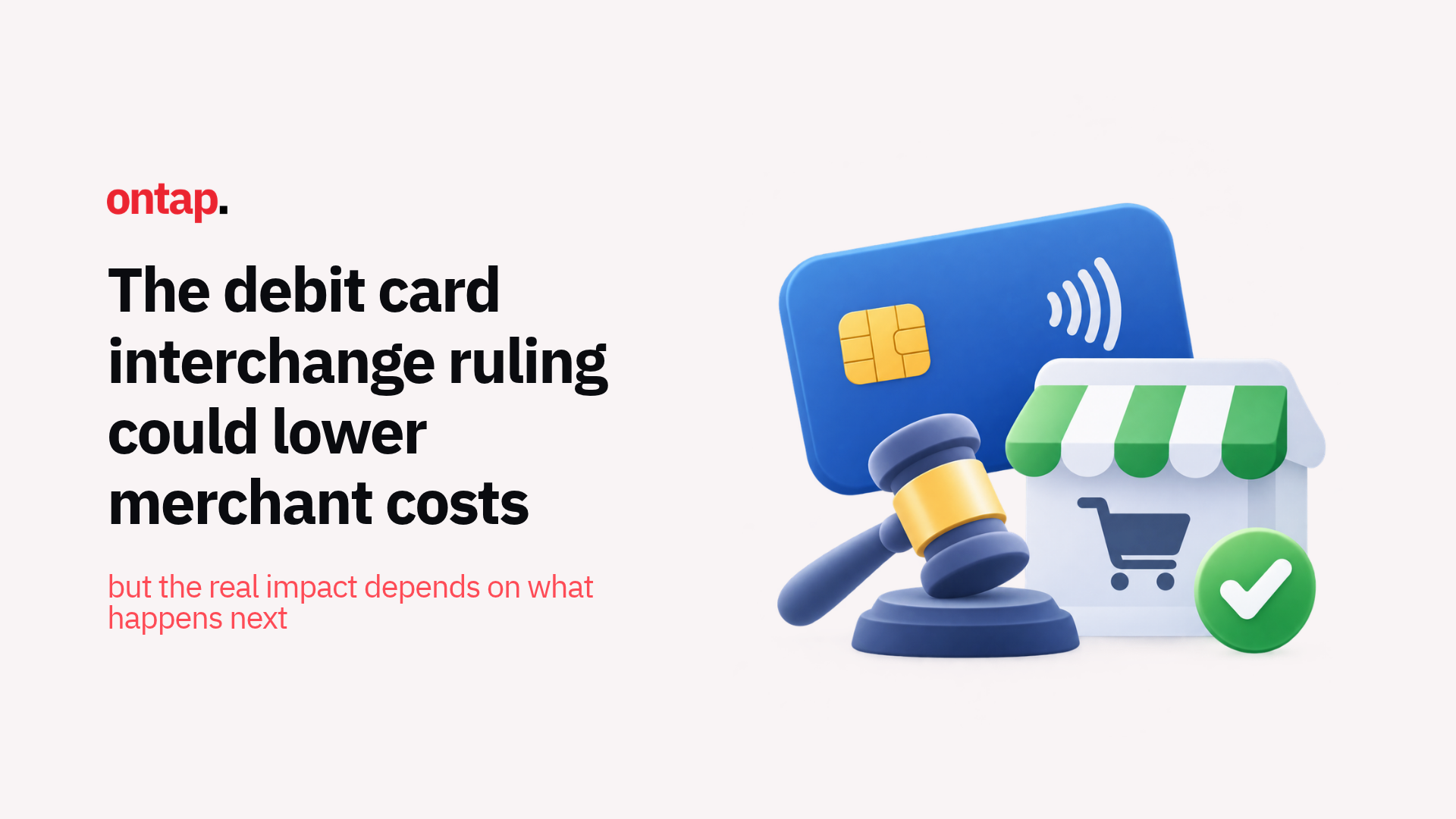
On 26 October, the Eighth Circuit handed merchants a significant victory in the long-running dispute over regulated debit card interchange fees.
In Corner Post v. Board of Governors, the court affirmed a lower-court judgment that the Federal Reserve's current Regulation II framework improperly considered costs that Congress said should not be included when setting regulated debit interchange fees.
The court ordered the current framework vacated and sent the issue back to the Federal Reserve to develop a fee structure consistent with the statute.
But the ruling does not mean merchants' debit processing costs fall immediately.
The decision only becomes effective when the court issues its mandate, and the Federal Reserve still has procedural options before that happens. Even after a new interchange standard eventually emerges, the amount an individual merchant saves will depend on its debit mix and processor pricing model.
For eCommerce merchants, this is a meaningful development to watch, not a fee reduction to model into next month's margin yet.
What the court actually ruled
The Durbin Amendment, part of the 2010 Dodd-Frank Act, requires regulated debit interchange fees to be reasonable and proportional to the issuer's costs related to the transaction.
Congress specifically told the Federal Reserve to distinguish between:
-
Incremental costs: costs incurred in the authorisation, clearance or settlement of a particular debit transaction, which the Fed must consider;
-
Other costs: costs that aren't specific to a particular debit transaction, which the Fed must not consider.
The Eighth Circuit concluded that "incremental cost" means marginal cost, or the additional cost created by processing another transaction.
The problem with Regulation II was that the Federal Reserve also considered costs that weren't specific to individual transactions, including:
-
Fixed authorisation, clearance and settlement costs;
-
Network processing fees;
-
Fraud-monitoring costs;
-
Fraud losses.
The court also criticised the flat 21-cent component because it applies uniformly regardless of the cost of processing a particular transaction.
That doesn't mean a future interchange fee must equal marginal cost exactly. The court said the Fed can use a reasonable proxy, potentially including average variable cost, as long as the resulting fee structure properly distinguishes transaction-specific costs from costs the statute excludes.
The current fee hasn't disappeared yet
The phrase "21-cent cap" is useful shorthand, but the existing regulated fee is more complicated.
For a covered debit-card issuer, Regulation II currently permits:
-
21 cents per transaction;
-
0.05% of the transaction value;
-
An additional 1 cent when the issuer qualifies for the fraud-prevention adjustment.
The rule generally applies to debit cards issued by institutions with $10 billion or more in assets. Smaller issuers and certain prepaid and government-program cards are exempt from the interchange limit.
The appeals court affirmed the decision vacating this framework, but the opinion itself says the judgment becomes effective only when the mandate issues.
Because the Federal Reserve is a party, it has 45 days to seek rehearing. The mandate would normally follow after that period, or after a rehearing request is resolved, unless further court action changes the timeline.
So merchants should not expect their current processing statements to change because of the 26 October ruling.
Why this could matter for eCommerce merchants
For merchants processing meaningful volumes of regulated debit transactions, a lower replacement fee could reduce one component of payment acceptance costs.
The regulated interchange amount depends partly on transaction value, not just the 21-cent base component. The cap also doesn't apply to every debit card, and interchange is only one part of what most merchants pay their payment provider.
The practical impact therefore depends on three things:
-
Debit mix: how much of your payment volume comes from regulated debit cards rather than credit cards or exempt debit issuers;
-
The eventual replacement rule: the court didn't set a new fee level;
-
Processor pricing: whether changes in underlying interchange flow through to what your payment provider charges you.
Merchants on interchange-plus pricing generally have greater visibility into the underlying interchange component and any subsequent change.
Merchants paying flat or bundled rates may not see the same immediate relationship between a lower interchange rate and their headline processing fee. That depends on the processor's pricing terms and any future changes it makes.
This ruling applies to debit, not credit
The distinction matters for eCommerce businesses.
The Durbin Amendment's interchange-fee restriction covers qualifying debit transactions, not credit-card interchange.
That means this ruling doesn't directly reduce Visa, Mastercard, American Express or other credit-card interchange charges simply because those cards are used online.
It also doesn't regulate the merchant's entire processing fee.
Interchange is one component of payment acceptance costs. Acquirer or processor markups, network assessments and other contractual fees can remain even if regulated debit interchange eventually falls.
The useful exercise for merchants is therefore not to ask, "How much will card processing fall?"
It is to ask, "How much regulated debit volume do we process, and how is that interchange currently passed through in our contract?"
The pricing transparency connection
The ruling arrived on the same day that pricing accuracy attracted scrutiny from another direction.
The FTC and 20 states sued Dollar General on 26 October, alleging that the retailer repeatedly charged customers more at checkout than the prices displayed on shelves, price tags and advertisements.
According to the complaint, Dollar General received at least 29,265 complaints categorised as "Did Not Honor Marked Price" between January 2023 and March 2026.
These are fundamentally different cases.
Corner Post concerns how a regulator calculates interchange limits between payment-system participants. The Dollar General case concerns alleged consumer pricing practices, and those allegations still need to be decided by the court.
But both are useful reminders that the difference between an expected cost and the amount ultimately charged deserves attention.
For eCommerce merchants, that applies on both sides of the transaction.
Actions to take:
-
Understand payment costs: separate regulated debit interchange, processor markup and other fees where your reporting allows it;
-
Check customer-facing prices: verify that prices, promotions, shipping charges and other mandatory amounts remain consistent from product discovery through checkout;
-
Document pricing changes: make sure promotional and checkout systems use current pricing rules, particularly during peak periods when campaigns change quickly.
The Dollar General lawsuit doesn't mean online merchants face the same factual circumstances. It does reinforce the importance of being able to explain and substantiate the price a customer ultimately pays.
What eCommerce merchants should do now
There is no immediate interchange change to implement.
The useful work now is understanding your exposure so you're ready when the legal and regulatory position becomes clearer.
Actions to take:
-
Audit your debit volume: determine how much transaction volume comes from debit cards and, where your payment reporting supports it, how much comes from regulated versus exempt issuers;
-
Review your processor agreement: identify whether you're on interchange-plus, flat-rate or another pricing structure and how underlying interchange changes are treated;
-
Establish your current baseline: record the interchange and total processing costs you're paying now so you can measure any future change accurately;
-
Monitor the court process: watch for a Federal Reserve rehearing request, the Eighth Circuit mandate and any further appeal;
-
Monitor the Fed: the court has remanded the issue to the Federal Reserve, so the eventual regulatory response will determine what replaces the current structure;
-
Don't renegotiate around an unknown fee: the ruling strengthens the case for reviewing your payment economics, but it doesn't yet provide a replacement interchange number to use in negotiations.
There is one existing benchmark worth knowing. The Federal Reserve had already proposed lowering the base component from 21 cents to 14.4 cents, alongside changes to the percentage component and fraud-prevention adjustment.
That 2023 proposal has not been adopted, and the appeals court explicitly said the pending rulemaking doesn't resolve the legal problem with the current rule.
Merchants therefore shouldn't assume 14.4 cents will become the new cap either.
The bigger picture
The Corner Post ruling is important because it changes the framework the Federal Reserve can use when setting regulated debit interchange fees.
The court didn't decide what merchants should pay.
It decided that the Federal Reserve can't build its fee structure by ignoring the distinction Congress drew between marginal transaction costs and costs that aren't specific to individual transactions.
What comes next matters more commercially than the headline alone.
The Federal Reserve can seek further review. The mandate still needs to issue. The agency then needs a fee structure that complies with the court's interpretation. Payment processors will need to translate any eventual change into their own merchant pricing models.
For eCommerce merchants, the practical lesson is straightforward: payment costs aren't one fixed number.
They are a stack of interchange, network, and processor charges governed by contracts, regulation, and payment-network rules.
Merchants who understand that stack will be better positioned to identify whether a future debit-interchange reduction actually reaches their bottom line.
The ruling is a meaningful merchant victory. The savings, however, haven't arrived yet.
About On Tap
On Tap helps eCommerce businesses improve their stores through development, ongoing support and optimisation. To discuss your checkout experience and payment integrations, contact us.