 Best full-service eCommerce agency 2026



Google AI mode is becoming a commerce platform, and the EU just ordered Google to open its data
On July 16, two announcements landed within hours of each other, and together they sketch out eCommerce's near future. Google began rolling out Connected Apps in AI Mode, letting US users complete shopping, design, and music tasks without leaving Google's conversational search experience. And the European Commission issued binding orders requiring Google to open both Android and Search to competitors, including rival AI systems.
Neither story is really about Google in isolation. Read together, they describe two forces pulling in the same direction: search is becoming a place where transactions start, and the data that makes those transactions possible is becoming less exclusively Google's to control.
Google AI mode goes transactional
Google announced that AI Mode now connects to Instacart, Canva, and YouTube Music, part of a broader Connected Apps framework the company first built for its standalone Gemini app. The Instacart integration is the one eCommerce merchants should study closely.
Here's how it actually works: a shopper can ask AI Mode to build a grocery list for a barbecue, have it generate the list, then push those items directly into an Instacart cart. Checkout itself still happens through Instacart's own app or website, not inside Google's interface. But the entire discovery-to-cart journey now happens without the shopper visiting a merchant's site or a comparison page at all.
This builds on a pattern we've been tracking. One year ago, Google launched AI Mode in the United States. It has since surpassed a billion monthly active users globally, and, by Google's own account, AI Mode queries have more than doubled every quarter since launch.
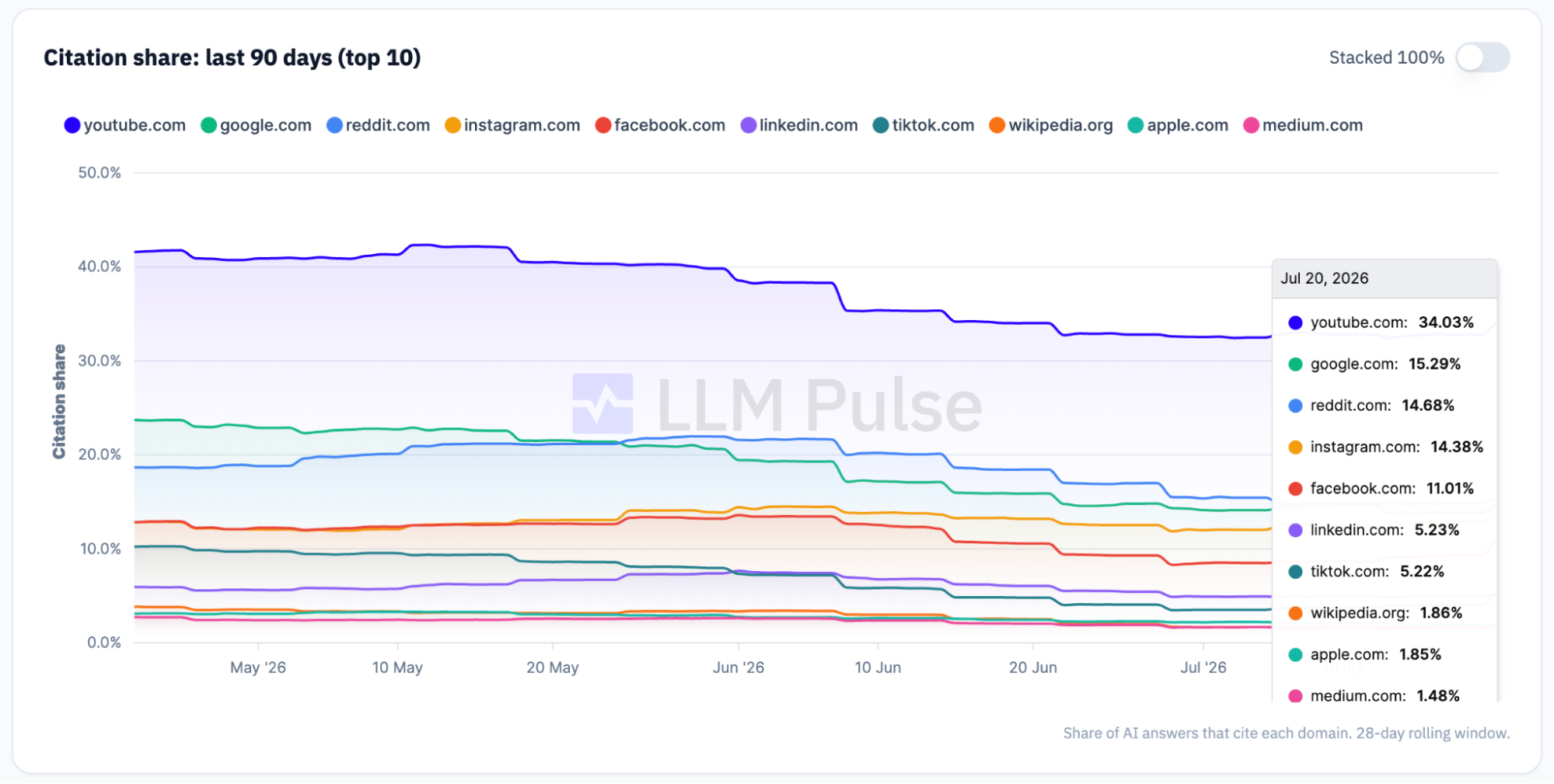
And per LLM Pulse's ongoing tracking of AI citation data, google.com itself is the second most-cited domain in AI Mode's answers, at a 15.29% citation share, behind only YouTube (34.03%). YouTube, worth noting, is also a Google property, which means two of AI Mode's three most-cited sources belong to Google.
Put those pieces together, and a pattern emerges. Google isn't simply intermediating between your products and your customers through search results anymore. It's building a loop where discovery, recommendation, and the first steps of a purchase all happen inside its own ecosystem, increasingly informed by its own data rather than a link out to your site.
The EU opens the door, with conditions
On the same day, the European Commission issued two binding decisions under the Digital Markets Act:
-
The first addresses Android: Google must open eleven core device features to rival AI assistants, so users can choose a different assistant, activate it by voice, and let it act inside other apps, by July 2027.
-
The second addresses Search: competing search engines, including AI chatbots with search features, must be able to receive anonymised data Google currently uses to improve its own search results, starting January 2027.
This isn't a fine. It's a technical compliance order, separate from the self-preferencing case over Google Shopping, Flights, and Hotels placement, which the Commission is still expected to rule on separately, reportedly in the hundreds of millions of euros, before its August recess.
Google objected the same day. In a statement from Kent Walker, the company's president of global affairs, Google argued the decisions risk exposing private search queries to unfamiliar companies without adequate anonymisation, and raised business-secret and security concerns on the Android side.
The Commission says its approach includes privacy and security safeguards developed with outside experts, and that the anonymisation method can be adjusted if evaluations show it needs to be. Google can appeal, but under DMA procedure, an appeal doesn't automatically pause the compliance deadline.
For merchants, the practical question isn't whether this order is implemented perfectly on schedule. Regulatory timelines slip constantly. It's what happens to product discovery if even a partial version of this plays out: multiple AI systems, not just Google, gaining meaningful access to the kind of search data that currently gives Google's own product recommendations their edge.
What This Means for Merchants Right Now
Despite the uncertainty around how and when the EU's order takes effect, the strategic direction for merchants is clear.
Treat your product data as your primary sales channel
When AI Mode can build a cart within Google's interface, your website becomes less important as a conversion tool and more important as a data source. The quality, completeness, and machine-readability of your product information determine whether AI systems recommend your products or your competitors'.
This means investing in:
-
Complete Merchant Center feeds with every available attribute filled accurately
-
Structured data markup on your site that goes beyond the minimum required fields
-
Machine-readable pricing and availability that doesn't require JavaScript rendering to access
-
Comprehensive product descriptions that give AI systems the context they need to make informed recommendations
Prepare for multi-platform AI discovery
The EU order signals that Google won't be the only AI system with access to rich product data indefinitely. Merchants who only optimise for Google's ecosystem will be at a disadvantage if ChatGPT, Claude, and others gain similar data access on the timeline the Commission has set out.
Start building a product data infrastructure that serves multiple platforms simultaneously. That means clean, standardised feeds that can be distributed to multiple channels, not bespoke optimisations for a single platform.
The strategic thread
The common thread connecting these developments is disintermediation followed by re-intermediation. Traditional search disintermediated local retail by sending shoppers to websites. Now, AI is disintermediating websites by completing more of a transaction within the AI interface itself.
But here's the counterweight: the EU order suggests that Google won't be the only intermediary, on paper at least. If multiple AI platforms gain meaningful access to product search data, merchants who invest in data excellence will be discoverable across all of them. The merchants who only optimise for one platform will be increasingly vulnerable to whichever way that platform's incentives shift.
The winners in this landscape won't be the ones with the biggest ad budgets. They'll be the ones with the cleanest data, the most complete product information, and the operational agility to serve whichever AI platform their customers choose to shop through.
On Tap's perspective
We've watched this pattern before. Search disintermediated local retail by routing shoppers to websites instead of storefronts. Now AI is disintermediating the website itself, completing more of the journey inside its own interface before a merchant's site ever loads. Each cycle rewards whoever controls the layer shoppers actually interact with.
What's different this time is that the EU order, however slowly it plays out, suggests Google may not get to be the only such layer. If that holds, the merchants who benefit won't be the ones who bet everything on optimising for one platform's algorithm. They'll be the ones whose product data is clean and complete enough to be legible to whichever system a shopper happens to be using, Google's, or somebody else's.
Need help turning this into a plan for your business? On Tap helps eCommerce merchants navigate exactly this kind of shifting market, from product data infrastructure and structured data markup to multi-platform AI discovery and technical readiness. Get in touch with our team to talk through where your product data stands before AI-mediated commerce moves any further.