
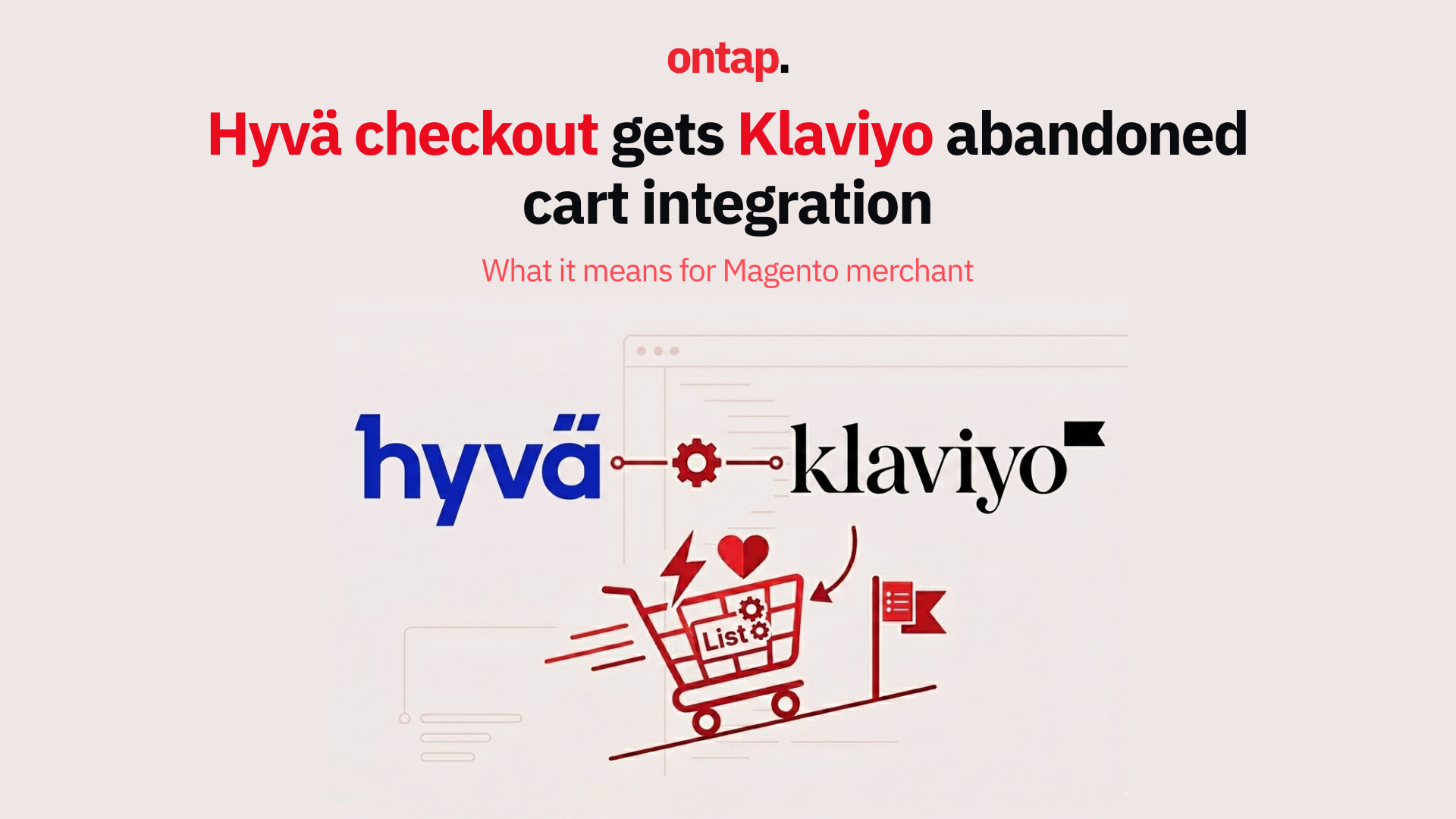
Hyvä has quietly shipped one of the most commercially significant modules in its checkout ecosystem: a first-party Klaviyo Reclaim integration for Hyvä Checkout. Released on 9 June 2026 as version 1.0.0, the magento2-hyva-checkout-klaviyo-reclaim module bridges what has been a persistent gap for merchants running Hyvä's lightweight checkout alongside Klaviyo's marketing automation platform.
Why does this matter more than a typical module release?
To understand why this is significant, you need to appreciate the tension that has existed between Hyvä's performance-first architecture and the third-party ecosystem that Magento merchants depend on.
Hyvä replaces Magento's legacy frontend, built on jQuery, KnockoutJS, and RequireJS, with a dramatically lighter stack based on Alpine.js and Tailwind CSS. The performance gains are substantial: Core Web Vitals scores that were previously unachievable on Magento become routine. But every time Hyvä strips out a legacy dependency, any extension that relied on that dependency breaks. This has been the central challenge of Hyvä adoption since its inception.
Checkout is where the stakes are highest. It is where revenue is won or lost, and it is where abandoned cart recovery, which Klaviyo's Reclaim product specialises in, operates. Without a working integration between Hyvä Checkout and Klaviyo, merchants faced an uncomfortable choice: accept the performance benefits of Hyvä but lose abandoned cart recovery revenue, or maintain a legacy checkout that works with Klaviyo but sacrifices performance.
This module eliminates that choice.
What the integration does
The Klaviyo Reclaim integration works by ensuring that Hyvä Checkout properly fires the events and passes the data that Klaviyo needs to identify abandoned carts and trigger recovery flows. In a standard Magento checkout, Klaviyo's JavaScript snippet hooks into the KnockoutJS-based checkout flow to capture email addresses as they are entered and track cart state changes. Since Hyvä Checkout does not use KnockoutJS, those hooks do not exist.
The new module re-implements this functionality natively within Hyvä's Alpine.js architecture. This means abandoned cart data flows to Klaviyo in real time as shoppers interact with the checkout, without any of the performance overhead of loading legacy JavaScript libraries. The module was contributed by Ryan Copeland of Foundation Commerce, as tracked on the Hyvä Checkout Integration Tracker.
For merchants, the practical impact is straightforward: you can now run Hyvä Checkout with full Klaviyo abandoned cart recovery working out of the box. According to Baymard Institute research, the average cart abandonment rate sits at 70.22%. Abandoned cart emails typically recover between 5% and 15% of otherwise lost revenue, and Klaviyo is one of the most widely used platforms for this in the Magento ecosystem. The commercial significance is clear.
The broader pattern: Hyvä's checkout ecosystem is maturing
This release is part of a broader pattern worth paying attention to. Hyvä has been systematically building out its checkout integrations, addressing the specific third-party services that merchants cannot operate without. Each integration follows the same philosophy: re-implement the required functionality natively rather than shimming legacy code.
Over the past fortnight alone, Hyvä has shipped 18 i18n locale packages to v1.4.0, the ElasticSuite 1.2.8 compatibility module for Magento 2.4.9, a MageWorx APO fix, and a ShipperHQ Checkout patch. Together with the Klaviyo Reclaim module, these releases signal that Hyvä is moving from a "great for greenfield projects" option to a genuinely viable migration path for existing Magento stores with complex extension stacks.
This is significant for the Magento community because one of the most common objections to Hyvä adoption has been the extension compatibility question: "We use X, Y, and Z extensions. Will they work?" With each first-party integration module, that list of potential blockers shrinks. The Hyvä public module tracker now covers hundreds of third-party extensions.
What should merchants do now?
Already on Hyvä Checkout? Add the magento2-hyva-checkout-klaviyo-reclaim module and verify your abandoned cart flows are working correctly. Test the full journey: enter an email in checkout, abandon the cart, and confirm that Klaviyo triggers the expected recovery sequence.
Evaluating Hyvä? Update your compatibility assessment. If Klaviyo was on your list of potential blockers, it is no longer one. Run through your complete extension list against the Hyvä compatibility modules and the community's compatibility tracker to see where you stand.
Running Klaviyo with legacy checkout? This is a good moment to quantify the performance gap. Run a Core Web Vitals audit on your current checkout and compare against Hyvä Checkout benchmarks. The combination of better performance (faster checkout loads, fewer JavaScript bottlenecks) and maintained Klaviyo functionality means you can improve conversion rates through speed without sacrificing recovery revenue.
Looking ahead
Hyvä's approach to ecosystem building, systematic, integration-by-integration, always native rather than shimmed, is paying dividends. For Magento merchants, the strategic question is shifting from "Can we use Hyvä?" to "When should we migrate to Hyvä?" The Klaviyo Reclaim integration is another data point suggesting that the answer is increasingly "now."
About On Tap
On Tap is a growth-focused eCommerce consultancy specialising in Magento and Hyvä implementations for international brands. From Hyvä migrations and extension compatibility audits to checkout optimisation and marketing automation integration, On Tap helps merchants unlock the performance benefits of modern frontend architecture without sacrificing the tools they depend on.
If you are considering a Hyvä migration or want to understand how it fits your specific extension stack, get in touch.