
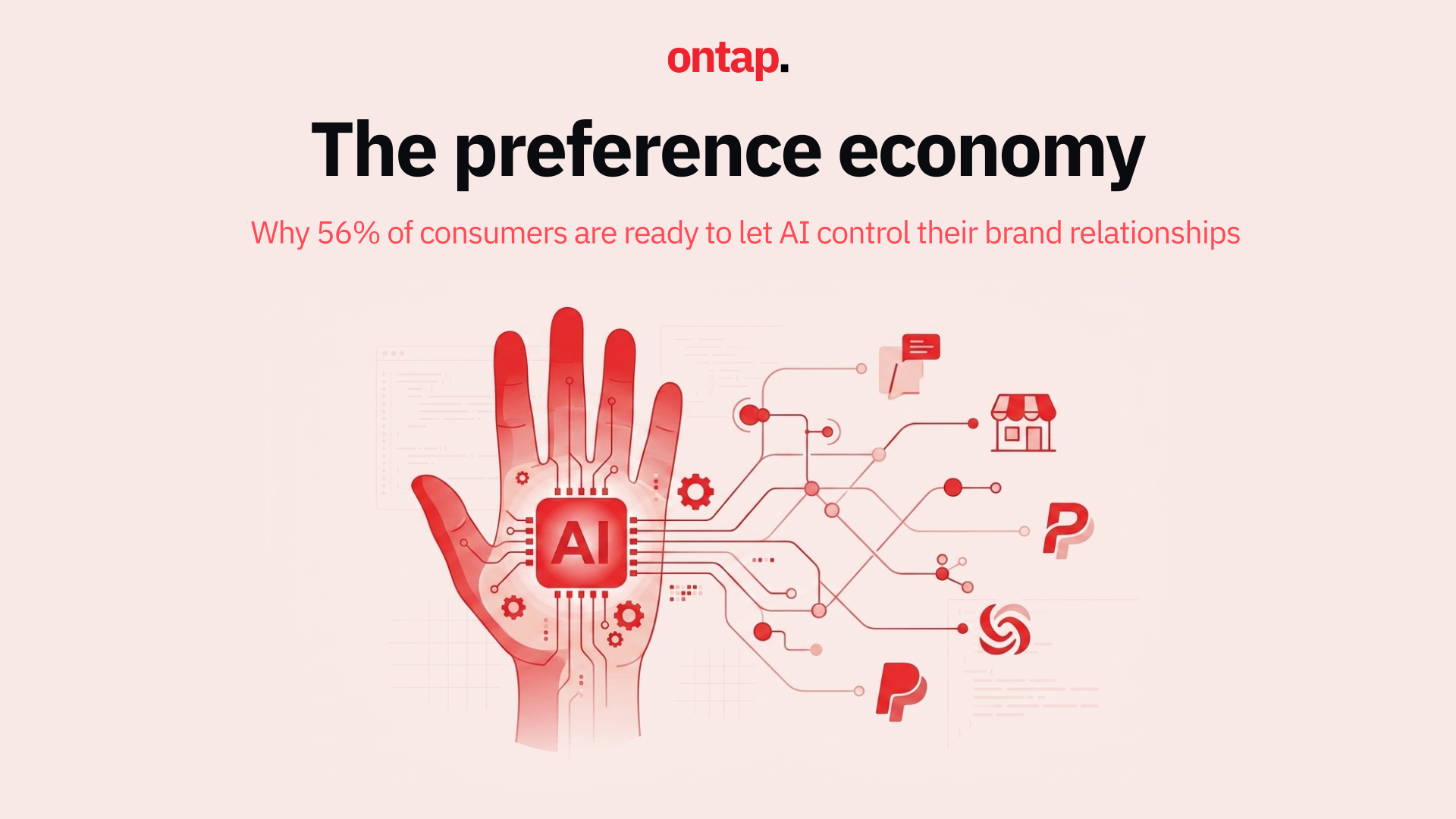
New research from the Gale agency has surfaced a statistic that should keep every eCommerce marketer awake tonight: 56% of consumers are now comfortable delegating the entirety of their brand communications through AI. Nearly one in three have already instructed an AI assistant to prioritise certain brands over others.
This is not a hypothetical future scenario. It is happening right now, and it fundamentally changes how brand loyalty works.
From loyalty programmes to "preference architectures"
Gale's report, titled "The Preference Economy: Earn True Loyalty or Get Filtered Out," surveyed 3,000 US and UK consumers and describes a world where a growing cohort of AI-savvy consumers architect their entire commercial reality through AI reliance. Instead of browsing your website, reading your emails, or scrolling through your social feed, they are telling ChatGPT, Gemini, or their preferred AI assistant what brands they like, and letting the AI handle the rest. According to Chain Store Age's coverage of the report, 24% of respondents plan to regularly set AI brand preferences within the next year, with another 21% following within a few years. Combined with a 30% "maybe" cohort, Gale estimates the realistic addressable market for AI-native loyalty will exceed 70% of consumers within three years.
As Gale CEO Andrew Noel told LBBOnline: "We're seeing a big shift in the loyalty landscape, and yet some brands continue to think of it as a one-off program rather than a holistic strategy."
Think about the investments most merchants have made: email nurture sequences, personalised on-site experiences, loyalty point systems, retargeting campaigns. All of these assume the consumer is directly engaging with your brand touchpoints. But if an AI intermediary is screening, summarising, and prioritising brand communications on the consumer's behalf, the consumer may never see your carefully crafted subject line or your dynamic homepage banner.
What this means for eCommerce merchants
Your brand needs to be "AI-legible"
The immediate practical implication is that your brand's digital footprint needs to be parsable and trustworthy to AI systems. Users are not prompting AI the way they use traditional search. They combine short queries with rich personal context: "I need a winter coat for my daughter, she is 8 and runs hot, nothing over £80, preferably sustainable brands."
AI systems answer these prompts by synthesising information from across the web: your product descriptions, your reviews, your structured data, your brand narrative on third-party sites. If that information is thin, inconsistent, or absent, the AI simply will not recommend it to you, regardless of how much you have spent on traditional advertising.
Structured data becomes a revenue driver
In a significant development for this thesis, Schema.org and Google announced on 4 June 2026 that they are now publishing aggregate adoption metrics for every schema type across millions of domains. As reported by Search Engine Land, merchants can now see exactly how widely Product, Offer, Review, and other structured data types are adopted in their category, providing a competitive benchmark for the first time.
This matters because it gives you a structural visibility signal. The initial dataset reveals that 12 schema types, including Organisation, WebPage, and BreadcrumbList, are deployed on over 10 million domains, while Product, Review, and Article sit in the 1 million to 10 million range. If your competitors have implemented rich product schema, including pricing, availability, aggregate ratings, shipping details, and return policies, and you have not, you are at a measurable disadvantage in AI-mediated discovery.
This is no longer just an SEO best practice. It is becoming a prerequisite for brand visibility in the preference economy.
First-party data is your moat
The Gale research highlights that roughly a quarter of respondents plan to regularly set brand preferences with AI within the next year. The brands that win in this environment will be the ones that give consumers a compelling reason to explicitly name them as a preferred brand in their AI configuration.
That means your first-party data strategy, the depth of your relationship with each customer, becomes your most defensible asset. A customer who has told their AI assistant "always check [your brand] first" has given you something no competitor can easily displace.
Building that level of preference requires genuine value delivery: exclusive content, genuinely useful communications, consistent quality, and a brand identity strong enough that customers actively want to include you in their AI preferences rather than letting the AI's own algorithms decide.
The timing is significant
This research lands at a moment when several other forces are converging. Google's zero-click searches have reached 68%, meaning traditional organic traffic is declining. A German court has ruled that Google can be directly liable for false claims made in AI Overviews, which may make AI systems more cautious about brand recommendations they cannot fully verify. And publishers are pushing Common Crawl to stop collecting content for AI training, which could reduce the data pool AI systems draw on for product recommendations.
For eCommerce merchants, the strategic response is threefold:
-
Invest in brand authority signals. Expert content, verified reviews, press coverage, and consistent structured data that AI systems can parse with confidence.
-
Audit your AI visibility. Search for your brand and products in ChatGPT, Gemini, and Perplexity. See what they say. Identify gaps.
-
Double down on direct relationships. Email subscribers, community members, repeat purchasers. These are the people most likely to explicitly set you as a preferred brand in their AI tools.
The bigger picture
The shift from search-mediated to AI-mediated discovery has been accelerating throughout 2026. What makes the Gale research particularly significant is the speed of consumer adoption. We are not talking about early adopters anymore. We are talking about a majority of consumers being ready to hand over their brand relationships to an AI intermediary.
The merchants who will thrive are the ones who stop thinking about AI as a channel to optimise and start thinking about it as an ecosystem to participate in. Your products, your content, your reputation: all of it needs to work for machines as much as for humans. That is not a future state. That is today.
The preference economy is here. The question is whether your brand is positioned to be preferred.
About On Tap
On Tap is a growth-focused eCommerce consultancy helping mid-market and enterprise merchants build brands that are visible, trustworthy, and discoverable in AI-mediated commerce. From structured data implementation and product feed optimisation to brand authority strategy and first-party data activation, On Tap works across the full eCommerce stack to help merchants earn preference, not just traffic.
If you want to understand how your brand appears in AI recommendation systems and what to do about it, get in touch.