
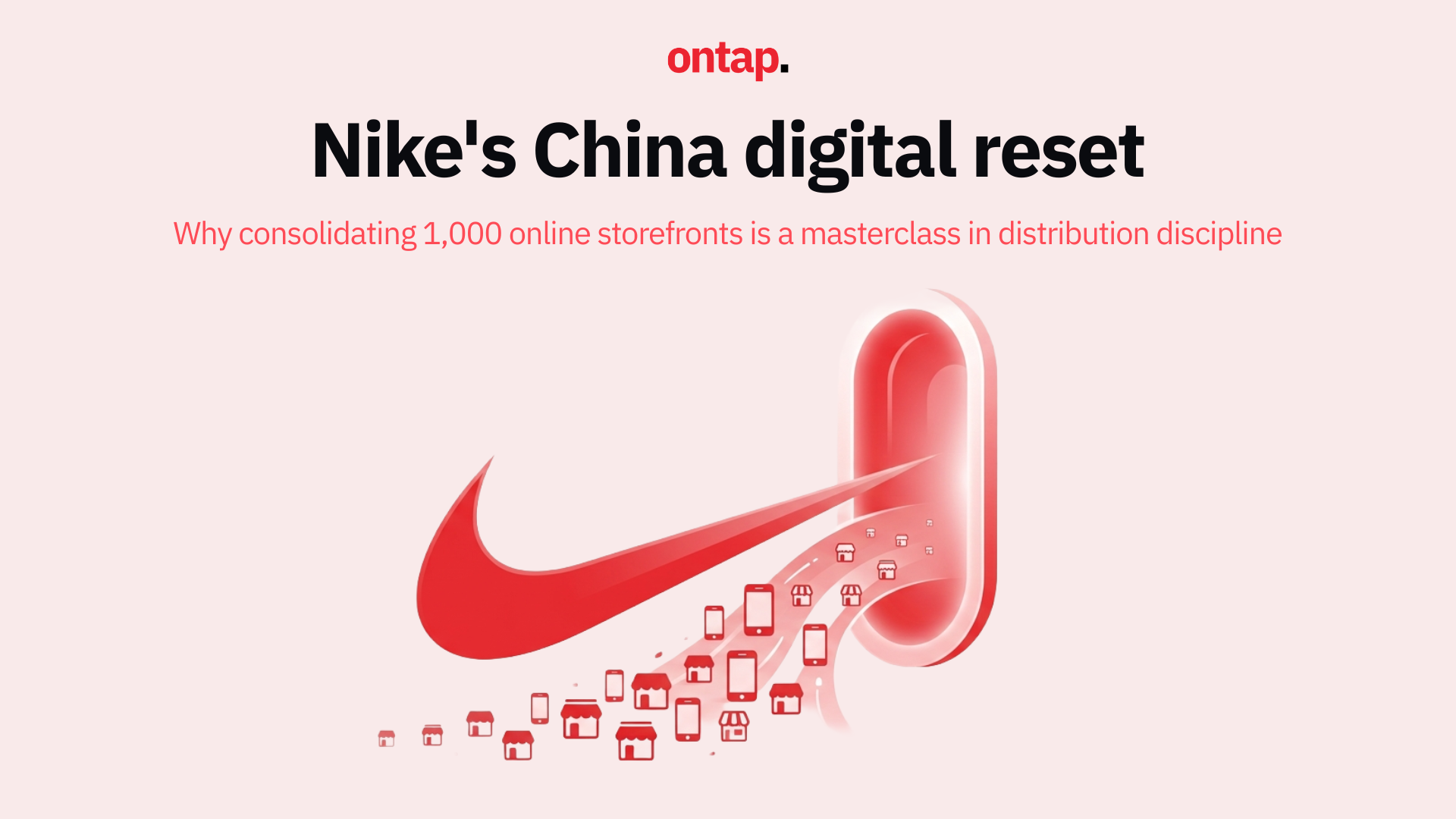
Nike announced on Tuesday that it is consolidating more than 1,000 digital storefronts across China's marketplace platforms down to a handful of official channels. By January 2027, the brand's online presence in China will rest within the Nike app, Nike.com.cn, and flagship experiences on Tmall, JD.com, and Douyin. Everything else closes.
This is not just a Nike story. It is a blueprint for every eCommerce brand that has let digital distribution sprawl beyond control.
The problem Nike is solving
Greater China revenue has now declined for eight consecutive quarters. In the most recent fiscal quarter ending 31 May 2026, as reported by Quartz, Greater China revenue fell 17% on a constant-currency basis to $1.3 billion, a steeper slide than the 10% decline in the prior period. The region accounts for roughly 15% of Nike's total annual sales.
Cathy Sparks, Nike's new Vice President and General Manager of Greater China, a 25-year Nike veteran who took charge of the region earlier this year, delivered her diagnosis in a letter published on Tuesday: the marketplace has "become too fragmented."
Currently, 16 Nike partners operate digital storefronts across China's platforms. Many use Nike stores to fulfil online orders, and a network of secondary distributors extends the footprint further. The result: over 1,000 digital touchpoints where Nike products appear, each with potentially different pricing, product presentation, storytelling, and customer experience.
As Sparks told Reuters: "Our marketplace has become so fragmented and cluttered. What consumers want is an experience that's premium, true to the brand, trustworthy, and certainly connected between digital and physical."
The market reaction was immediate. As Inside Retail Asia reported, shares in Topsports International, Nike's largest distributor in China, fell as much as 26% on Wednesday to a record low, closing down roughly 24%. Shares in Pou Sheng, another major distributor, also fell sharply. Distributors have five months to unwind Nike inventory from their online storefronts.
Why this matters for every eCommerce brand
Nike's problem exists at every scale. Whether you are a global brand with marketplace sprawl or a mid-market merchant selling across Amazon, your own site, and two or three other channels, the fundamental challenge is identical: every additional touchpoint you do not directly control dilutes your brand, complicates your operations, and creates opportunities for inconsistency.
-
Brand consistency: When consumers encounter different pricing, different imagery, or different product descriptions across channels, it erodes trust. In a market where counterfeiting is already a concern, fragmented distribution amplifies doubt.
-
Data consolidation: A thousand separate storefronts means a thousand separate data streams about customer behaviour. Consolidating into a few official channels gives Nike a unified view of its Chinese customer.
-
Pricing discipline: Fragmented distribution inevitably leads to pricing inconsistency. Different partners discount at different times, creating a race to the bottom. As Sparks told Reuters, the intent is to "rebuild trust with Chinese shoppers and sell products at full price."
-
Fulfilment quality: When multiple partners fulfil from different inventory pools, service levels vary. Shipping speed, packaging quality, and return handling become unpredictable, and the customer blames Nike, not the third-party partner.
Alongside the channel consolidation, Nike announced its first-ever Greater China Vice President of Local Product Creation, as CNBC reported, focused on products "designed, developed and made in China for Chinese consumers." The reset is not just about fewer channels. It is about making the remaining channels genuinely local and genuinely premium.
Practical lessons for mid-market eCommerce
You do not need to be operating 1,000 storefronts for Nike's lesson to apply.
Audit every channel touchpoint
Map every place your products appear online: your own site, Amazon, eBay, social shops, marketplace listings, reseller pages. For each one, evaluate: is the product information accurate? Is the pricing consistent? Is the brand experience on-brand? If you cannot answer "yes" to all three, that channel is actively hurting you.
Measure revenue per channel against brand cost
Revenue contribution is the easy metric. The harder question is: what does each channel cost you in brand dilution, customer data loss, and pricing pressure? A channel that generates £50K in annual revenue but trains customers to expect 30% discounts and gives you zero customer data may be net negative.
Consolidate to channels you can control
Nike is keeping its own properties (app, website) and flagship presences on the platforms that matter most (Tmall, JD.com, Douyin). The principle is clear: be present where your customers actually shop, but maintain control over how you appear. Remove the rest.
Invest in the channels you keep
Consolidation is not just subtraction. It is concentration. The resources you were spreading across a dozen channels can now be focused on making three or four channels exceptional. Better content, better customer service, better data collection, better personalisation.
The bigger picture
Nike's China distribution reset is one of the most significant eCommerce strategy moves of the year, not because of its scale, but because of its clarity. The company is choosing to have fewer touchpoints with better quality over maximum coverage with inconsistent quality.
For every eCommerce merchant reading this, the question is simple: how many of your channels are genuinely serving your brand and your customers, and how many are you maintaining out of inertia? Nike's answer- to cut over 90% of them- is extreme. But the direction is right.
Fewer channels, owned properly, will beat many channels managed poorly. Every time.
About On Tap
On Tap is a growth-focused eCommerce consultancy helping mid-market and enterprise merchants build focused distribution strategies that prioritise quality over sprawl. From channel audits and marketplace rationalisation to brand consistency assessments and product data architecture, On Tap helps merchants concentrate their resources where they drive the most value.
If you want to audit your channel strategy and build a focused distribution plan, get in touch.