
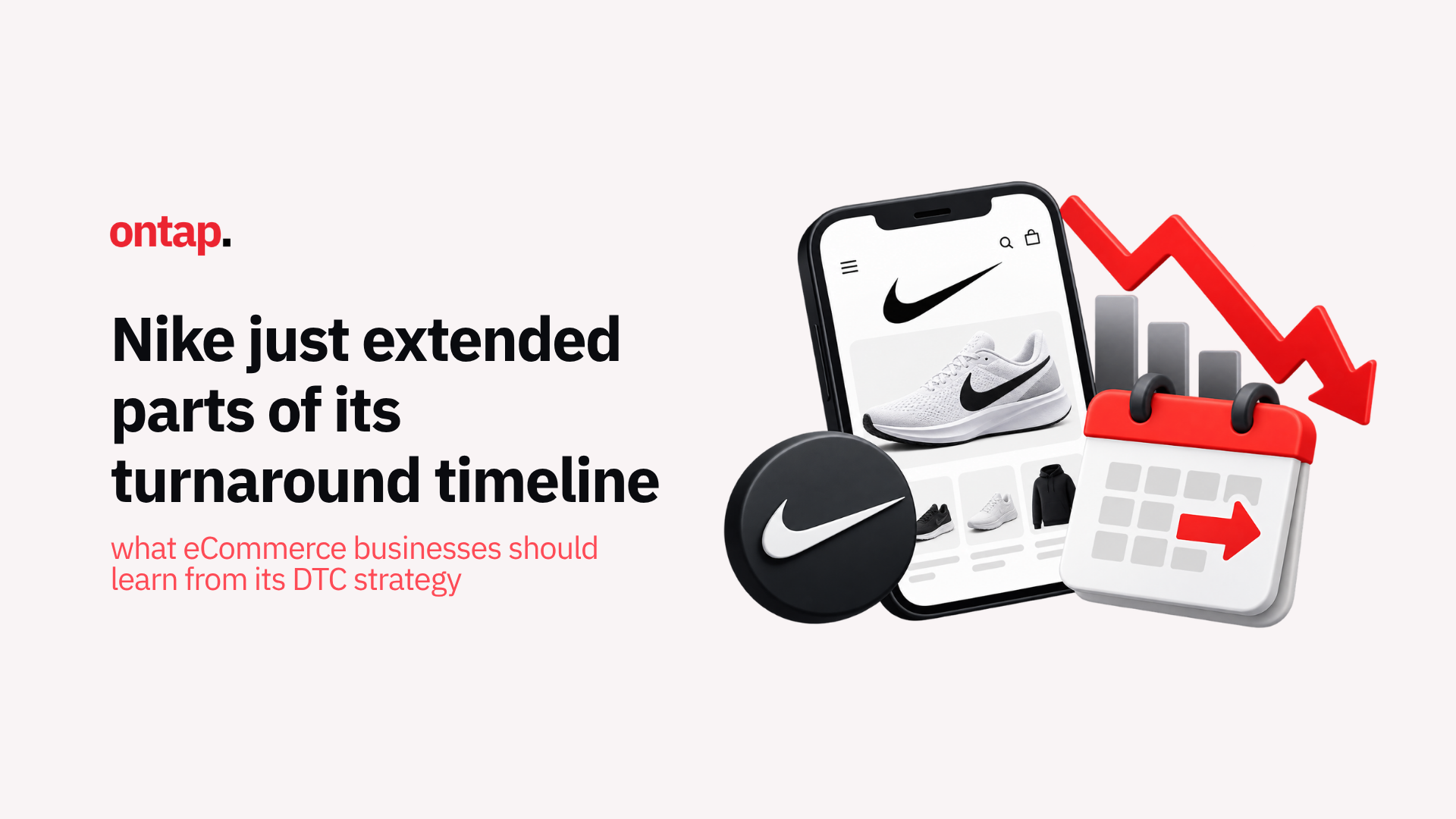
Nike announced another operational reset this week, introducing its new Pace operating model, signalling fewer roles over time and acknowledging “significant work ahead”. Its latest filing also says additional actions around Nike Sportswear and Jordan Brand are expected to extend beyond fiscal 2027.
The company once hailed as a case study in bold digital-first strategy has become a cautionary example of what happens when a brand puts too much weight on channel control without balancing distribution with customer value.
For eCommerce merchants and digital commerce leaders, Nike’s ongoing difficulties are more than corporate drama; they offer a useful case study in the specific ways a direct-to-consumer pivot can create problems when the execution prioritises channel economics over how customers actually discover and buy.
What actually happened at Nike
The narrative everyone knows is simple: Nike pulled back from parts of wholesale distribution to sell more through its own channels. The reality is more instructive.
Nike’s Consumer Direct Acceleration strategy, launched in 2020, was built around leading with Nike Digital and its own stores while continuing to work with selected strategic partners. The goal was to create a more premium, consistent, and seamless customer experience while strengthening Nike’s direct consumer relationships.
The thesis made sense on a spreadsheet. More direct sales could give Nike greater control over the customer experience, support its digital capabilities, and improve channel economics.
The strategy risked underestimating what happened to customers who relied on wholesale partners for discovery. Nike.com is excellent at serving customers who already know what they want. It is significantly less effective at replacing the browsing, trying-on, and discovery experience that retail partners provide, particularly for casual buyers who are not already Nike loyalists.
The numbers tell part of the story. In Q4 FY2026, Nike Direct revenue fell 7%, Nike Brand Digital fell 12%, while wholesale revenue grew 4% on a reported basis.
The latest quarter shows a more mixed picture, but the pressure on direct channels remains. In Q1 FY2027, Nike Direct fell 8% and Nike Brand Digital fell 13%, while global wholesale declined 1%. In North America, wholesale grew 9% while Nike Direct fell 6%
The company that spent years putting more weight on direct channels is now explicitly reinvesting in wholesale distribution as part of its marketplace strategy.
The three mistakes eCommerce leaders should learn from
-
Confusing channel control with customer value.
Nike’s DTC strategy gave the company more control over the customer relationship and channel economics. But greater control does not automatically mean greater customer value.
When you reduce wholesale channels, you are not just changing where customers buy, you can also change the context in which they discover, compare and experience the product. Nike assumed more customers would follow the brand towards its direct channels. The risk was that customers who still preferred wholesale environments had plenty of other options.
This is the same mistake eCommerce merchants can make when they optimise for channel economics at the expense of customer convenience. The channel that maximises your margin and the channel your customer prefers are not always the same channel.
-
Underestimating the cost of replacing wholesale distribution with digital acquisition.
Any demand you no longer reach through wholesale has to be generated somewhere else.
Wholesale distribution is not free; retailers take margin and come with their own commercial costs. But they also provide reach, discovery, and existing customer traffic that a DTC business may otherwise need to recreate through marketing and its own channels.
That tension is visible in Nike’s latest results. In Q1 FY2027, demand creation expense increased 5% while Nike Brand Digital declined 13%. That does not prove Nike’s digital customer acquisition cost increased, because demand creation also includes broader brand and sports marketing, but it shows why channel margin alone gives an incomplete picture.
For eCommerce merchants, this is a direct parallel to the marketplace-versus-DTC question. Amazon, TikTok Shop, and wholesale channels all take a margin cut, but they also provide distribution and discovery you would otherwise need to build or pay for. The total cost of customer acquisition matters more than the per-unit margin.
-
Moving too fast without feedback loops.
Nike reduced its reliance on parts of wholesale distribution before the long-term marketplace balance was clear. Now, rebuilding wholesale distribution is part of the recovery.
By the time the data shows that a channel shift has gone too far, reversing it can take time. Retail relationships need to be rebuilt, distribution needs to expand again and customer shopping habits may already have changed.
eCommerce merchants face the same risk with any channel strategy change. Whether you are pulling products from Amazon, exiting a marketplace or consolidating your distribution, the downside of moving too fast is asymmetric; it is often much easier to reduce a channel than to rebuild it.
What this means for eCommerce merchants right now
Nike’s experience reveals four principles that apply to any eCommerce business making channel strategy decisions.
-
Distribution is not just a cost; it’s a discovery mechanism. Every channel your products appear in is also a place customers can find you. Before you exit a channel to protect margins, model the discovery value you are losing, not just the margin you are gaining.
-
Digital-first doesn’t mean digital-only. Nike’s mistake was not going digital. Its original strategy still included selected strategic partners. The lesson is what happens when too much weight shifts towards direct channels without maintaining the right marketplace balance.
-
Channel transitions require overlap, not switches. If you are shifting from marketplace to DTC, from wholesale to direct or from one platform to another, run both channels long enough to understand whether the new channel is actually capturing the demand. The cost of temporary overlap can be far lower than the cost of rebuilding lost distribution.
-
Turnaround timelines can extend. Nike’s fiscal 2026 annual report said it expected to complete a set of product, marketplace and brand-management actions by the end of December 2026.
Nike’s new Pace programme adds another multi-year layer to that work. The programme covers supply-chain modernisation, geographic restructuring and workforce changes, and Nike expects it to deliver approximately US$2.5 billion in cumulative savings through fiscal 2031.
Once a channel strategy problem compounds through distribution changes, product decisions and organisational restructuring, recovery can take longer than originally expected.
The peak season connection
Nike’s Q1 FY2027 results, released on 1 October, are its latest test before the holiday season.
The results remain mixed. Nike Direct declined 8% and Nike Brand Digital fell 13%. Wholesale declined 1% globally, although North American wholesale grew 9% while Nike Direct fell 6%.
That does not prove that Nike’s DTC bet destroyed more value than it captured. Product mix, Greater China, discounting, inventory and broader competitive pressure are also affecting performance.
But it does reinforce the original lesson: major channel decisions need evidence, not assumptions.
For eCommerce merchants heading into peak season, the lesson is immediate: do not make major channel changes during your highest-volume period unless there is a clear operational reason to do so.
Lock your channel strategy, run it through peak season with full instrumentation and use the resulting data to make informed changes afterwards. Nike’s turnaround problems are the compound effect of decisions made years earlier across marketplace, product and distribution. You have the opportunity to measure first.
The uncomfortable truth
Nike generated US$46.4 billion in revenue in fiscal 2026 and remains one of the strongest brands in global sportswear.
Even at that scale, Nike could not assume customers would simply change where they shop because the company wanted more business to move through direct channels.
If a brand with Nike’s reach and recognition still needs the right mix of direct and wholesale distribution, no eCommerce merchant should assume customers will automatically follow them wherever they choose to sell.
The merchants who win peak season, and the year after, will be the ones who meet customers where they already are, while understanding the economics of every channel they use.
Nike is spending years rebalancing that equation. Other eCommerce businesses can learn from it before making the same trade-offs at their own scale.
About On Tap
On Tap is a growth-focused eCommerce consultancy helping mid-market and enterprise merchants improve their digital commerce operations. From channel strategy and marketplace integration to storefront performance, analytics and customer experience, we help businesses make commerce decisions based on how customers actually discover and buy.
To review your eCommerce channel strategy and identify where distribution, acquisition and customer experience can work better together, get in touch.