
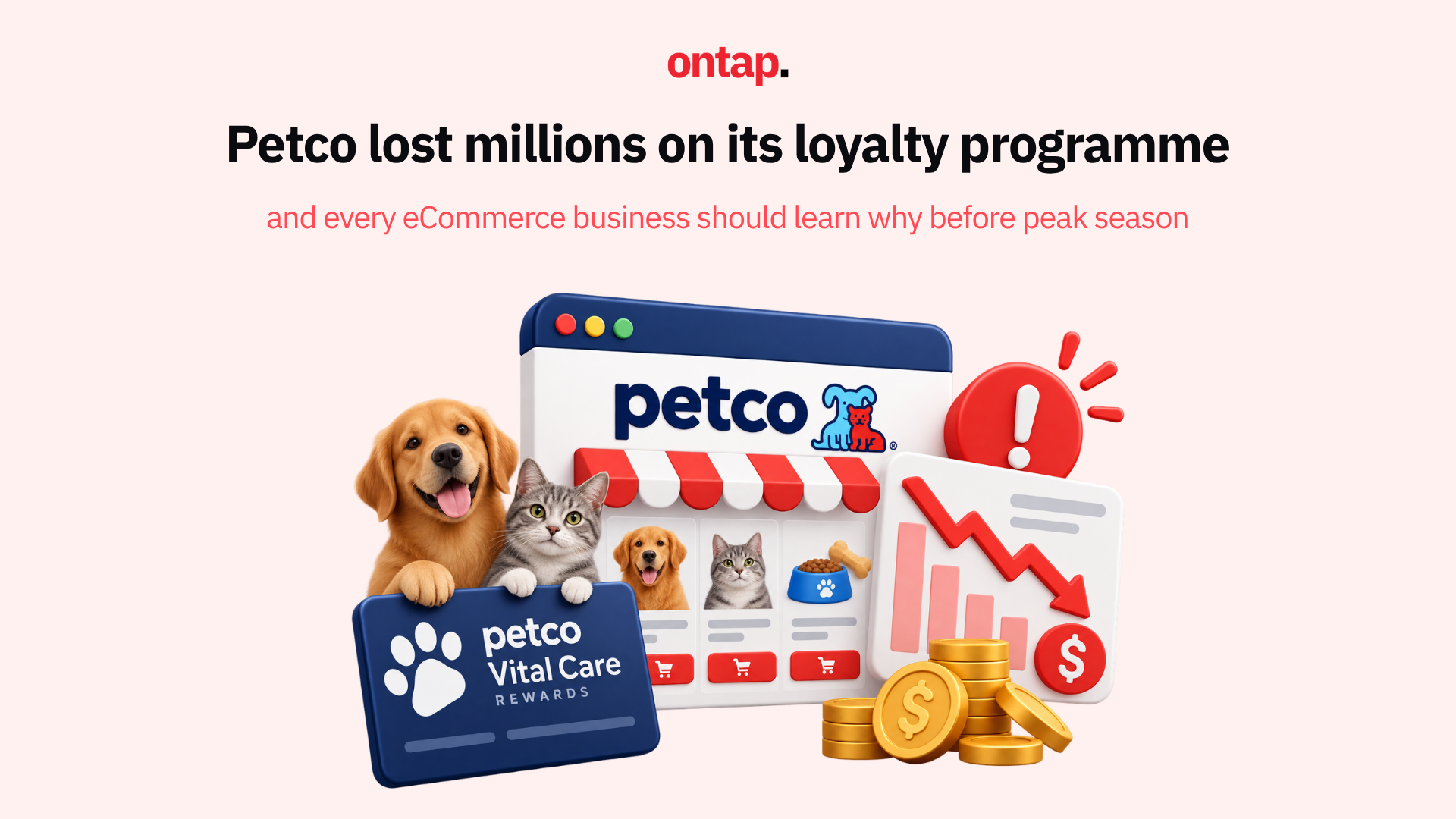
When Petco's CEO Joel Anderson told analysts on the Q2 2026 earnings call that "customer point redemption volumes far exceeded our initial projections," he was describing one of the most expensive loyalty programme mistakes a retailer can make: designing a programme that customers actually love, without properly modelling what that looks like at scale.
As Retail Dive reported on 4 September, the newly relaunched Petco Perks programme cost the company "mid-single-digit millions" in Q2 2026. Net sales were essentially flat year over year, when they had been tracking ahead of the 0.3% growth target before the programme launched. Petco "acted swiftly to deploy post-launch guardrails on redemption velocity," and management said they believe the peak of redemptions has passed.
Six weeks before peak season, with loyalty programmes central to Q4 retention strategies across eCommerce, the Petco story deserves careful attention.
What went wrong
Petco relaunched Petco Perks in late June 2026 with a simplified structure: members earn 10 points for every dollar spent on most products, and 30 points per dollar spent on private-label brands. Every 1,000 points redeems for a $1 discount.
That structure sounds reasonable in isolation. Ten cents back on every dollar, or 30 cents on private label, are not unusual loyalty rates. The problem was the combination of a simpler redemption process, a customer base that had been building loyalty equity for years, and an effective redemption rate that apparently exceeded what Petco's financial models had projected.
The Robin Report's commentary drew the comparison to Pepsi's infamous 1996 Harrier jet promotion: a programme that was designed to drive engagement but was not stress-tested against customers who would rationally optimise their behaviour within its rules. When customers do exactly what your programme incentivises them to do, and the financial outcome surprises you, the problem is not customer behaviour. It is the programme design.
The loyalty programme design problem most merchants ignore
Most eCommerce loyalty programmes are designed around an optimistic user: a customer who earns points slowly, redeems occasionally, and primarily provides the merchant with repeat purchase data and incremental sales.
But loyalty programmes have a distribution of behaviours. A small percentage of customers, sometimes called "super-redeemers" or programme optimisers, will earn and redeem at rates the programme designers never explicitly planned for. When those customers exist in sufficient numbers, they can alter the financial profile of an entire programme.
The three questions that should precede any loyalty programme launch or relaunch:
What is the worst-case redemption scenario?
Model the financial impact if 30%, 40%, or 50% of earned points are redeemed in the first quarter. Does the programme still make economic sense at those redemption rates? If not, either the earn rate, the redemption rate, or the eligibility criteria need adjustment.
What happens during peak trading periods?
Q4 is when customers make their largest purchases of the year. Redemption-heavy programmes may face the highest redemption pressure at exactly the moment when margin pressure is already highest. Has the programme been modelled against peak season transaction patterns?
What are the guardrails?
Petco had to deploy "post-launch guardrails on redemption velocity" after the problem emerged. Those guardrails should be designed before launch, not retrofitted in response to financial damage. What is your maximum redemption velocity per customer? Is there a ceiling on points that can be redeemed per transaction? How does the programme handle large redemptions combined with already-discounted products?
The peak season timing problem
The specific danger for eCommerce businesses heading into Q4 is that loyalty programmes launched or relaunched in the months before peak season carry an amplified version of the Petco risk. Customers will accumulate points during the relatively lower-spend summer months and redeem them at scale during the higher-spend Q4 period. If your programme economics were stress-tested only against average monthly transaction patterns, your peak season actuals may look very different from your projections.
This matters most for businesses that have:
-
Recently relaunched or redesigned a loyalty programme
-
Significantly increased their active member base in 2026
-
Simplified their redemption process (making it easier to redeem typically increases redemption rates)
-
Added high-earn-rate categories (private label, subscription, or bundled purchases)
What eCommerce merchants should do before peak season
-
Run the redemption stress test: Pull your current active member count, their average earned point balance, and your average redemption rate. Model what happens if redemption rates double or triple during Q4. Does the programme remain profitable?
-
Review your guardrails: Does your programme have limits on per-transaction redemption? On redemption combined with other discounts? On the percentage of order value that can be covered by loyalty redemption? If not, add them before peak season.
-
Audit your earn rate on promotional SKUs: If customers can earn full loyalty points on already-discounted promotional products, the effective cost per redeemed point increases substantially. Consider whether promotional products should have modified earn rates.
-
Segment your super-redeemers: Identify the customers who consistently maximise loyalty benefit. Understand their purchase patterns. They are likely your most engaged customers, which makes them valuable. But they are also most likely to redeem heavily during peak season.
-
Communicate changes proactively: If you do need to implement guardrails or adjust programme mechanics, communicate transparently before peak season, not in the middle of it. Trust damage from unexpected programme changes during the gift-buying season is harder to repair than the financial cost of the original programme design.
The bigger picture
Petco's loyalty programme story is not a story about customers behaving badly. It is a story about the gap between programme design intent and financial modelling rigour. The programme worked as designed. Customers earned and redeemed points. The financial outcome was unexpected because the modelling was insufficient.
With six weeks until peak season, there is still time to stress-test your loyalty mechanics. The merchants who do this work now will enter Q4 with programmes they understand, rather than discovering the limits of their financial modelling when it is too late to adjust.
About On Tap
On Tap is a growth-focused eCommerce consultancy helping mid-market and enterprise merchants build loyalty strategies that drive sustainable revenue growth. From programme financial modelling and redemption mechanics design to peak season readiness and retention strategy, On Tap helps merchants ensure their most engaged customers are also their most profitable.
If you want to stress-test your loyalty programme before peak season, get in touch.