
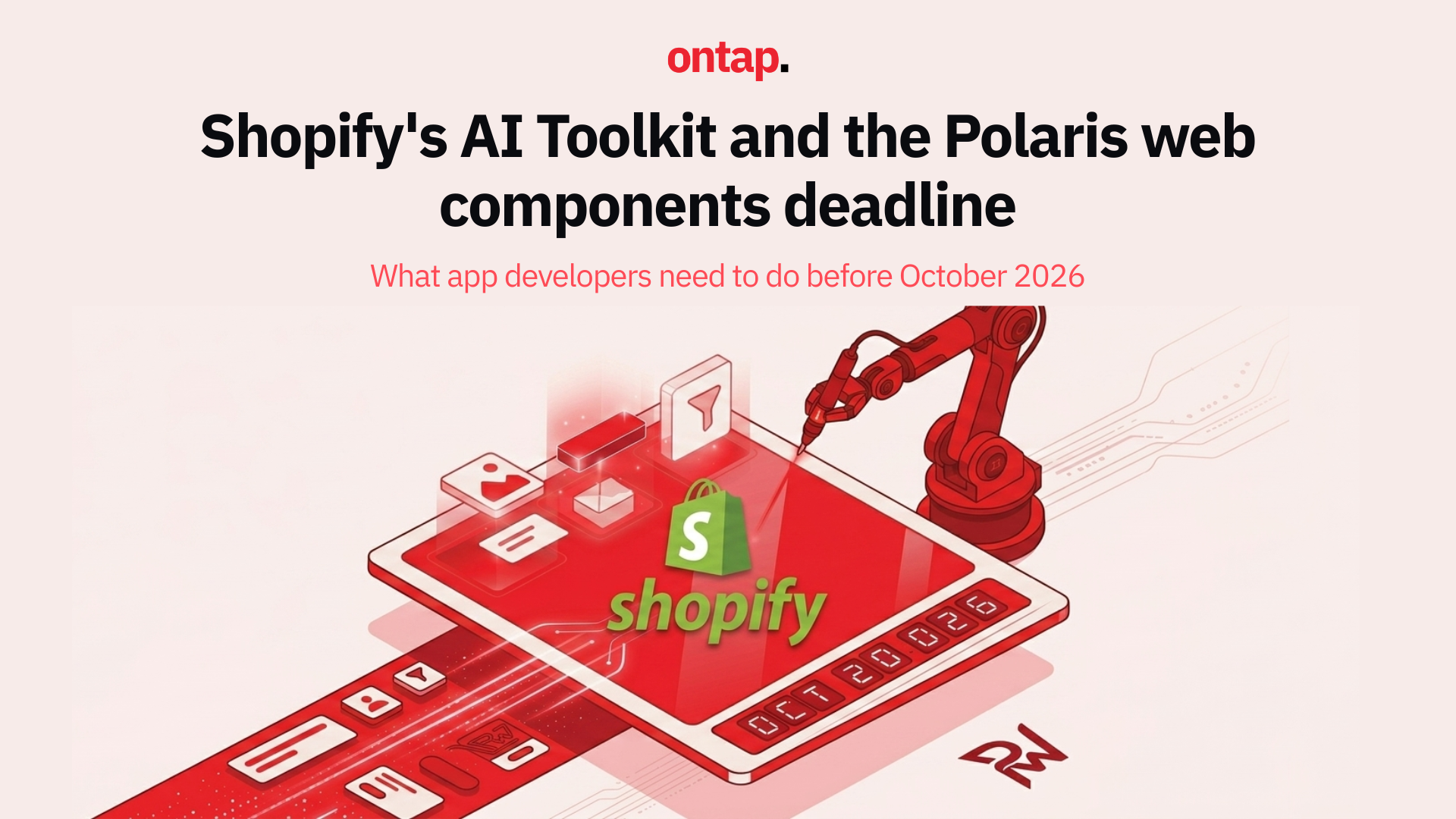
Shopify dropped a significant developer changelog update on 11 June that combines two trends reshaping the platform: AI-assisted development tooling and a hard migration deadline that will affect every app with checkout or customer account UI extensions. If you are a Shopify merchant relying on third-party apps at checkout, or a developer maintaining those apps, this demands your attention.
What changed
The Shopify AI Toolkit now supports upgrading checkout and customer account UI extensions to the latest API versions, including the migration from legacy React extensions to Polaris web components. The toolkit works with popular AI coding agents to automate the heavy lifting: handling React to Preact conversion, mapping and replacing legacy components with their Polaris web component equivalents, and updating extension APIs.
But the real story is not the tooling. It is the deadline attached to it.
The 1 October 2026 deadline
Starting 1 October 2026, Shopify CLI will block app updates if any of an app's extensions are running on API versions 2025-07 or earlier. That is not a soft deprecation or a gentle nudge. If your app contains checkout or customer account UI extensions on those older versions, you simply will not be able to push updates.
As the Shopify developer changelog states plainly: "Extensions built with Polaris web components render significantly faster than legacy React extensions, ensuring optimal loading time and extension performance." All API versions from 2025-10 onward use Polaris web components by default, so the migration path is clear: upgrade to the latest API version, adopt Polaris web components, and do it well before the deadline.
The architectural shift behind this deadline is substantial. As Gadget's analysis of the 2025-10 API release explains, Polaris has moved from versioned React npm packages to framework-agnostic web components served from Shopify's CDN. Extensions now use Preact instead of React, with a new 64 KB bundle size limit that effectively makes React incompatible with the latest API versions.
Why this matters for merchants
If you're a merchant, you might think this is purely a developer concern. It isn't. Here's why:
-
App reliability is at stake. After 1 October, apps that have not migrated will not receive updates. That means no bug fixes, no security patches, and no new features. If your checkout relies on a third-party app that falls behind, you are exposed.
-
Performance improvements are real. Extensions built with Polaris web components render significantly faster than legacy React extensions. At checkout, where every millisecond of loading time correlates with conversion rates, this is not a minor technical detail. Faster extension rendering means faster checkout, which means more completed purchases.
-
This signals Shopify's platform direction. The move to Polaris web components is part of Shopify's broader architectural shift towards web-native standards and away from framework-specific implementations. As Shopify's partners blog describes it, the new Polaris is "a unified UI toolkit that works seamlessly across all Shopify surfaces, including Admin, Checkout, and Customer Accounts." Extensions that render as web components are lighter, more portable, and more performant than their React predecessors.
The AI Toolkit angle
What makes this migration different from previous platform shifts is the tooling Shopify is providing. Rather than leaving developers to manually rewrite extensions, the AI Toolkit pairs with AI coding agents to handle the repetitive mechanical work of migration.
The migration documentation recommends a straightforward approach: install the Shopify AI Toolkit and prompt your preferred coding agent with something like "Use the Shopify Polaris checkout extensions skill to migrate the extensions/$extensionFolder extension to version 2026-04." The agent handles React to Preact conversion, component mapping, and API updates in a supervised workflow.
For agencies and development teams managing multiple Shopify apps, this could compress what would have been weeks of migration work into days. That is particularly relevant given the four-month window before the deadline.
What you should do now
If you are a merchant:
-
Audit your checkout apps. Ask your development team or agency to identify which apps have checkout or customer account UI extensions and what API versions they are running on.
-
Contact app vendors. If you use third-party apps at checkout, reach out to the vendors now and ask about their Polaris migration timeline. Any vendor that has not started planning is a red flag.
-
Test early. Once updated versions are available, test them in your development environment before October. Migration-related bugs are easier to catch early than to fix under deadline pressure.
If you are a developer:
-
Install the Shopify AI Toolkit and set up the migration workflow with your preferred AI coding agent.
-
Start with your highest-traffic extensions. Prioritise the extensions that handle the most critical checkout interactions.
-
Do not wait until September. Four months sounds like plenty of time until you factor in testing, QA, and the reality that every other developer will be racing towards the same deadline.
-
Read the migration docs. Shopify has published specific guides for both checkout UI extension migration and customer account UI extension migration. The docs are detailed, and the AI Toolkit is designed to work alongside them.
The bigger picture
This update sits at the intersection of two forces reshaping Shopify development. First, the platform is getting more opinionated about performance: web components over React, faster rendering as a requirement rather than an aspiration. Second, AI tooling is becoming the expected way to handle platform migrations, not a novelty.
The merchants and developers who treat this as a Q3 priority rather than a September emergency will be the ones who capture the performance gains without the migration headaches. Given that Q4 is the busiest retail season of the year, having your checkout stack fully migrated and stable before the holiday rush is not just good practice. It is a competitive advantage.
About On Tap
On Tap is a growth-focused eCommerce consultancy helping mid-market and enterprise merchants navigate platform migrations, checkout optimisation, and technical readiness across Shopify and Magento. From extension audits and API migration planning to performance testing and Q4 readiness, On Tap helps merchants ensure their technology stack supports their busiest selling periods.
If you need help assessing your Shopify checkout app readiness before the October deadline, get in touch.