
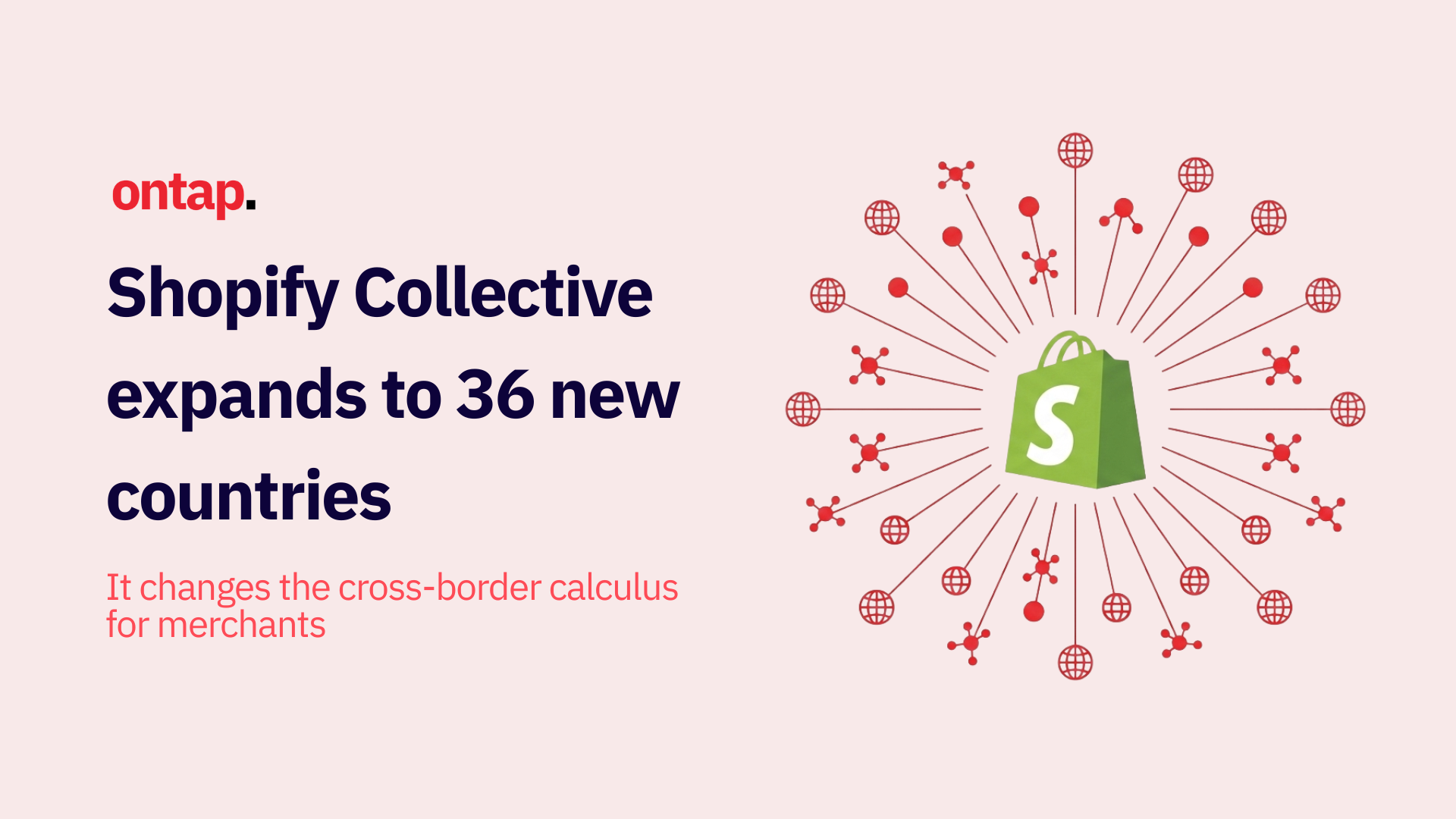
On 31 July 2026, Shopify announced that Collective, its retailer-to-retailer product sharing feature, is now available in 36 additional countries. What started as a US-only capability has become a genuinely international infrastructure, and for Shopify merchants considering cross-border growth, this changes the traditional expansion playbook in ways worth understanding clearly.
What Shopify Collective actually does
Collective allows one Shopify store to sell products from another Shopify store without ever holding inventory. The supplying merchant handles fulfilment. The selling merchant handles the customer relationship. Orders flow through automatically, and the economics are agreed between the two parties. Product data, inventory levels, and pricing sync in real time.
Why international availability matters
Traditional international expansion on Shopify, or any platform, involves significant investment: localised storefronts, translated content, currency configuration, tax compliance, and most critically, fulfilment infrastructure in the target market. Many merchants stall on international growth not because there is no demand, but because the operational overhead of serving that demand feels disproportionate to the opportunity.
Collective introduces a different model. A UK-based fashion merchant could now sell products from a French or German supplier directly to local customers, without importing stock, managing cross-border shipping from their own warehouse, or navigating import duties on every unit. The supplier handles fulfilment from their local facility. The merchant handles the storefront experience.
This is not a replacement for full market entry. But Collective offers something valuable as a market testing mechanism: a way to gauge demand, build a customer base, and validate product-market fit in a new country before committing to warehousing, staffing, and regulatory compliance.
What merchants should evaluate
-
Product quality control: When you sell someone else's products, your brand reputation rides on their quality and fulfilment reliability. Across borders, oversight becomes harder. Establish clear quality expectations and test the supplier's fulfilment performance before listing products on your storefront.
-
Customer experience consistency: If a customer buys three items and two ship from your UK warehouse while one ships from a supplier in Germany, the experience fragments. Different packaging, different delivery timelines, potentially different return processes.
-
Tax and duty implications: Although the supplier handles physical fulfilment, the tax treatment depends on the specific jurisdictions involved. Merchants need clarity on who is responsible for VAT collection, customs declarations, and any applicable duties.
-
Margin economics: Collective transactions involve a revenue split between the selling and supplying merchants. In a cross-border context, currency conversion, longer shipping distances, and higher return rates can compress margins further. Model the unit economics carefully before scaling.
The bigger strategic picture
This expansion arrives alongside several other Shopify developments. Shopify Managed Markets now supports EU buyer cancellation and return requests. Multi-currency payouts have removed the previous 8-currency cap. And the developer changelog shows ongoing work on tax recalculation for cross-border scenarios.
For merchants already on Shopify, the platform is systematically removing the technical barriers to international selling. The question is whether each merchant's specific product, margin structure, and operational readiness justify the move.
What to do next
-
Identify target markets where you have existing demand signals: analytics showing international traffic, social media engagement from specific countries, or direct customer enquiries.
-
Find Collective-compatible suppliers in those markets whose products complement your existing catalogue.
-
Run a controlled test: add a limited product selection, promote it to the target geography, and measure conversion rates, return rates, and customer satisfaction.
-
Model the economics based on real data before scaling.
Collective does not eliminate the complexity of international commerce. But it changes the sequence. You can now test before you invest, rather than investing before you know whether the test would have passed.
About On Tap
On Tap is a growth-focused eCommerce consultancy helping mid-market and enterprise merchants navigate international expansion with confidence. From cross-border strategy and marketplace evaluation to fulfilment planning and localisation, On Tap helps merchants validate demand before committing capital.
If you want to explore whether Shopify Collective fits your international growth strategy, get in touch.