 Best full-service eCommerce agency 2026


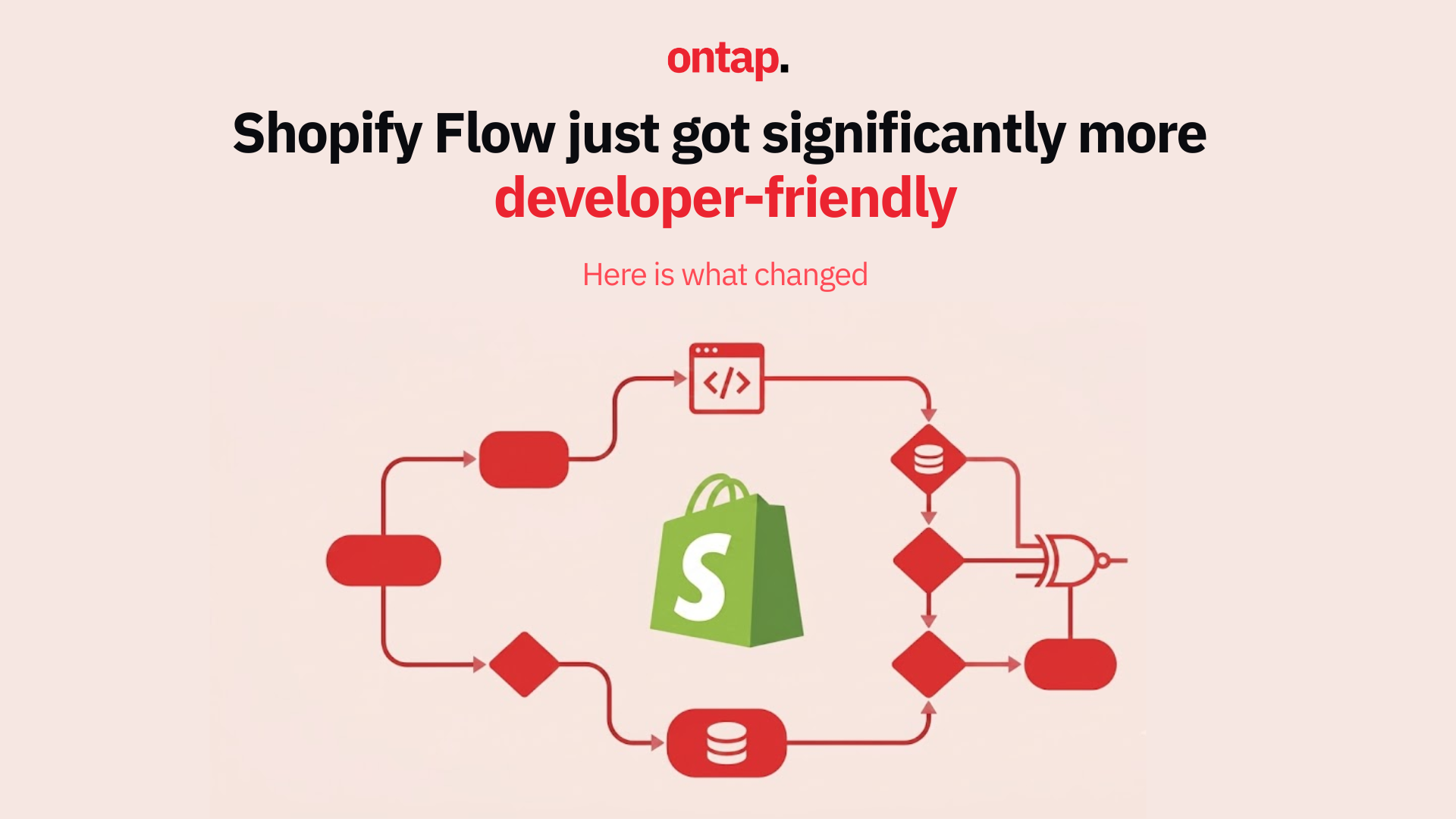
Shopify has quietly shipped two changes to its Flow automation platform that solve real, persistent pain points for developers building on the ecosystem. While these updates will not make headlines, they represent a meaningful shift in how Shopify treats the developer experience around workflow automation, and they have practical implications for every merchant relying on Flow-powered integrations.
The problem: Breaking changes that should not break
If you have built a Shopify Flow action extension, you are familiar with the frustration. Previously, any change to an action's configuration fields - adding a new required field, removing an old one - was treated as a hard breaking change. As the Shopify developer changelog describes it, "Runtime validation would fail, and Shopify wouldn't send the request to the partner server." Merchants' existing workflows would simply stop working, silently, with no opportunity for your server to handle the situation gracefully.
This was particularly painful for app developers iterating quickly. Adding a new feature to your Flow action could break every merchant with the previous version active in their workflows. The only fix? The merchant had to manually open, edit, and re-save their workflow, something most merchants do not do proactively. The Shopify Developer Community forums are full of threads from developers encountering exactly this problem.
What changed: Server-side control over schema differences
Starting now, Shopify Flow no longer blocks requests when there is a field mismatch between the merchant's saved workflow and your action's current configuration. Instead, workflows continue to execute, and Shopify sends the request to your configured endpoint regardless of schema differences.
Your server receives the payload and decides how to handle it. The practical strategies Shopify recommends are straightforward:
-
Apply sensible defaults to fields that are now required but were missing in older workflow versions.
-
Ignore unknown or legacy fields that existed in previous versions but have since been removed.
-
Return a clear error response when the payload genuinely cannot be processed safely.
This is a fundamental architectural shift. Instead of Shopify acting as a rigid gatekeeper, the responsibility moves to the developer, who has the context to know whether a missing field is a fatal problem or something that can be gracefully handled with a default value.
For merchants, this means fewer mysterious workflow failures. For developers, it means you can iterate your action extensions with confidence that existing deployments will not immediately break.
The second change: Runtime URLs that actually update
The second change addresses another long-standing headache. Previously, when you deployed a Shopify Flow action, the runtime_url was hard-coded into each merchant's workflow at activation time. If you updated your endpoint URL, perhaps migrating infrastructure, changing routing, or fixing a deployment, the old URL was baked into every existing workflow. Merchants would need to manually re-save their workflows to pick up the change.
Now, as the runtime URL changelog entry confirms, Shopify resolves the runtime_url dynamically on every execution. Deploy a new URL, and existing workflows automatically use it the next time they run. This also works during local development with shopify app dev, where the URL is updated automatically in development shops.
This eliminates an entire class of subtle bugs. No more merchants running against outdated endpoints because they never re-saved their workflow. No more support tickets about "my Flow action stopped working" that trace back to an infrastructure migration three months ago.
Why this matters for eCommerce merchants
If you are a merchant rather than a developer, you might wonder why these changes affect you. The answer is reliability.
Shopify Flow has become central infrastructure for many eCommerce operations. Merchants use it to automate inventory management, customer segmentation, order routing, fraud flagging, loyalty programmes, and dozens of other workflows. When these automations break silently, because an app developer shipped an update that triggers Shopify's validation, the downstream effects can be significant: orders routed incorrectly, customer tags not applied, notifications not sent.
These two changes reduce the surface area for silent failures substantially. Your Flow automations become more resilient to the normal evolution of the apps they connect to.
What developers should do now?
If you maintain a Shopify Flow action extension, there are immediate steps to take:
-
Audit your endpoint's input handling. Your action may now receive payloads that do not match the current schema. Ensure your endpoint validates gracefully rather than throwing unhandled errors.
-
Implement default value logic. For any field you have added recently, define what happens when it is absent. This is now your responsibility, not Shopify's.
-
Remove assumptions about URL persistence. If you had workarounds for the old URL-caching behaviour, those can likely be cleaned up.
-
Test with older workflow versions. Simulate payloads from previous action configurations to ensure your endpoint handles them correctly.
The bigger picture
These changes reflect a broader maturation of Shopify's developer platform. The pattern is consistent: move away from rigid platform-level validation towards flexible, developer-controlled handling. Give app developers more control, and reduce the number of situations where the platform creates friction between developers and merchants.
For the Shopify ecosystem as a whole, this should lead to fewer broken automations, faster app iteration, and ultimately better merchant experiences. It is not glamorous, but it is exactly the kind of infrastructure improvement that compounds over time. Shopify is investing heavily in making Flow a reliable backbone for eCommerce automation, and these updates make it significantly easier for developers to build on that foundation with confidence.
About On Tap
On Tap is a growth-focused eCommerce consultancy helping mid-market and enterprise merchants build reliable, automated Shopify and Magento operations. From Flow automation architecture and app integration audits to platform migration and ongoing technical maintenance, On Tap helps merchants ensure their automation infrastructure keeps pace with their growth.
If you want to review your Flow automations or evaluate your app stack's reliability, get in touch.