
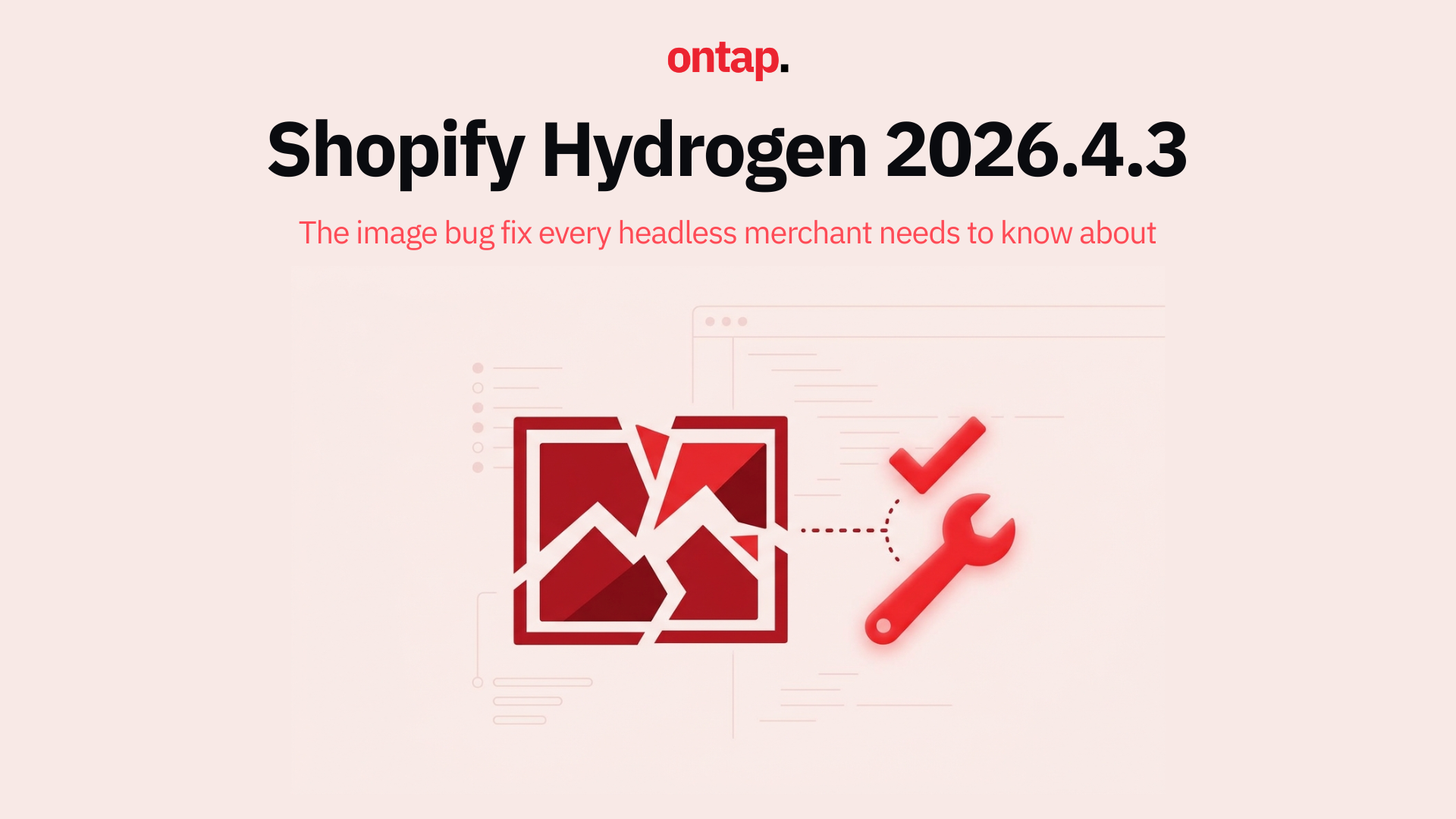
Shopify has released Hydrogen 2026.4.3, and while it is a patch release, it includes a fix that could silently degrade the visual experience on thousands of headless Shopify storefronts. If you are running a Hydrogen-powered store, this one deserves your immediate attention.
The blurry image problem you did not know you had
The headline fix in this release addresses a subtle but impactful bug in Hydrogen's Image component, the core building block that renders every product image, hero banner, and content visual on a Hydrogen storefront.
Here is what was happening: when a product image stored in Shopify was small enough that the default responsive srcset ladder (200px, 400px, 600px, 800px, and so on) got filtered down to exactly three entries by the source-dimension cap, the Image component incorrectly switched from width descriptors (w) to density descriptors (1x/2x/3x). On a standard DPR-1 screen, this caused the browser to select the smallest srcset entry, often just 200px wide, regardless of the rendered image size.
The result was blurry product images that looked fine in development (where retina screens masked the issue) but appeared noticeably degraded on standard-resolution monitors. Worse, the bug silently ignored the sizes attribute that developers had carefully set, meaning responsive behaviour was broken without any console errors or obvious warnings. This is a variation of the srcset descriptor issue first flagged on GitHub in late 2024, in which the Image component generated density descriptors alongside a sizes attribute, resulting in invalid HTML.
The fix is elegant: descriptor type is now determined by whether the image is in fixed or fluid mode, not by how many srcset entries survive source-dimension filtering. This is the correct behaviour. The number of available sizes should never change the fundamental rendering strategy.
Why does this matter more than a typical bug fix?
Product image quality has a direct and measurable impact on conversion rates. Research consistently shows that high-quality product images are the single most influential factor in online purchase decisions, ahead of reviews, descriptions, and even price. A blurry hero image or a soft product photo does not just look unprofessional. It actively erodes trust and suppresses conversion.
What makes this bug particularly insidious is its selectivity. It only affected images whose source dimensions happened to produce exactly three srcset entries after filtering. This means some products looked perfect while others appeared degraded, creating an inconsistent visual experience that is hard to diagnose without inspecting individual image elements.
If you have been running a Hydrogen store and noticed occasional image quality inconsistencies, particularly on product photos that are not extremely high-resolution originals, this is likely the culprit.
The storefrontRedirect fix: Single fetch compatibility
The second significant fix addresses a compatibility issue with React Router v7's Single Fetch feature. React Router v7 changed how data requests work, moving from a _data query parameter to a .data pathname suffix. Hydrogen's storefrontRedirect function was not detecting this new convention, which meant storefront redirects were not working for client-side navigations.
For merchants, this manifested as broken redirect flows during soft navigations, situations where a customer clicks an internal link that should redirect (such as a moved product page or a promotional URL) but instead fails silently. The fix ensures storefrontRedirect correctly detects both the old and new conventions, strips the .data suffix before matching redirects, and returns the proper 204 status code.
React Router 7.16 compatibility
Hydrogen 2026.4.3 also widens the React Router peer dependency ranges to accept compatible React Router 7.16 patch versions, as noted in the Hydrogen April 2026 release changelog. This resolves npm peer dependency conflicts that were causing installation warnings and blocking updates for teams on the latest React Router releases. New Hydrogen projects now default to React Router 7.16.0.
Cart handler improvements
Two smaller but welcome improvements round out the release:
Recursive line item children. Cart now includes line item children recursively, which matters for merchants using bundles, gift wrapping, or other line item extensions that create nested cart structures.
Generic cart result typing. createCartHandler now supports generic types for custom cart fragments, meaning developers using custom cart queries get proper TypeScript type safety instead of any types.
What you should do
Upgrade immediately if you are running any Hydrogen 2026.4.x version before 2026.4.3. The image quality fix alone justifies the update, and the storefrontRedirect fix prevents a class of navigation bugs that are difficult to reproduce and diagnose.
The upgrade path is straightforward. Update @shopify/hydrogen and @shopify/hydrogen-react to version 2026.4.3. Update @shopify/remix-oxygen to 3.0.4. Update @shopify/cli-hydrogen to 12.0.1. Run your test suite and visually inspect product images across a range of source dimensions. You can upgrade by running npx shopify hydrogen upgrade as described in the Hydrogen update documentation.
Pay particular attention to product images that are under 1600px wide in their original upload. These are the most likely to have been affected by the srcset bug.
The bigger picture
This release is a reminder of why headless commerce requires ongoing vigilance. The freedom and performance benefits of a custom Hydrogen storefront come with the responsibility of staying current with framework updates. Unlike a hosted Shopify theme where patches are applied automatically, Hydrogen stores require active maintenance.
For agencies and development teams managing Hydrogen storefronts, this is exactly the kind of release that should trigger an immediate update cycle. The bugs it fixes are the sort that silently degrade the customer experience without triggering alerts, and those are always the most costly.
About On Tap
On Tap is a growth-focused eCommerce consultancy with deep expertise in headless commerce architecture across Shopify Hydrogen, Magento, and Hyvä. From framework upgrades and performance audits to custom storefront builds and ongoing technical maintenance, On Tap helps merchants get the operational benefits of headless without the operational risk.
If you are running Hydrogen in production and want help assessing your upgrade path, get in touch.