
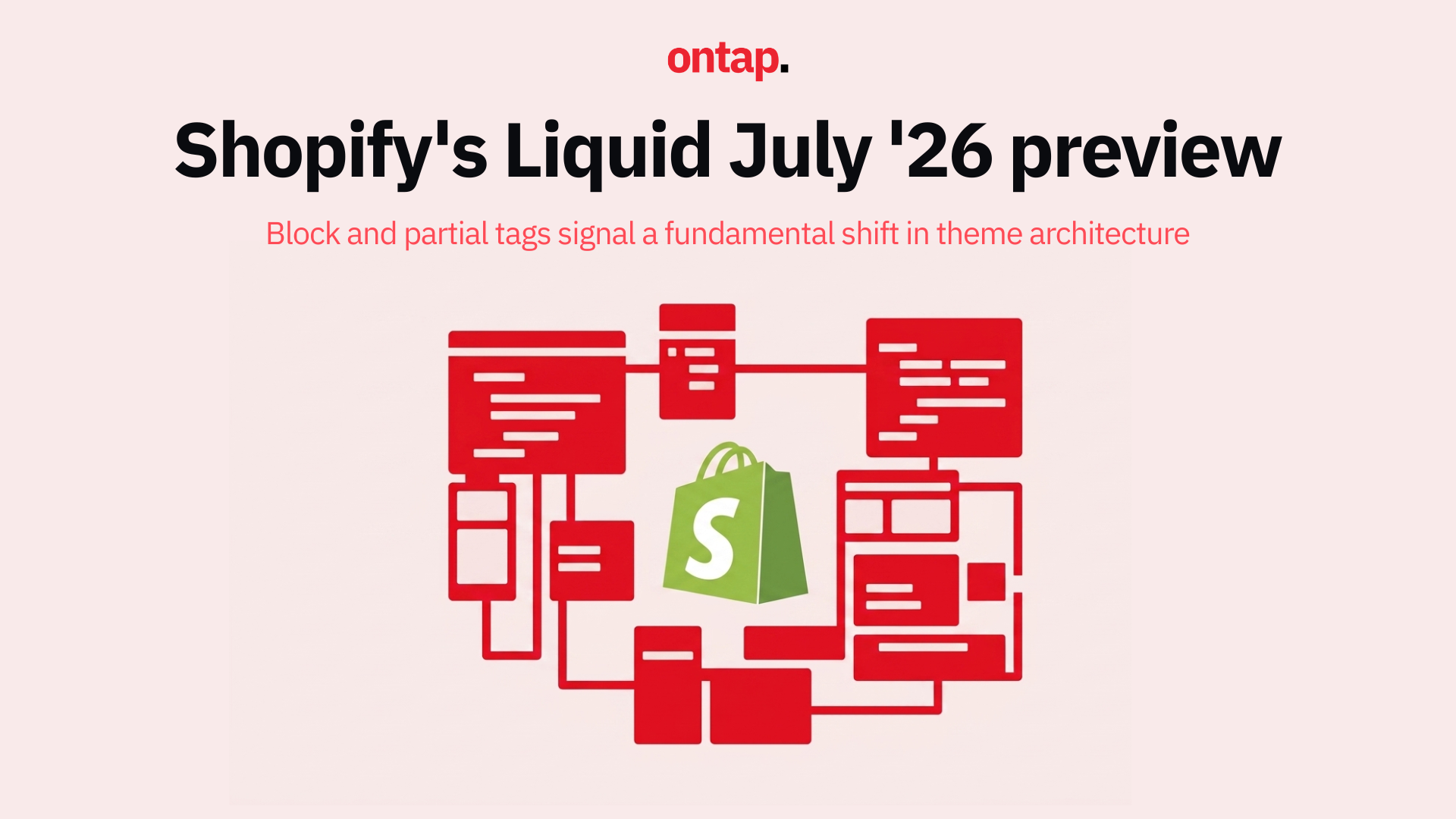
Shopify dropped three significant developer changelog updates on 21 July. Still, one of them deserves particular attention from anyone building or maintaining Shopify storefronts: the Liquid July '26 developer preview, which introduces {% block %} and {% partial %} tags. This is not a minor feature addition. It is the beginning of a new composition model for Shopify themes that could fundamentally change how storefronts are built.
What changed
As the Shopify developer changelog describes it, the preview introduces "a simpler way to build theme pages. Page structure can live directly in a Liquid template, where developers and coding agents can read and edit everything in one place."
Two new tags work together:
-
{% block %} renders a reusable theme block directly from a Liquid template. You name it, pass its inputs, and provide body content, similar to {% render %} but designed for composing page structure rather than just including snippets.
-
{% partial %} defines a named region of server-rendered HTML that JavaScript can refresh without reloading the full page. This is Shopify's native answer to the partial hydration patterns that frameworks such as Astro and Fresh have popularised, and directly relevant to the hydration and SEO challenges we covered in our recent analysis.
Together, these tags let developers compose entire pages in Liquid while adding dynamic storefront interactions, without pulling in a client-side JavaScript framework.
The preview also ships new Theme Check rules (v3.28.0) specifically for Liquid-first themes, catching syntax errors, excessive complexity, oversized files, and schema mismatches before they reach production. Existing themes continue to work with sections, theme settings, and JSON templates. This preview adds a Liquid-first composition model alongside the existing architecture.
Why this matters
To understand the significance, you need to appreciate the current state of Shopify theme development. Since Online Store 2.0 launched in 2021, Shopify themes have relied on a JSON template architecture where sections and blocks are defined through schemas and configured via the theme editor. This system is powerful for merchant customisation but creates a disconnect for developers: page structure lives across multiple JSON files, section definitions, and Liquid snippets. Reading and understanding a page's complete composition requires navigating between several files.
The Liquid-first model addresses this by allowing page structure to live directly in a single Liquid template. The explicit mention of "coding agents" in the changelog is not incidental. Shopify is designing its templating system to be AI-friendly from the ground up. A single-file, readable Liquid template is dramatically easier for an AI to understand and modify than a multi-file JSON template architecture.
The {% partial %} tag is perhaps the more revolutionary of the two. It enables server-rendered partial page updates without client-side frameworks. If you have been watching the broader web development ecosystem, this mirrors the industry shift away from heavy JavaScript SPAs back towards server-rendered architectures with selective interactivity. Shopify is bringing this pattern to theme development natively.
Three updates, one direction
The Liquid preview did not arrive alone. On the same day, Shopify shipped two other significant platform updates.
-
Metafield triggers for Events now let apps subscribe to specific metafield changes on products, orders, customers, collections, and locations. Previously, apps had to subscribe to the entire resource update and manually diff payloads to find what changed. This precision means apps can react only to the data changes that matter, reducing unnecessary processing and making custom data workflows dramatically more efficient.
-
Shopify Analytics as a full-stack platform opens the analytics infrastructure to app developers. Metafields can now be marked as analytics-queryable, making custom data dimensions available in ShopifyQL alongside native store data. A new App Events API lets apps emit custom events that merchants can query in Shopify Analytics. And Analytics Web Components let apps embed the same chart and metric components used in the Shopify admin.
The thread connecting all three updates is platform depth. Shopify is systematically eliminating the reasons developers need to build infrastructure outside the platform. Your templating can be Liquid-first. Your event handling can be metafield-precise. Your analytics can run on Shopify's stack. Each update reduces the external tooling tax for building on Shopify.
Practical implications for merchants and agencies
-
For agencies building Shopify themes: start exploring the developer preview now. Create a development store with the Liquid July '26 preview flag enabled and experiment with the skeleton theme release candidate. The patterns you learn now will give you a head start when these features reach stable.
-
For merchants evaluating platforms: these updates strengthen the case for Shopify as a platform that is investing heavily in developer experience. The Liquid-first model should translate into faster theme development and more maintainable codebases, which means lower long-term costs for custom storefronts.
-
For app developers: the metafield triggers and analytics platform updates are immediately actionable. If your app creates or modifies metafields, the new event subscriptions let you build more responsive integrations. If your app generates data merchants care about, the analytics platform lets you surface that data where merchants already make decisions, inside the Shopify admin.
The bigger picture
The most telling detail in the entire changelog is the explicit mention of "coding agents." Shopify is not just building for today's developers. It is building for a future where AI agents participate in theme development. A single-file, readable Liquid template is dramatically easier for an AI to understand and modify than a multi-file JSON template architecture.
This is forward-thinking platform design that acknowledges where the industry is heading. And for the Shopify ecosystem, it means the gap between "what Shopify can do" and "what you need external tools for" continues to narrow.
About On Tap
On Tap is a growth-focused eCommerce consultancy helping mid-market and enterprise merchants build and maintain high-performing storefronts across Shopify and Magento. From Liquid theme development and developer preview evaluation to platform migration and ongoing technical strategy, On Tap helps merchants adopt new platform capabilities with confidence.
If you want to understand what the Liquid July '26 preview means for your theme architecture, get in touch.