 Best full-service eCommerce agency 2026


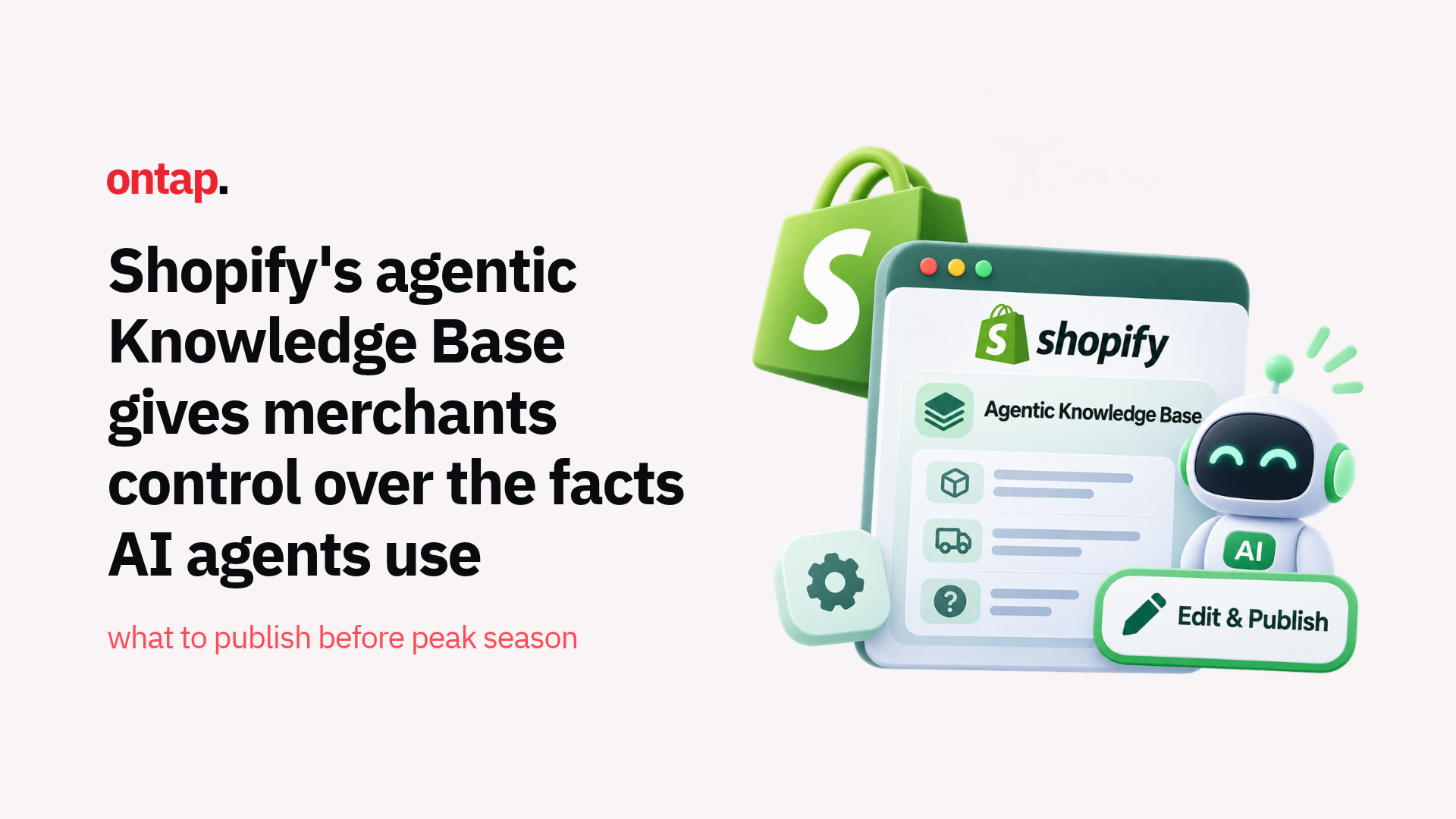
On 26 October, Shopify moved its Knowledge Base from a standalone app into the core admin, placing it under Sales channels > Agentic > Knowledge Base.
The change sounds administrative. It isn't.
The Knowledge Base is now the source of truth for non-product information that compatible AI agents can retrieve about your store, including shipping timelines, return processes, payment options, gift services, and brand information.
Shopify drafts information from your published storefront and relevant admin settings, then gives merchants control over what is published, edited or removed. For storefront-scanned facts, nothing reaches AI agents until you publish it. Some information sourced directly from Shopify admin, including policies and contact details, can be published when Shopify creates it.
For merchants heading into peak season, the important question is no longer simply whether AI agents can find your products. It's whether they have accurate information when customers start asking questions about your store.
What changed and why it matters
Previously, Shopify offered a standalone Knowledge Base app for managing information used in AI shopping conversations.
That functionality now sits directly inside the Agentic sales channel.
The new Knowledge Base lets merchants review the facts AI agents can use, see where each piece of information came from, edit the source, add references, and publish or unpublish individual fields or entire categories.
Shopify organises information into categories including:
-
Company policies: terms of service, privacy, shipping and returns;
-
Contact: address, email, phone number and social profiles;
-
Gift services: gift cards, gift receipts, registries and wrapping;
-
Payment: payment methods accepted at checkout;
-
Returns and warranty: return windows, refunds and warranty information;
-
Fulfilment: international shipping, express delivery and store pickup;
-
Brand information: store description, target audience, brand values and identity;
-
Additional facts: merchant-created information that isn't already covered by the standard fields.
Each field can also include reference links that AI agents can use alongside the fact when answering a customer.
This gives merchants meaningful editorial control over the information source AI agents use.
It does not mean merchants control the exact sentence an AI agent produces. For example, Shopify says agents can use paragraph facts as the source for an answer while expressing the information in their own words.
Why this is commercially significant right now
The timing matters because Shopify has spent October expanding the infrastructure around agent-assisted shopping.
On 13 October 2026, Shop MCP opened Shopify Catalog search, carts and Shop Pay checkout to compatible AI agents through a single connection using Model Context Protocol (MCP), a standard that lets AI agents access tools and data.
Shopify's current Agentic storefront infrastructure also connects eligible merchants to AI shopping surfaces including ChatGPT, Google AI Mode and Gemini, Microsoft Copilot, Meta and Shop. Merchants can manage third-party channel access from Sales channels > Agentic. Shop has separate controls in the Shop sales channel.
That makes the Knowledge Base a different type of commerce asset from product data.
Product data helps an AI system understand what you sell.
The Knowledge Base helps it understand how your store operates.
That distinction is important because Shopify explicitly says Knowledge Base content improves the accuracy of AI responses about a merchant, but does not determine how often the store appears in AI platform results.
So this isn't an AI-ranking feature.
Publishing a fact that says you offer gift wrapping does not mean an agent will recommend your store above a competitor. But if your store is already part of the customer's consideration set and they ask whether gift wrapping is available, the Knowledge Base gives the agent an authoritative answer to retrieve.
For peak season, that accuracy matters across questions about shipping cut-offs, extended returns, gift services and delivery options.
What should merchants publish first?
Published Knowledge Base facts are publicly accessible, so include only information intended for customers generally, not confidential account-specific pricing or negotiated terms.
Actions to take:
-
Shipping and fulfilment: confirm delivery timeframes, international availability, express options, pickup services and any peak-season shipping information;
-
Returns and exchanges: review return windows, refund processes, warranty information and any extended holiday return terms;
-
Contact information: make sure customers and agents have accurate ways to reach the business;
-
Gift services: publish whether you offer gift wrapping, gift receipts, gift cards or registries;
-
Payment options: verify the payment methods customers can use at checkout;
-
Brand information: review how the store, audience, values and positioning are described;
-
Seasonal information: add additional facts for important peak-season information that isn't already represented in Shopify's standard categories.
The priority should be accuracy, not volume.
A smaller set of current facts is more useful than filling the Knowledge Base with seasonal or promotional information that your team won't maintain.
Review the source, not just the answer
Shopify automatically creates Knowledge Base content using information from your storefront and relevant admin settings.
There are storefront limitations: custom storefronts and stores on the Agentic plan can add only additional facts. For password-protected stores, Shopify cannot scan the storefront and uses only applicable admin information.
Each field identifies where that information came from. Merchants can keep Shopify's detected source or switch a field to Manual and maintain the information themselves.
This is useful when the storefront copy is technically correct but lacks the detail an AI shopper needs.
For example, your shipping page might say that free shipping applies above a certain order value. If the offer is limited to specific markets or excludes express shipping, the Knowledge Base should make those conditions clear.
The same principle applies to holiday return windows, gift services and fulfilment promises.
If you switch a field to Manual, references supplied by the previous source are removed, while references you added yourself are retained. Check the remaining links and add publicly accessible, customer-facing URLs where needed. Keep the Knowledge Base information consistent with your storefront.
Don't assume storefront changes update your facts automatically
The connection between your storefront and Knowledge Base isn't a live content sync.
Shopify regularly rescans the online store. If it finds new information, it can show a Suggested update for you to approve or reject.
Shopify does not overwrite published Knowledge Base content on your behalf.
This distinction matters during peak season because store information changes quickly. Shipping cut-offs move. Return windows change. Promotions expire.
A storefront edit therefore shouldn't be treated as confirmation that the Knowledge Base has changed too.
Actions to take:
-
Review suggested updates: approve or reject changes that Shopify identifies from storefront scans;
-
Edit urgent information directly: don't wait for a scan when a peak-season fact needs to change immediately;
-
Request a rescan when needed: Shopify lets merchants manually request one, although completion can take up to 48 hours;
-
Unpublish expired facts: remove seasonal information when it is no longer accurate.
Shopify also warns that a scan doesn't always detect every storefront change, so information that materially affects the customer journey should be checked directly.
Check your migration if you used the previous app
The standalone Shopify Knowledge Base app is being replaced and is no longer available for new installations.
For existing users, migration depends on the size of the previous Knowledge Base.
-
1,000 facts or fewer: store fact overrides and additional facts are automatically transferred and published in the new Knowledge Base;
-
More than 1,000 facts: additional facts and store fact overrides need to be added manually before the standalone app is deprecated on 15 January 2027.
There is also an important limit to understand: the current Knowledge Base can hold 1,000 facts in total, including generated and additional facts.
That makes prioritisation important for merchants with large legacy Knowledge Bases. Start with information most likely to affect customer decisions and support queries rather than trying to preserve every historical FAQ.
The bigger picture
This release confirms something we've been tracking throughout October: agent-facing content is becoming its own commerce layer.
Shopify now separates two types of information that AI shopping systems need.
The catalogue provides structured product information for discovery and shopping.
The Knowledge Base provides structured non-product information about the merchant, including policies, fulfilment, payments, contact details, and brand information.
Both matter, but for different reasons.
Product optimisation can influence whether products are understood and surfaced for relevant searches. Knowledge Base optimisation improves how accurately agents answer questions once they need information about the store.
For merchants, that means AI readiness now includes another content-maintenance workflow.
Review what AI agents currently know about your business. Publish the facts that matter. Give important information clear references. And add Knowledge Base reviews to your regular content-maintenance schedule, particularly when delivery deadlines, return terms, or seasonal services change.
About On Tap
On Tap supports eCommerce merchants with Shopify development, consultancy, and systems integration. If you need help preparing your store for AI-assisted shopping, contact us to discuss your priorities.