 Best full-service eCommerce agency 2026


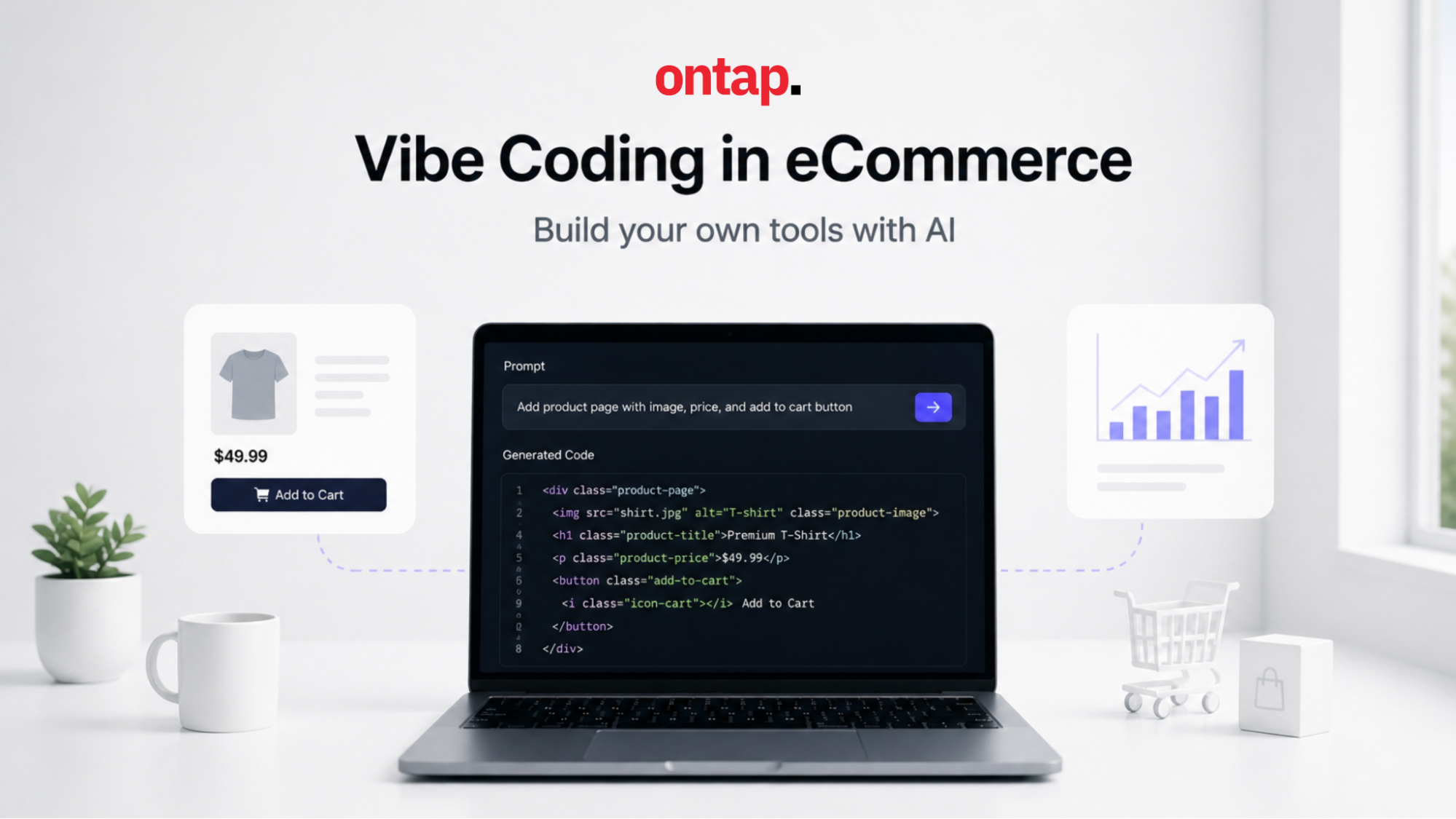
Something is shifting in eCommerce operations as merchants with no coding background are now building their own internal tools using natural language and AI coding assistants. Tasks that once required developers or clunky spreadsheets, from inventory alerts to pricing calculators and reporting dashboards, can now be created in an afternoon through simple prompts. This shift signals a deeper change in how eCommerce businesses operate, where building small, purpose-built software is becoming accessible to the people who actually run the business.
What is vibe coding?
For eCommerce merchants, vibe coding is a new way to build small internal tools by describing what you need in plain English and letting an AI assistant generate the code. The term was coined by Andrej Karpathy and has quickly become shorthand for a more conversational approach to software development. Instead of writing code line by line, you define the outcome, review what the AI produces, and refine it through iteration. Tools like Cursor, Bolt, Replit, and ChatGPT’s code interpreter have made this accessible to anyone with a clear use case, even without a technical background.
In practice, this means a merchant can go from idea to working tool in a single session. A store operator might describe a workflow for tracking low stock, a marketer might outline a weekly reporting dashboard, or an operations lead might define rules for routing orders. The AI handles the underlying logic, while the user focuses on what the tool should actually do.
Why this matters right now
This shift is happening now because three forces are converging:
AI coding tools have reached a level of reliability that makes them genuinely useful for everyday business problems. For straightforward applications such as data transformation, API integrations, and simple dashboards, the output is often usable with minimal refinement.
eCommerce operations are becoming more complex as merchants manage more channels, more data sources, and more interconnected workflows. The demand for small, custom tools is growing faster than the availability of developers to build them.
Economic pressure is forcing teams to do more with less. With ongoing uncertainty around tariffs, fluctuating shipping costs, and tighter margins, merchants are looking for ways to automate manual work without increasing headcount or adding new software subscriptions.
Real eCommerce use cases
In practice, most vibe-coded tools fall into a few repeatable patterns, each focused on solving a narrow but persistent operational problem:
-
Operational automation: Scripts that monitor inventory levels and send alerts, tools that reconcile orders across channels, and automated reporting that pulls data from multiple sources into a single view.
-
Pricing and competitive intelligence: Lightweight scrapers that track competitor pricing, calculators that model the margin impact of tariff changes, and dynamic pricing tools for specific product categories.
-
Customer data utilities: Tools that segment customers based on purchase behaviour, scripts that clean and deduplicate mailing lists, and dashboards that visualise customer lifetime value trends.
-
Content and marketing: Product description generators, bulk image resizing tools, and social media schedulers that pull directly from product feeds.
What could go wrong
Vibe coding is powerful, but it introduces risks that are easy to underestimate, especially for non-technical users who may not fully see the implications of what they are building.
Over-reliance on tools you do not fully understand. There is a meaningful difference between automating a convenience task and delegating business-critical decisions. A script that generates a daily report is low risk. A script that automatically adjusts prices or updates inventory levels carries direct commercial impact. The boundary between the two can blur quickly.
Security blind spots are another concern, particularly when tools interact with customer data or platform APIs, because code produced by AI can include vulnerabilities that are not obvious without technical review. When sensitive data is involved, even a small flaw can lead to serious consequences, and compliance requirements such as PCI still apply regardless of how the code is created.
Maintenance debt also builds quickly, since a tool created in an afternoon still needs ongoing support as APIs change, platforms evolve, and edge cases emerge. If the person who built the tool does not fully understand how it works, resolving issues later can become slow, unpredictable, and increasingly dependent on trial and error.
Legal and intellectual property considerations. Code generated with AI may unintentionally replicate protected material from training data. For commercial use, the legal landscape is still evolving and not yet fully tested.
On Tap's practical framework
Rather than telling merchants to embrace or avoid vibe coding, we would suggest a simple framework for evaluating whether it is appropriate for a given use case:
-
Green light, build it: Read-only tools such as reports, dashboards, and alerts, tools that do not handle sensitive data, internal utilities with a single user, and tools where failure leads to inconvenience rather than loss.
-
Yellow light, build with caution: Tools that connect to platform APIs, tools that modify any data, including non-sensitive data, tools used by multiple team members, and anything that runs on a schedule without human review.
-
Red light, get professional help: Anything that touches payment data, tools that automatically modify prices or inventory, customer-facing applications, and integrations with compliance-sensitive systems.
The bottom line
Vibe coding represents a genuine democratisation of software development, and eCommerce merchants stand to benefit enormously from it. The ability to build custom tools without a developer on staff could be transformative, particularly for small and mid-sized businesses.
However, it is not magic, and it is not without risk. The merchants who benefit most are those who approach it with a clear understanding of where it creates value, where it introduces risk, and where professional development remains the better choice.
The tools gap in eCommerce is real, and vibe coding can help close it, but success depends on knowing how far to take it and when to step back.
If you are exploring how to apply this in practice, contact On Tap to identify where lightweight tools can drive efficiency and where more robust solutions are needed.