
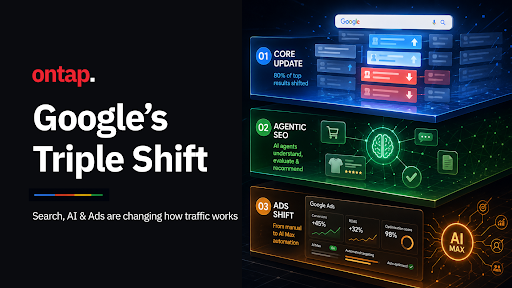
If you rely on Google for eCommerce traffic, recent developments deserve your full attention. In a short period of time, three changes landed: a core update that reshuffled most search results, a new framework for how AI agents evaluate content, and a shift in how Google runs ads.
Together, they point in the same direction. Google is no longer just ranking pages; it is deciding whether your store can be understood and recommended by both search algorithms and AI systems. That shift is already changing who gets traffic and who disappears.
The March 2026 Core Update: 80% of Top Results Shifted
Search Engine Land reported that Google’s March 2026 core update was significantly more volatile than the previous one, with nearly 80% of top results shifting during the rollout. This wasn’t a routine adjustment; it was a large-scale reset of what Google considers worth ranking.
The sites that lost visibility follow a familiar pattern. Aggregators that compile content without adding real value dropped, while brands, official stores, and data-rich sources moved up. Google is not just rewarding authority in theory anymore; it is actively replacing middlemen with sources.
On the other hand, stores that invest in detailed product information, real customer reviews, rich media, and category-level expertise are moving in the opposite direction. They are not just easier for Google to rank; they are easier for users to trust.
The gap between these two approaches is widening. Stores that treat their site as a source of expertise gain visibility, while stores that treat it as a catalogue gradually lose it.
For eCommerce merchants, this change is not subtle. If your product pages are built on manufacturer descriptions, thin copy, or duplicated content, this update exposes that immediately. More traffic will not fix it; it only sends more users to pages that do not give them a reason to stay or buy.
Agentic Engine Optimisation: Google's New Content Playbook
A more subtle shift happened this week, but it may have a longer-term impact. A Google Cloud AI Director introduced what they call “Agentic Engine Optimisation”, a framework for making content discoverable not just by users, but by AI systems.
This matters because product discovery is already changing. As AI shopping assistants and comparison tools become more common, the decision is no longer made only by someone scanning search results. It is increasingly shaped by systems that need to understand your content before they can recommend it.
That changes what optimisation actually means. Traditional SEO focused on keywords and links. This framework focuses on whether your data is complete, structured, and clear enough for a machine to interpret without guessing.
For eCommerce operators, the implications are practical:
- Product data needs to be explicit. Attributes like size, material, compatibility, and use case should be structured, not buried in paragraphs, because AI systems do not infer context the way humans do.
- Schema is no longer optional. Product, review, and FAQ schema are how your data becomes usable, not just visible.
- Content needs to answer specific questions directly. Vague descriptions are easy to write but hard for machines to trust, which makes them less likely to surface.
- Your homepage matters again. As AI reduces clicks to deeper pages, more users arrive through branded searches, and a weak homepage now creates friction at the first step instead of the last.
The End of Dynamic Search Ads
Google announced it will stop allowing the creation of new Dynamic Search Ad (DSA) campaigns in September 2026 and will auto-migrate existing DSA, ACA, and broad match campaigns to its new AI Max format.
This is significant because DSAs have been a workhorse for eCommerce advertisers for years, automatically generating ads based on your site content without requiring manual keyword targeting. Their replacement, AI Max, takes this automation further by using Google's AI to dynamically optimise targeting, creative, and bidding at the same time.
The migration timeline gives merchants roughly five months to prepare. Here's what to do now:
- Audit your current DSA campaigns. Understand which ones are performing well and document their structures.
- Start testing AI Max. Do not wait for forced migration. Run parallel tests now to understand how performance differs.
- Ensure your product feed and site content are immaculate. AI Max will only be as good as the data it has to work with, and poor product data will produce poor AI-driven ads.
- Watch for automation drift. As Search Engine Land also noted this week, the growing reliance on AI-driven campaign management creates a real risk of "automation drift", where campaigns gradually deviate from your business goals without anyone noticing. Build regular performance reviews into your process.
The Through-Line: Data Quality Is Your Competitive Moat
These three shifts point in the same direction, where visibility depends less on how well you optimise pages and more on whether your data can be clearly understood and trusted by the systems evaluating it.
Search, AI assistants, and ad platforms are increasingly relying on the same underlying inputs, which means incomplete or poorly structured product data does not just limit performance in one channel but reduces your ability to be recommended across all of them, even if your product itself is competitive.
As a result, the gap is widening between stores that invest in structured, reliable data and those that do not, because one becomes easier to surface consistently while the other gradually loses visibility without an obvious failure point.
On Tap helps eCommerce businesses navigate the evolving digital landscape. Visit ontapgroup.com to learn how we can help you future-proof your commerce strategy.