
Introduction: The Untapped Customer Base
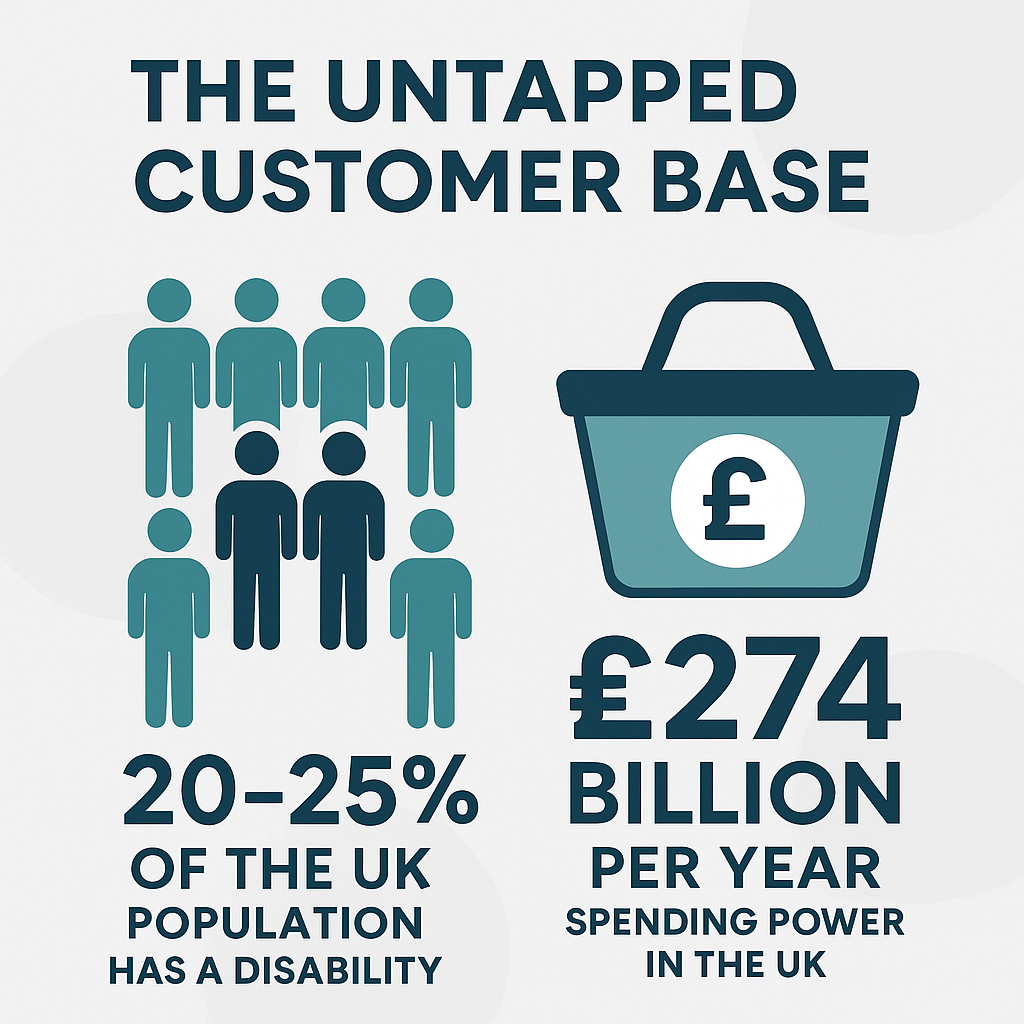
A website accessibility audit can unlock a vast, underserved market of potential customers who currently struggle to use your e‑commerce site. In the UK, about 20-25% of the population has a disability, representing roughly 16 million. These individuals and their families command enormous spending power - the so-called “Purple Pound” is valued at around £274 billion per year in the UK. Let's take the example of a products retailer with an average order value of ~£25 based in the UK, this means a significant portion of your audience already has accessibility needs. By improving your site’s accessibility, you enable these customers to transact with you where previously they could not, directly translating into new sales.
Critically, many disabled users are currently driven away by inaccessible websites. Surveys show that about 70% of disabled online shoppers will “click away” from a site with accessibility barriers. In fact, UK retailers in 2019 lost an estimated £17.1 billion in revenue because customers abandoned sites that were too difficult to use. This is often called the “Click-Away Pound” - money that literally goes to competitors with more accessible sites. An accessibility audit identifies these barriers on your site so you can recapture such lost opportunities. Even a modest increase in conversion of disabled users can yield outsized returns. For example, enabling just a few hundred extra orders (easily achievable given the size of the market) at ~£25 each would recoup the audit cost. In short, there is a strong business case: improving accessibility directly increases your addressable market and revenue.
Diagnosing Barriers: WCAG Points and Common Issues
A professional audit will evaluate your website against the Web Content Accessibility Guidelines (WCAG) - the industry standard for accessibility. WCAG 2.1 (Level A/AA) includes 50 testable success criteria covering issues from text alternatives to keyboard navigation. The audit will pinpoint which of these “WCAG points” your site fails to meet. It’s common for e-commerce sites to have dozens of accessibility errors. In fact, analyses show the average homepage has ~50 detectable errors, with the most frequent issues being low-contrast text, missing alt text on images, empty links/buttons, and missing form labels. These directly correlate to WCAG criteria:
- Text alternatives (WCAG 1.1.1): Ensuring every product image has descriptive alt text. Missing alt text means a blind shopper using a screen reader can’t know what a product isaccessiblyapp.com. For an ecommerce site, think of product photos, shade swatches, or ingredient list images - without alt descriptions, a visually impaired customer is locked out from buying those items.
- Sufficient color contrast (WCAG 1.4.3): Many brands use stylish color schemes, but text needs enough contrast against the background. If your product descriptions or prices are in faint text that a low-vision user cannot read, that’s a lost saleaccessiblyapp.com. An audit will flag low-contrast elements so you can adjust colors or font sizes.
- Keyboard navigation (WCAG 2.1.1) and Focus indicators (2.4.7): A significant number of users cannot use a mouse due to mobility or vision issues; they rely on keyboard-only navigation. Common problems are menus, sliders, or pop-ups that trap keyboard focus or are impossible to access via Tab keys. For instance, if a makeup category dropdown can’t be opened without a mouse, keyboard-only users (including some screen reader users) simply can’t browse or add items to cart. The audit will test all interactive features to ensure keyboard accessibility and visible focus outlines.
- Form labels and feedback (WCAG 3.3.2, 4.1.3): E-commerce involves forms (login, registration, checkout). If form fields are unlabelled or error messages are not announced to assistive technologies, users with cognitive impairments or screen readers may be unable to complete checkout. The audit will check that every input (e.g. search box, address field) has a proper label and that any validation messages are accessible.
Each WCAG criterion fixed is one less barrier for a segment of customers. Think of it this way: resolving a single issue like adding alt text for images can suddenly make your entire product catalog accessible to blind users -an audience that was previously excluded can now convert. An audit typically yields a prioritized list of such issues. You might discover, for example, that your site meets only, say, 30 out of 50 WCAG 2.1 AA criteria today. By addressing the 20 missing points, you dramatically increase your compliance and open your store to virtually everyone, regardless of disability. In essence, the audit provides a roadmap of improvements that enable customers who were previously locked out to finally use your site.
Conversion Rate Uplift from Accessibility Improvements
Improving accessibility is proven to boost conversion rates and sales. When your site is easier to use for people with disabilities, it becomes easier for all users - a phenomenon often called the “curb-cut effect” (after how sidewalk curb cuts, meant for wheelchairs, also benefit parents with strollers, travelers with luggage, etc.). By eliminating pain points, you reduce bounce rates and cart abandonments across the board. Consider some telling statistics and case studies:
- Fewer abandoned visits: As noted, 70% of users with access needs leave sites that are hard to use. By fixing accessibility issues, you can retain these visitors. This can have a 15-20% relative uplift in overall conversion if previously a significant chunk of visitors were dropping out. Even for users without disabilities, many accessibility best practices (clear navigation, readable text, captions, etc.) overlap with good UX - so everyone finds the site more navigable. It’s no surprise that better accessibility leads to lower bounce rates and higher conversion.
- Increased conversion rates: Research indicates that making websites accessible can increase conversion rates by up to 50%. While “up to 50%” may reflect exceptional cases, even a fraction of that is substantial. For example, if your e-commerce site currently converts 2% of visitors, a 0.5-1.0 percentage point increase (to 2.5% or 3%) means 25-50 more orders per 1,000 visitors. At ~£25 per order, that’s an extra £625-£1,250 in revenue per 1,000 visitors - easily justifying the audit and fix costs as traffic scales. Real-world examples back this up: After improving their site’s accessibility and UX, Legal & General (a UK financial services company) doubled their online sales within 3 months. This was attributed to the new accessible site allowing more people to complete purchases (in L&G’s case, more people obtaining insurance quotes). In an archived case study, L&G reported 100% ROI within 12 months of the accessible redesign, as well as a 50% increase in traffic from organic search - a clear indicator that accessibility changes had broad positive effects.
- Customer loyalty and new sales: Accessibility can also drive new customer acquisition and loyalty. 83% of disabled consumers limit their shopping to sites they know are accessible - meaning if your e-commerce site becomes known as accessible, you can attract a loyal following from a demographic that has fewer sites competing for their business. By investing in accessibility, you not only improve conversion rates, but potentially increase average order values and customer lifetime value because satisfied customers will choose your brand even if it isn’t the cheapestreciteme.com. In many products sectors, where brand loyalty and repeat purchasing are key, winning the trust of users with disabilities can translate into significant recurring revenue.
- Case study - Beauty retail example: A California skincare retailer who undertook accessibility improvements (audit + remediation) found that the changes “significantly improved the overall user experience” for all customers and broadened their customer base. In practical terms, this means more shoppers could navigate product categories, understand product info, and complete checkout - lifting sales. Likewise, a major UK supermarket, Tesco, invested ~£35k in creating an accessible version of their online grocery store and reaped an estimated £13 million per year in additional revenue from disabled and convenience-seeking customers. That is a 370x return on investment and underscores that accessibility enhancements can unlock huge pent-up demand. Even for much smaller brands - say a few hundred thousand pounds of extra yearly sales - would be transformational, and it all starts with identifying what to fix via an audit.
In summary, making your site accessible removes friction that has been silently costing you conversions. The potential uplift is evidenced by both statistics and cases: higher conversion rates, lower cart abandonment (exceeding 70% in general e-commerce), and more customer spend on sites that accommodate everyone. These improvements directly correlate with revenue growth.
Beyond Conversion: Additional Benefits and ROI Justification
An accessibility audit and the subsequent modifications should be seen as an investment that yields returns well beyond just immediate sales:
- Improved SEO and traffic: Many accessibility best practices (proper HTML structure, alt tags, logical headings) also improve search engine optimization. For instance, adding alt text not only guides blind users but also helps Google index your product images. After implementing accessibility changes, companies like Legal & General saw organic search traffic jump by 50%. More traffic at no extra marketing cost means more potential customers and conversions.
- Reduced maintenance costs: Clean, accessible code often means a more structured and streamlined site. L&G reported a 66% reduction in maintenance costs after their accessible redesign, because the site became easier to update and had fewer customer support issues. For an ecommerce store, this could mean less time fixing UI bugs or answering usability queries, and more time enhancing features or content.
- Risk mitigation and compliance: In the UK, the Equality Act 2010 legally requires businesses to not discriminate against people with disabilities, which extends to website access. While enforcement in the UK is less litigation-driven than the US, the trend (especially with the upcoming European Accessibility Act) is toward stricter digital accessibility expectations. Investing in an audit now could save you from potential legal complaints or the scramble of retrofitting under threat of a lawsuit. The number of web accessibility lawsuits has been rising steadily in recent years, particularly in e-commerce, which accounts for about 74% of digital accessibility cases in the US. Proactively fixing issues not only avoids legal risk but also protects your brand reputation – you position your brand as inclusive and socially responsible.
- Brand enhancement and customer perception: An accessible website sends a strong message of inclusivity. Many shoppers (with and without disabilities) prefer brands that demonstrate corporate social responsibility. By being inclusive, you tap into positive PR and word-of-mouth. There’s evidence that companies excelling in accessibility outperform peers financially - for example, an Accenture study found companies that champion disability inclusion had 28% higher revenue and double the net income on average compared to othersbemyeyes.com. In part, this is because they can serve all customers and attract talent and goodwill. For a retailer, aligning with accessibility can enhance your appeal especially if your target market includes older adults (who may have visual or motor impairments) or diverse groups of users.
Given these multifaceted benefits, the return on investment (ROI) from accessibility is compelling. A frequently cited analysis by Forrester Research estimated that every $1 invested in accessibility can yield up to $100 in benefits when you factor in increased sales, improved SEO, reduced legal risk, and better customer retention. Even if your results are a fraction of that, the ROI is still enormous. The case of Tesco’s £35k investment yielding £13m/year is a real-world testament. Legal & General’s project (which included an audit, redesign, and testing) paid for itself within one year. A well-executed audit will similarly pay back quickly by enabling new revenue. The cost to implement fixes identified by the audit will vary (perhaps a few thousand pounds more, depending on the number of issues and your development resources), but the combined cost of audit + remediation is still dwarfed by the upside. For example, if fixing issues brings even an additional £50k in annual sales, that’s a 10x return on a £5k overall spend. Many businesses see much larger gains over time as they retain loyal customers who were previously alienated.
Conclusion: Enabling Customers = Driving Growth
Investing in a website accessibility audit for your e-commerce site is a high-value decision that opens the door to both doing the right thing and achieving tangible business improvements. The audit will illuminate precisely where your storefront falls short of modern accessibility standards (the dozens of WCAG checkpoints), and provide a clear roadmap to fix those gaps. By acting on these recommendations, you create an online shopping experience that everyone can use - including people who are blind, deaf, have limited mobility, or cognitive differences. In practical terms, this means potential customers who previously gave up (or never even found your site usable) can now search products, add that special item to their basket, and successfully checkout.
The opportunities unlocked by these improvements are quantifiable and compelling: a larger user base, higher conversion rates, increased revenues, better SEO, and stronger customer loyalty. You’re not just avoiding missing out on the £274 billion Purple Pound market - you’re actively welcoming it. Case studies from multiple industries (finance, retail, etc.) have shown conversion lifts of 20–50% and rapid ROI when accessibility barriers are removed. By ensuring your site meets key WCAG success criteria, you could easily fulfill dozens of “quick win” improvements that yield an immediate uptick in sales (for example, simply adding proper labels and error notices could rescue many abandoned checkouts by users with screen readers). Each improvement is an inclusive design enhancement that often makes the experience better for all shoppers, not just those with disabilities - for instance, captions help anyone watching product videos in a quiet environment, and good contrast benefits mobile users in sunlight.
Finally, consider the broader perspective: accessibility is not a cost, it’s an investment in quality. Just as a clean, well-organized physical store invites more customers, an accessible website invites more online customers. The audit is the first step to identify how to make your site the best it can be. With real potential for substantial conversion rate uplift and revenue growth, the audit’s value far exceeds its price. The bottom line is that an accessibility audit can pay for itself many times over by enabling customers who previously couldn’t use your site to finally engage and buy - turning lost opportunities into loyal, paying customers. In the competitive world of e-commerce, that inclusivity and reach can be the differentiator that drives sustained growth. An accessible website is not just ethically right - it’s economically smart, creating a win-win where more customers can happily give you their business, and your business reaps the rewards.
Looking for a trusted partner to improve your website accessibility?
On Tap - A certified Magento development agency, delivers comprehensive audits produced using a mixture of automated scanning and real-person analysis, focusing on the practical improvements for ecommerce merchants that will deliver the improvements mentioned in this article.