
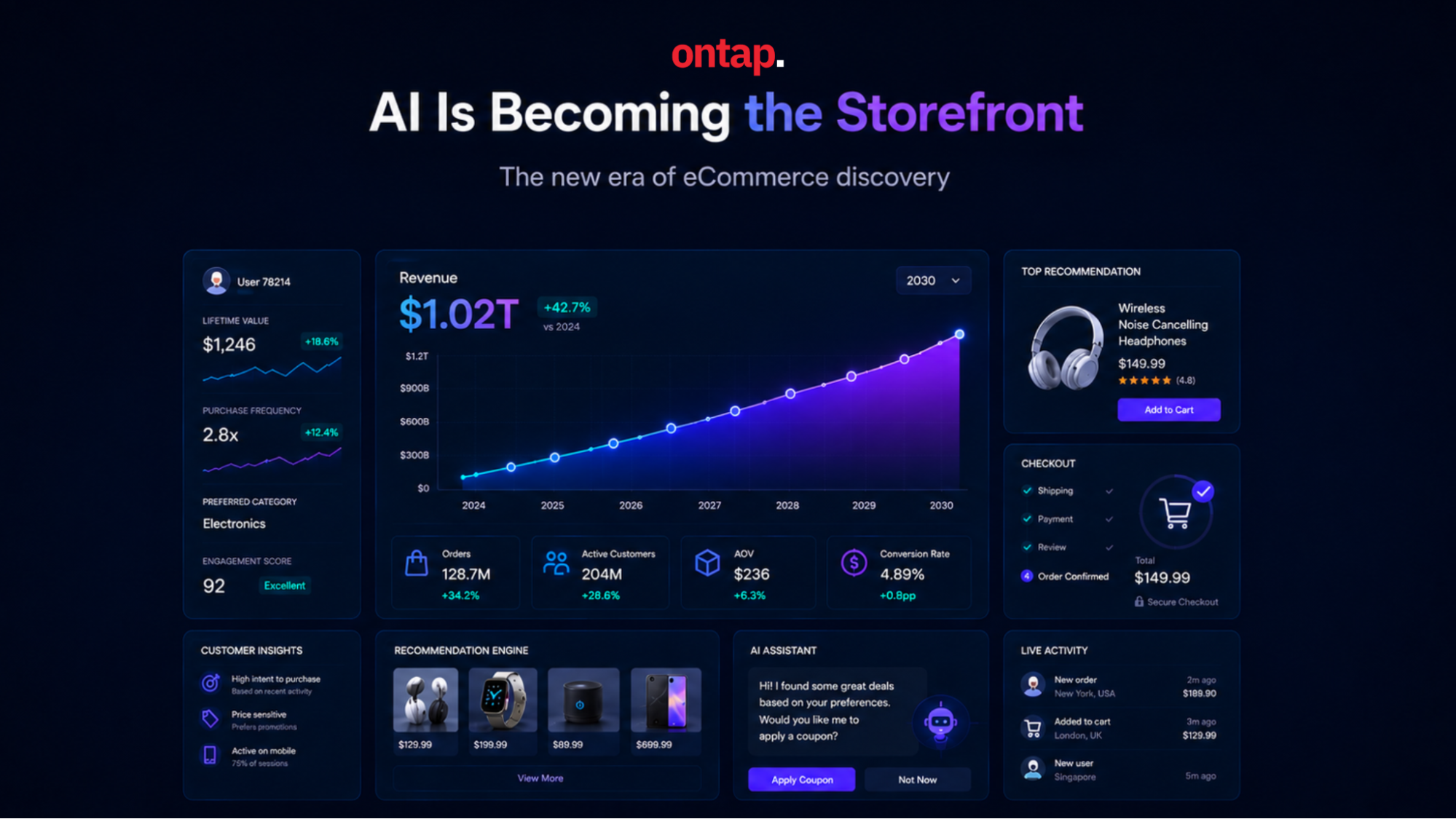
A new report from ICSC and McKinsey & Company has put a number on the agentic commerce opportunity that should make every eCommerce operator pay attention: US business-to-consumer agentic commerce revenue is forecast to reach $1 trillion by 2030.
But this is not just a headline about AI growth. It signals a structural shift in how eCommerce discovery, comparison, and purchasing are beginning to work. AI is increasingly becoming the interface between consumers and merchants, changing how products are discovered, how brands gain visibility, and how customer acquisition happens online.
The data behind the forecast
The McKinsey and ICSC report, covered by Retail Dive this week, contains several data points that help explain why agentic commerce is accelerating so quickly.
-
68% of consumers surveyed said they had used at least one AI tool in the past three months as part of their shopping journey. That matters because it suggests product discovery behaviour is already shifting away from traditional search and merchant-led browsing experiences.
-
62% of those consumers used AI to compare brands, models, prices, or reviews. In practice, this means product comparison is increasingly happening outside merchant websites, with AI platforms becoming an intermediary layer between brands and customers.
-
The report also found that nearly 40% of Gen Z and millennial consumers prefer experiential retail environments. Rather than replacing physical stores entirely, AI-assisted commerce may push stores further towards roles centred around validation, experience, and confidence before purchase.
The important point is not that AI shopping is coming. It is that consumer behaviour is already changing ahead of the infrastructure itself. Platforms like Google and OpenAI are now building commerce systems around behaviour that already exists.
What "Agentic commerce" actually means
What Agentic commerce means
The term "agentic commerce" refers to AI systems acting on behalf of consumers to discover, evaluate, compare, and potentially purchase products. Instead of consumers manually searching, browsing, and researching products themselves, AI tools increasingly handle much of that process by surfacing recommendations, comparing options, analysing reviews, and narrowing purchase decisions.
The shift is significant because discovery, comparison, and eventually checkout are increasingly being abstracted away from merchant-owned experiences. In an agentic commerce environment, the AI interface may become the primary layer between brands and consumers.
Why is this becoming real so quickly?
Recent moves from Google and OpenAI show how quickly the infrastructure behind agentic commerce is developing.
Google recently expanded its Universal Commerce Protocol checkout functionality from AI Mode into core search experiences, creating pathways for consumers to complete purchases directly from search environments. OpenAI has also launched a self-serve Ads Manager for ChatGPT, signalling that ChatGPT is evolving into a genuine commerce and discovery platform rather than remaining purely a conversational tool.
These are not experimental features from emerging startups. They are infrastructure-level changes from two of the most influential AI companies in the world. The implication for eCommerce businesses is significant: discovery, comparison, and transaction flows are increasingly shifting into AI-controlled environments rather than merchant-owned channels.
Why the physical store isn't dead (but its role is changing)
One of the more interesting findings in the McKinsey and ICSC report is that physical retail is not disappearing alongside AI-assisted commerce. Instead, its role is shifting.
Many younger consumers are using AI tools for product discovery, comparison, and research online, then visiting stores to validate decisions before purchasing. Rather than acting primarily as discovery channels, physical stores may increasingly function as environments for hands-on product experiences, consultations, community events, premium service, and convenient collection or fulfilment.
For eCommerce businesses with physical retail components, this changes how stores create value. The opportunity is no longer just driving footfall for browsing, but creating experiences that reinforce trust and purchase confidence after AI-assisted discovery has already taken place.
The implications for pure-play eCommerce
If you're a pure-play eCommerce business without physical stores, the agentic commerce shift presents both opportunity and risk.
The opportunity is clear. AI agents still need merchants to serve. Businesses with clean product data, competitive pricing, strong reviews, reliable fulfilment, and accurate inventory are more likely to appear in AI-driven recommendation systems.
However, the challenges are becoming increasingly significant:
-
Discovery is moving away from merchant-owned channels: As consumers rely more heavily on AI Overviews, ChatGPT, and shopping assistants, traditional SEO and category browsing behaviours may weaken.
-
Product commoditisation may accelerate: AI systems are likely to optimise around measurable factors like price, shipping speed, availability, and ratings, making differentiation harder.
-
Customer relationship ownership becomes less direct: If AI platforms control discovery and recommendation, merchants may lose visibility into where influence actually happens within the purchase journey.
This is the central tension of agentic commerce: it can democratise access to consumers while simultaneously weakening direct brand relationships.
What should eCommerce businesses do now?
For eCommerce businesses, the shift towards agentic commerce is not something to monitor passively. Consumer behaviour, discovery patterns, and platform infrastructure are already changing, even if the ecosystem is still developing. The businesses that adapt early will be in a stronger position as AI-mediated commerce becomes more mainstream.
Treat structured data as AI-readable commerce infrastructure
AI systems rely heavily on structured and machine-readable information to evaluate products and merchants. Product feeds, schema markup, enriched product attributes, review data, inventory freshness, pricing consistency, and merchant metadata all influence how AI systems interpret and surface eCommerce businesses.
This is no longer just a technical SEO requirement. It is becoming part of the infrastructure layer for AI-driven commerce visibility.
Diversify your discovery channels
If consumers increasingly use AI systems during the shopping journey, eCommerce businesses need visibility beyond traditional search rankings. That means understanding how brands appear across ChatGPT, AI Overviews, shopping assistants, and recommendation engines.
Businesses should start experimenting with AI visibility testing, prompt testing, citation tracking, and AI referral analysis to understand where and how their products surface inside AI-driven environments.
Prepare for AI-native checkout infrastructure
Commerce platforms are increasingly moving towards AI-assisted and embedded checkout experiences. While many systems are still early, eCommerce businesses should monitor how AI-native transaction flows evolve across search engines, assistants, and commerce platforms.
The ability to support frictionless purchasing inside AI-assisted environments could become an important competitive advantage over time.
Protect your customer relationship
As AI platforms mediate more of the shopping experience, maintaining direct customer relationships becomes more important. eCommerce businesses should continue investing in owned audiences, first-party data, loyalty programmes, email, SMS, and post-purchase experiences that exist outside AI-controlled platforms.
If discovery becomes increasingly intermediary-driven, retention and customer lifetime value become even more strategically important.
Watch the advertising landscape closely
As organic discovery becomes more AI-mediated, paid visibility inside AI interfaces will likely become more important as well. With OpenAI launching self-serve ChatGPT ads and Google expanding AI-driven shopping and advertising experiences, the performance marketing landscape is already beginning to shift.
This does not mean traditional advertising disappears, but eCommerce businesses should begin testing how AI-native advertising environments influence traffic quality, conversion behaviour, and customer acquisition costs.
The bottom line
The most important shift is not simply that AI will influence eCommerce. It is that AI is increasingly becoming the interface between consumers and merchants.
As discovery, comparison, and recommendation move into AI-controlled environments, eCommerce businesses will need to rethink how they earn visibility, build trust, and maintain customer relationships. The businesses that adapt early to AI-mediated commerce will be better positioned as consumer behaviour continues to shift.
On Tap helps eCommerce businesses prepare for the future of digital commerce. Visit ontapgroup.com to learn more.