
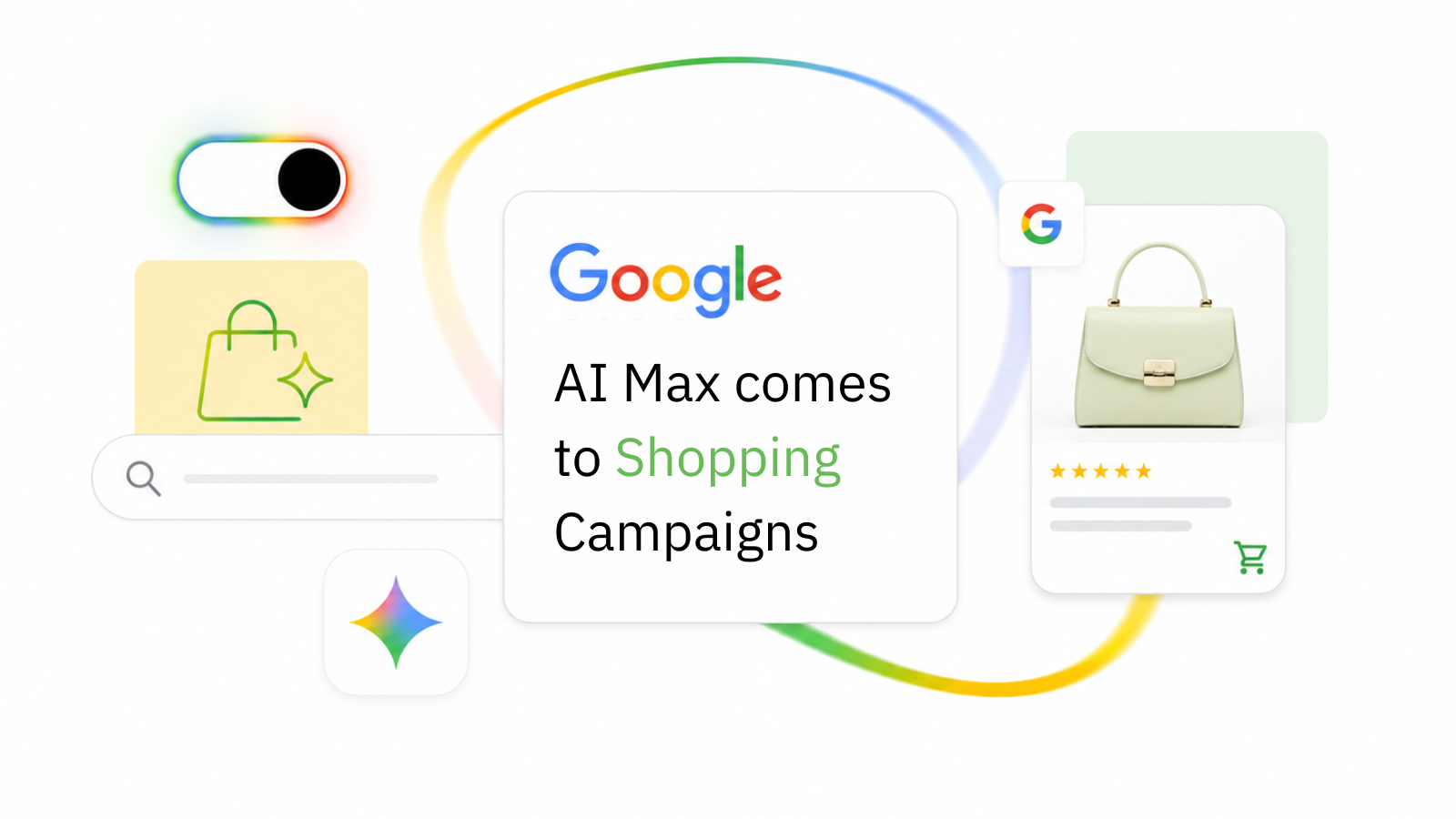
Google has just expanded its AI Max framework to standard Shopping campaigns, marking one of the most significant changes to how product ads work since the introduction of Performance Max. For eCommerce merchants who rely on Google Shopping as a primary acquisition channel, this update deserves close attention, not just for what it enables today, but for what it signals about where Google Ads is heading.
3 AI Max updates you need to know
As of April 30, 2026, with details emerging across industry coverage this week, Google announced three major AI Max updates:
1. AI Max for Shopping Campaigns
AI Max now powers standard Shopping campaigns, not just Search and Performance Max. This means your Merchant Center product feed data is used to dynamically generate Shopping ads that match conversational and long-tail search queries, the kind of complex, natural-language searches that traditional keyword-matched Shopping campaigns typically miss.
The practical impact is significant. Standard Shopping campaigns have historically been limited to matching product attributes against relatively straightforward search terms. With AI Max, Google's AI interprets shopper intent from longer, more nuanced queries and serves relevant product ads even when the search doesn't contain your exact product title or description keywords.
Google is positioning this as "a one-click upgrade for immediate incremental reach," and it's also coming to Performance Max campaigns. For merchants, this means the AI is taking a larger role in deciding when and where your products appear.
It’s not just AI changing search. In March 2026, Google introduced a triple shift, marking the end of Dynamic Search Ads. Brands now have just 5 months left to prepare for what comes next.
2. AI Brief
Powered by Gemini, AI Brief is a new tool that lets advertisers provide guidance on brand tone, messaging preferences, and audience targeting, essentially giving the AI context about your brand before it starts generating ad creative and targeting decisions.
Think of it as a briefing document for the AI. Instead of the algorithm making all creative and targeting decisions based purely on performance signals, you can now set parameters: "We're a premium brand," "Our target audience values sustainability," "Never use discount-focused language." The AI then uses these guardrails when generating ad variations.
For eCommerce merchants who've felt that automated campaigns strip away brand identity in pursuit of conversion efficiency, this is a meaningful step forward.
3. Text Disclaimers for Final URL Expansion
Final URL expansion, where Google's AI decides which landing page on your site to send users to, now supports mandatory text disclaimers. This is critical for regulated industries or any merchant with compliance requirements around advertising claims.
What this means for your campaigns
The expansion of AI Max to Shopping campaigns represents Google doubling down on a clear strategic direction: AI-mediated commerce. The traditional model, in which the merchant creates product feed, Google matches to search queries, and the shopper clicks through to the merchant's site, is evolving into something more fluid and AI-driven.
Here's what's practically changing for merchants:
1. Your product feed becomes even more critical. AI Max uses your Merchant Center data as the foundation for everything it does. Rich, accurate, well-structured product data gives the AI more to work with. Poor data quality limits what it can do. If you haven't invested in feed optimisation recently, this is the time.
2. Long-tail search capture should improve. One of the persistent frustrations with Shopping campaigns has been their inability to capture more conversational queries. AI Max directly addresses this. If someone searches "comfortable running shoes for flat feet that work on concrete," AI Max can potentially match that to your relevant products even if those exact terms aren't in your feed.
3. Creative control is changing, not disappearing. The introduction of AI Brief suggests Google recognises that pure algorithmic control doesn't work for every brand. The ability to set creative and messaging guardrails is a direct response to advertiser feedback.
4. Measurement complexity increases. With the AI making more targeting and creative decisions, understanding what's actually driving performance becomes harder. Google simultaneously announced new data, experimentation, and marketing mix modelling (MMM) tools designed to help advertisers measure impact, a tacit acknowledgement that as automation increases, so does the measurement challenge.
How to prepare your campaigns for AI Max
1. Audit your product feed quality. Ensure titles are descriptive and include relevant attributes. Ensure descriptions are comprehensive. Add missing attributes. AI Max can only work with what you give it.
2. Prepare your AI Brief. Start documenting your brand guidelines, messaging do's and don'ts, and audience insights. When AI Brief becomes available for your account, you'll want to have this ready.
3. Review your Shopping campaign structure. With AI Max extending the reach of standard Shopping campaigns, consider whether your current campaign structure still makes sense or whether consolidation might give the AI more data to work with.
4. Set up measurement baselines now. Before enabling AI Max, document your current performance metrics. You'll want clean before-and-after comparisons.
5. Don't rush to enable everything at once. Google positions this as a one-click upgrade, but one-click changes to how your ads are served deserve careful testing. Enable on a subset of campaigns first and monitor results.
The bigger picture: Where Google is taking this
This update arrives in the same week that Google expanded its Universal Commerce Protocol (UCP) checkout to the main search results; previously it was only available in AI Mode. Taken together, these moves paint a picture of Google building an end-to-end AI-powered commerce experience: AI matches shoppers to products, AI generates the ad creative, and UCP enables checkout without ever leaving Google.
For eCommerce merchants, the message is clear: AI-mediated commerce isn't a future concept, it's the current direction of the world's largest advertising platform. The merchants who invest in feed quality, structured data, and understanding how AI systems interpret their brand will have a significant advantage over those who don't.
The transition won't happen overnight, and traditional Shopping campaigns aren't going away immediately. But the direction of travel is unmistakable, and the time to prepare is now.
On Tap helps eCommerce businesses navigate platform changes and optimise their digital commerce strategy. Get in touch with our team, and we will help you get there.