 Best full-service eCommerce agency 2026



AI is being talked about everywhere in eCommerce right now. Platforms are adding it, your competitors are leading with it, and the industry press is full of predictions about what it will change next. According to McKinsey, 88% of organisations are now regularly using AI in at least one business function, up from 78% the previous year. The question that matters is not whether AI is worth the attention it is getting, but whether it is worth your time and budget, and if so, where to start.
This guide cuts through the noise to show you where AI in eCommerce is delivering real value today, how the technology is transforming day-to-day operations, and which use cases are worth prioritising if you want fast, tangible impact.
The AI eCommerce explosion
By 2027, 80% of retail CEOs want their companies to leverage AI-powered intelligent automation, a figure that reflects growing strategic commitment rather than mere curiosity.
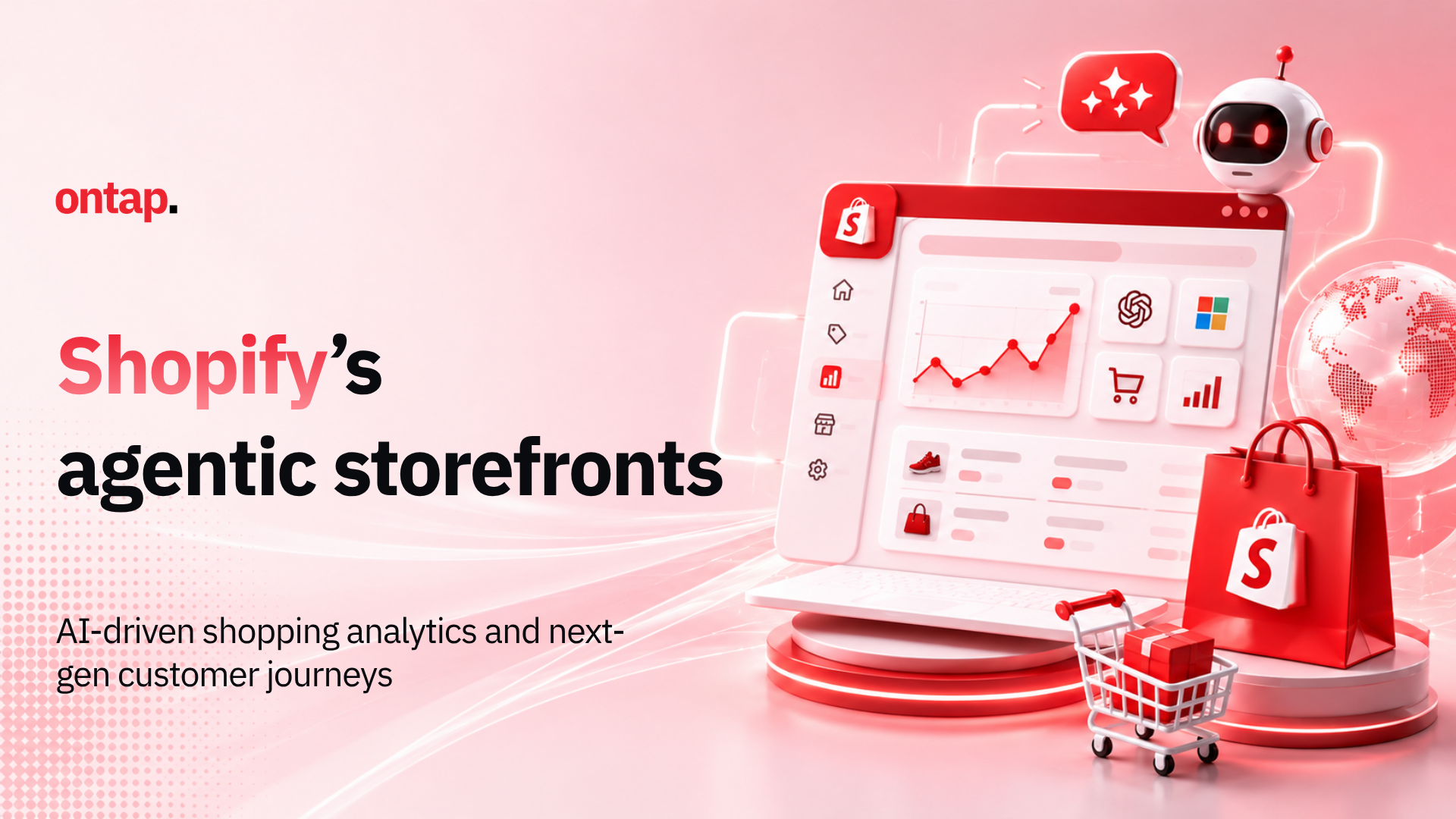
The most significant shift, however, is agentic AI. AI agents are systems that can autonomously research, compare, and purchase on behalf of consumers. They are projected to generate between $3 and $5 trillion globally in eCommerce revenue by 2030, with $1 trillion in the US alone. On the consumer side, over half of US consumers already report turning to tools like ChatGPT or Gemini to browse and buy online. With the AI-powered shopping assistants, one in three shoppers is actively interested in having AI anticipate their needs before they articulate them.
Other AI applications are also widely adopted across eCommerce, as NVIDIA reported:
-
Content generation for marketing (60%)
-
Predictive analytics (44%)
-
Personalised marketing and advertising (42%)
-
Customer analysis and segmentation (41%)
-
Digital shopping assistants (40%)
Yet for all the momentum, full-scale AI adoption remains rare. According to McKinsey's State of AI report, only 7% of organisations have fully scaled their AI programmes, with the majority still experimenting or piloting. As the technology continues to evolve and use cases become better understood, that gap will narrow. For businesses that have not yet committed, the opportunity is still there. The early majority of adopters have not yet pulled away, and there is still time to build a strong position, provided the investment is approached with the right priorities and realistic expectations.
Is AI in eCommerce really worth it, or is it overhyped?
The honest answer is: both, depending on what you are trying to do with it.
AI in eCommerce is not hype. But it is not a shortcut to growth either. The technology is genuinely capable, and a growing number of use cases are delivering real, measurable results. The problem is that expectations frequently run ahead of what businesses are actually ready to implement.
Where AI tends to deliver real business value
A Shopify Merchant Survey reveals 75% of business owners now use AI tools in their operations. This reflects a practical shift in how merchants are running their businesses, starting with foundational AI applications to remove bottlenecks, produce more output with the same resources, and respond faster to trading demands.
The commercial impact of that adoption is already visible at scale. Salesforce data from over 1.5 billion shoppers showed that during the 2025 holiday season, AI agents directly drove 20% of all retail sales, contributing $262 billion in revenue. Retailers that knew how to leverage AI agents grew sales at a rate 59% higher than those that did not. These are not projections or pilot results. They are outcomes from businesses operating at scale, across a peak trading period where performance gaps between retailers are most visible.
Where expectations often run ahead of reality
The results above are real. But they do not tell the full story. BCG research found that only 22% of companies have moved beyond the proof-of-concept stage to generate some value from AI, and just 4% are creating substantial value. Technology is not the problem. The bottleneck is readiness: clean data, clearly defined processes, and the operational infrastructure to act on what AI produces.
The use cases that attract the most attention, such as deep personalisation at scale, autonomous shopping assistants, and predictive merchandising, tend to come with the steepest requirements. Most businesses are further from that baseline than they realise, which is why the gap between piloting AI and scaling it remains so wide.
BCG also found that the companies generating the most value focus on a small number of high-priority opportunities and get the foundations right before expanding. Those that spread their efforts too broadly, or lead with the most exciting use case before the infrastructure is ready, tend to cycle through pilots without ever reaching meaningful impact.
AI applications across eCommerce
Before diving into the five priority use cases, it helps to understand where AI is actually being applied in eCommerce today, and what each area is capable of delivering.
|
Application area |
What it covers |
What it delivers |
|
Content production |
Product descriptions, SEO copy, marketing materials, email campaigns |
Higher output volume without proportional headcount growth |
|
Personalisation and merchandising |
Product discovery, semantic search, dynamic recommendations, bundling, homepage adaptation |
Revenue uplift when supported by sufficient data and clear customer signals |
|
Conversational commerce |
AI chatbots, shopping assistants, FAQ automation, returns handling, post-purchase support |
Reduced support costs and, increasingly, direct revenue contribution |
|
Productivity and operations |
Order processing automation, inventory synchronisation, cross-channel reconciliation |
Operational cost reduction and fewer manual errors, often without customer-facing visibility |
|
Analytics and reporting |
Demand forecasting, customer segmentation, insight generation, automated reporting |
Faster, more accurate outputs that free teams to focus on decisions rather than data preparation |
|
Fraud detection and security |
Transaction monitoring, anomaly detection, suspicious behaviour flagging, identity verification |
Reduced fraud losses and faster risk identification without adding manual review overhead |
|
Localisation and market expansion |
Currency and tax adaptation, local SEO, cultural content adaptation, region-specific promotions, and multilingual customer support |
Faster market entry with content and experiences tailored to local audiences at scale |

Not all of these will be the right starting point for every business. The five use cases that follow are the ones most likely to deliver fast, tangible results across a range of eCommerce operations and team sizes.
The 5 best AI use cases to start with
Content production: Product description generation

For most eCommerce teams, keeping product content accurate, complete, and optimised across a large or frequently changing catalogue is a persistent drain on time and resources. AI addresses this directly by accelerating the production of product descriptions at a scale that manual workflows cannot match.
How it works
-
Generates titles, descriptions, tags, attributes, and FAQs based on structured inputs such as product specifications, category rules, and brand guidelines
-
Produces localised or translated versions at scale across large catalogues
-
Updates existing content in bulk when product information changes
How it helps your business
Good product content does two things: it helps shoppers make confident purchase decisions, and it helps search engines understand what you are selling. AI makes it possible to achieve both at scale, across large catalogues, without the manual overhead that typically makes this a bottleneck. Teams can launch new product lines faster, keep existing content accurate, and maintain SEO performance across thousands of SKUs without proportional increases in resources.
One important note: Human review remains essential for brand voice, product accuracy, and pricing claims. AI accelerates production but does not replace editorial judgement.
Where the costs sit
Tool subscription, prompt and workflow setup, and human QA to maintain brand voice and product information accuracy.
Best suited to
Stores with large or frequently changing SKU volumes, lean content teams, and businesses that regularly launch or update products.
Personalisation and merchandising: Dynamic recommendations and bundling

Shoppers who cannot find what they are looking for may leave for competitors. Shoppers who are not shown relevant alternatives tend to buy less than they could. AI-powered dynamic recommendations and bundling address both by continuously analysing shopper behaviour and surfacing the products they are most likely to want, at the point in the journey where it matters most.
How it works
-
Analyses real-time browsing behaviour, purchase history, and session signals to surface relevant product suggestions
-
Powers "you may also like" carousels, cross-sell and upsell prompts, and bundle suggestions across the site
-
Adapts homepage and category modules based on who is visiting and how they are behaving
How it helps your business
Relevant recommendations improve product discovery, increase average order value, and raise the likelihood of repeat purchases. Because this use case sits close to conversion, its revenue impact tends to be more direct and measurable than most other AI applications in eCommerce.
Where the costs sit
Platform and integration costs are higher here than for content tools. Setup requires more technical resources and a longer implementation timeline. Budget should also account for ongoing feed quality management and merchandising logic maintenance as the catalogue evolves.
Best suited to
Stores with broad catalogues, sufficient traffic volume to generate meaningful behavioural signals, and businesses where product discovery friction is already an identified and measurable problem.
|
Learn more: Want to go deeper on personalisation in eCommerce? On Tap's guide covers the strategies, features, and implementation considerations worth knowing before you invest. |
Conversational commerce: AI chatbot and FAQ automation
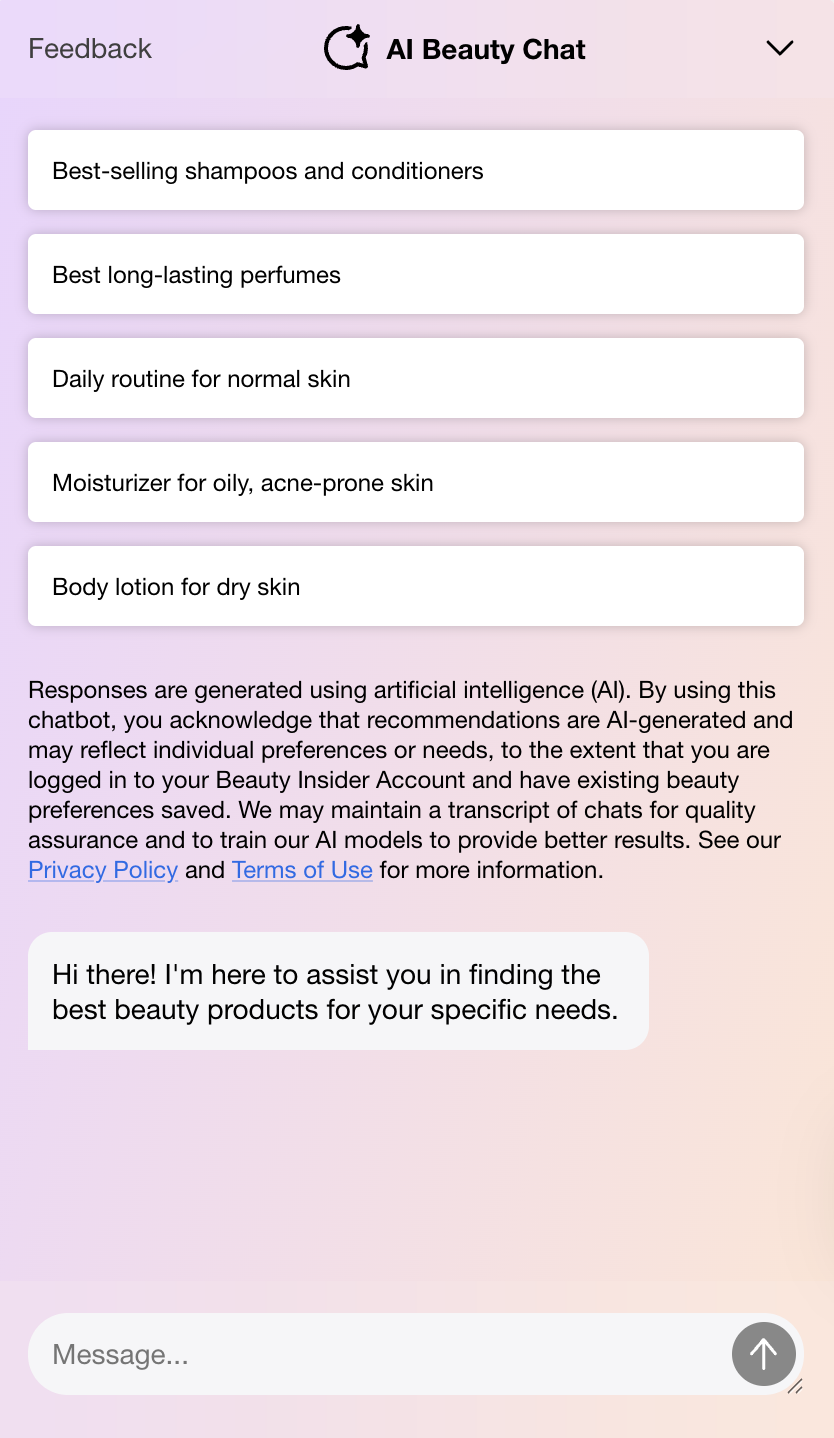
A large share of inbound support queries in eCommerce is predictable. Shipping times, return policies, order status, and product details are the same topics, asked repeatedly by different customers. Handling them manually is time-consuming and scales poorly as the business grows. AI chatbots and FAQ automation have evolved significantly from the rule-based tools of a few years ago, and the most capable implementations today can handle complex, multi-turn conversations and resolve issues directly without escalating to a human agent.
How it works
-
Handles repetitive inbound queries around shipping, returns, order status, product information, and policy questions through an automated response layer
-
Manages multi-turn conversations and escalates to human agents when the query requires judgment or sensitivity
-
Operates across web, app, and messaging channels without requiring additional headcount as query volumes grow
How it helps your business
AI chatbots and FAQ automation reduce the volume of queries handled by human agents, freeing the support team to focus on interactions that genuinely require their attention. Faster response times improve customer satisfaction, particularly for pre-purchase queries where a delayed answer can cost a sale.
Where the costs sit
Chatbot or app subscription, knowledge base setup and ongoing maintenance, and quality monitoring to ensure responses remain accurate as products, policies, and processes change. The initial setup investment is moderate, but the ongoing maintenance requirement is often underestimated.
Best suited to
Stores with high pre-purchase query volumes, businesses with a heavy repeat support burden, or small customer service teams managing more tickets than their current capacity allows.
Productivity and operations: Automated order processing

Order processing is one of the most operationally intensive areas of eCommerce, and one of the least visible to customers. Validation, routing, exception handling, and cross-channel reconciliation consume significant team time when managed manually, and the risk of errors grows proportionally with order volume. AI automation addresses this by taking on the repetitive, rule-based work that currently sits with operations teams.
How it works
-
Automates order validation, routing, and exception handling across sales channels without manual intervention
-
Monitors for anomalies such as duplicate orders, payment mismatches, and fulfilment delays, and flags issues for human review
-
Manages the flow of order data between platforms, keeping inventory, fulfilment, and customer records aligned in real time
How it helps your business
Order processing automation reduces the manual effort involved in day-to-day order management and accelerates fulfilment cycles. Fewer manual touchpoints mean fewer errors, which translates directly into lower refund rates, fewer customer complaints, and stronger operational margins. For businesses operating across multiple sales channels, it removes the complexity of reconciling orders, stock, and returns without proportional increases in headcount.
Where the costs sit
Integration setup, platform or middleware subscription, and the time required to map existing order workflows before automation can be applied. The more complex the current process, the more investment the initial setup requires. Ongoing costs are generally low once the system is running, making this a use case with strong long-term return on investment.
Best suited to
Merchants managing high order volumes, businesses operating across multiple sales channels, and operations teams where manual processing is a known constraint on growth.
Analytics and reporting
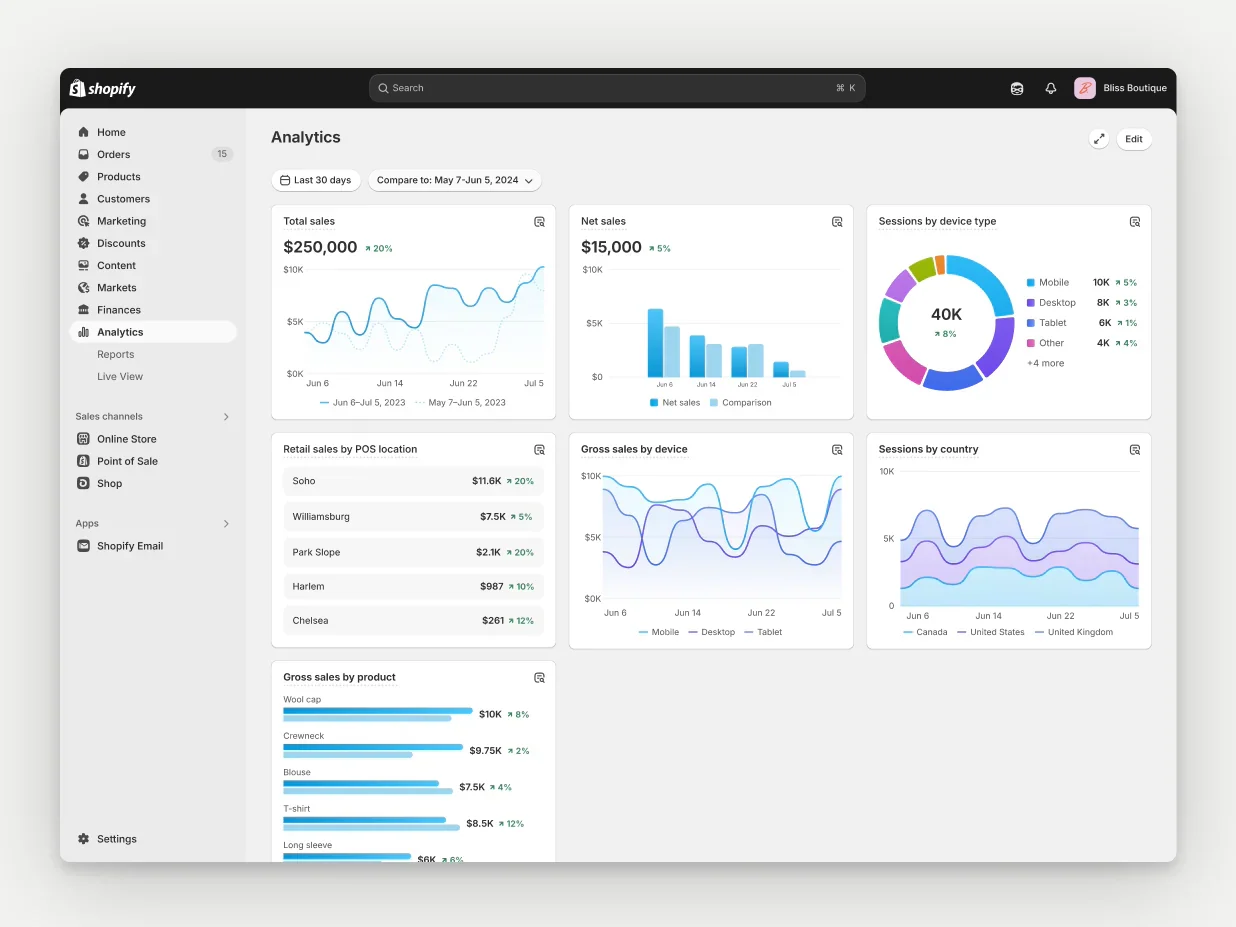
Most eCommerce teams have access to more data than they have time to process. Trading reports, customer behaviour, campaign performance, inventory levels, and demand signals all generate information that could inform better decisions, but only if someone has the capacity to analyse it. AI transforms that equation by processing large volumes of data faster and more consistently than manual analysis allows.
How it works
-
Processes large volumes of trading, customer, and operational data to surface patterns and generate forecasts
-
Produces automated reports and trading summaries that would otherwise require manual compilation
-
Identifies anomalies, flags underperforming areas, and surfaces actionable insights on demand
How it helps your business
AI analytics tools give merchants faster access to the insights they need to make better decisions. Businesses that leverage demand forecasting effectively make more accurate buying decisions, reduce dead stock, and minimise stockouts across categories and channels.
Where the costs sit
Tool access, data integration, and the time needed to build reporting templates and forecasting models that reflect how the business actually operates. The quality of the output depends directly on the quality and structure of the data going in.
Best suited to
Data-rich businesses where the bottleneck is analysis rather than collection, merchants with complex or seasonal buying cycles, and teams spending disproportionate time compiling reports rather than acting on them.
|
Where to start If the priority is quick wins, low risk, and cost-conscious implementation, content generation, FAQ automation, and order processing are the natural starting points. That said, every business has a different starting point. For a clearer view of which AI use cases are worth prioritising given your current operation, team, and budget, our specialists are happy to help. |
What happens if you ignore AI in eCommerce?
You can run a successful eCommerce business without AI. Many do. But the businesses investing in it now are building execution advantages that compound over time, in speed, cost efficiency, and the ability to scale without proportional headcount growth.
The real risks of deferring AI adoption are not dramatic. They are structural:
-
Slower execution speed compared to competitors who are iterating faster with AI-assisted tooling
-
Higher cost per output, particularly in content production, customer support, and data analysis
-
Teams stuck in manual work that could be automated, limiting their capacity for strategic activity
-
Difficulty scaling without proportional headcount growth, as operational complexity outpaces team capacity
It is also worth noting the opposite risk: applying AI to the wrong problems, investing in tools that solve bottlenecks you do not actually have, or expecting AI to compensate for poor data infrastructure or unclear processes.
Both failure modes are common. The businesses that benefit most from AI are those that approach it as an operational problem to be solved, not a technology to be adopted for its own sake.

How to start using AI in eCommerce without wasting budget
AI budgets are easy to waste, especially when you are early in adoption and tempted to try everything at once. Tools get purchased before problems are defined, pilots run without clear success criteria, and implementations expand before the initial use case has proven anything.
The principles below are designed to help you avoid those patterns.
1. Audit the processes consuming the most time, cost, or causing friction: Start with what is actually slowing your business down. The best AI use case is the one that solves a real, felt problem, not the one that looks most impressive in a vendor demo.
2. Choose a small number of use cases to begin with: Trying to implement AI across content, personalisation, support, and operations simultaneously is a reliable way to achieve mediocre results across the board. Start narrow, go deep.
3. Prioritise pre-built tools before considering custom development: Unless your requirements are genuinely unique, purpose-built AI products, properly configured, will almost always outperform bespoke builds on a cost and time-to-value basis.
4. Set clear success criteria before you start: Whether it is time saved per week, reduction in support tickets, faster content production, or improved search conversion, define what good looks like in advance so you can measure it.
5. Keep humans in the loop on the things that matter most: Brand voice, pricing decisions, product accuracy, and customer trust touchpoints all require human oversight. AI accelerates; it does not replace judgment in the areas where judgment counts.
6. Only scale after proving tangible value from the initial implementation: The businesses that get the most from AI are those that resist the temptation to expand before they have demonstrated results. Prove it works, then build on it.
7. Keep 24/7 monitoring in place while rolling out AI: New AI tools and scripts can introduce performance, security or technical regressions that only appear under live traffic. Continuous visibility is essential to catch these issues early. AuditIQ is designed to track Core Web Vitals, uptime, JS errors and overall store health in real time, so problems are flagged before they impact conversion. Beyond these checks, AuditIQ is an eCommerce monitoring platform that also covers security, configuration changes, SEO & GEO health and frontend stability from a single dashboard.
Where to go from here
AI in eCommerce is not a future consideration. For a growing number of merchants, it is already transforming competitive dynamics across content production, customer acquisition, and operational efficiency. Most businesses are somewhere in the middle: aware of the opportunity, but not yet leveraging AI in a way that delivers consistent, measurable returns.
That middle ground is where the most significant commercial advantage will be won or lost over the next two to three years. The businesses that close the gap between experimentation and scaling are not necessarily the ones with the biggest budgets. They are the ones that identified the right problems and expanded from a position of proven value.
If you are ready to move from experimentation to impact, On Tap is well-placed to help. Our team has been helping eCommerce businesses navigate complex technology decisions for over 20 years, across Magento, Adobe Commerce, Shopify, and beyond. Get in touch with our team to discuss how AI can be applied to your specific eCommerce challenges.