 Best full-service eCommerce agency 2026


A new study from Quantum Metric, covered by Retail Dive on 20 May, reveals a paradox at the heart of AI-driven commerce that every merchant needs to understand: customers who discover your brand through AI are extraordinarily valuable - until they are not.
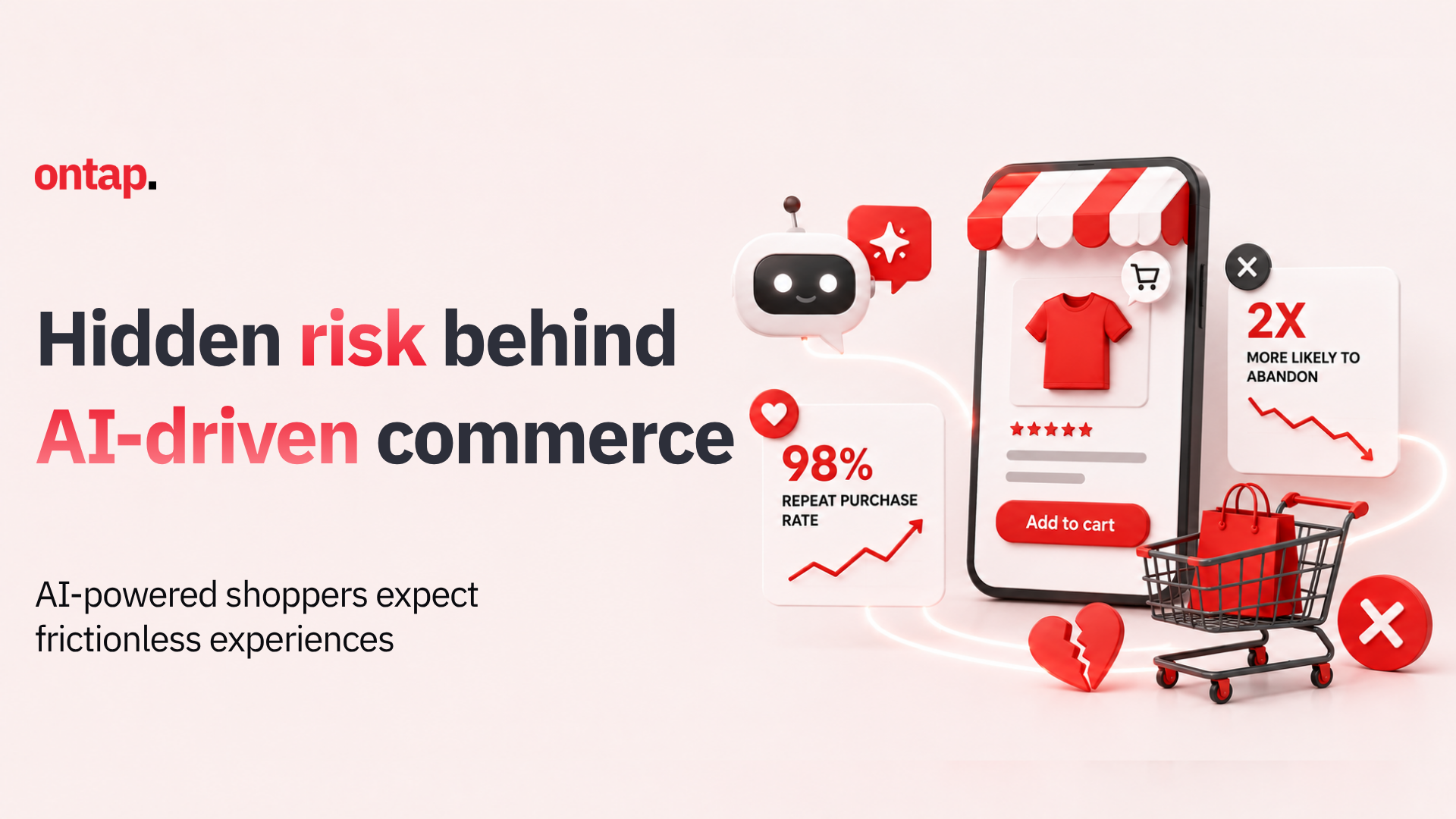
The headline numbers are striking. Nearly 98% of consumers make repeat purchases from brands recommended by third-party AI platforms. That is a loyalty rate that would impress any retention marketer. But here is the catch: those same customers are twice as likely to abandon their cart if they experience any friction, and four out of five say they will not return to a brand they discovered through AI if they have a negative experience.
This is not just an interesting data point. It is a fundamental insight into how AI is reshaping the psychology of shopping, with immediate implications for how you build, optimise, and operate your store.
Why AI referrals create extreme behaviour
To understand why AI-referred customers behave so differently, you need to understand the implicit contract they have made. When a customer asks an AI assistant for a recommendation, they are outsourcing their trust. They are saying, "I trust this AI to find me the best option." When the AI recommends your brand, that customer arrives with borrowed confidence - they believe your brand is good because a system they trust told them so.
This creates what Info-Tech Research Group's Principal Research Director Julie Geller describes as a validation window. As she noted in commentary reported by Retail Dive: "Customers are looking to quickly confirm that the recommendation was justified, so brands need to reinforce the 'why' immediately through reviews, clear positioning and strong proof points. If that validation isn't obvious, confidence drops fast."
The borrowed confidence is powerful but fragile. Unlike customers who have done their own research, compared options, and chosen your brand deliberately, AI-referred customers have not built their own conviction. That means any friction - a slow page load, a confusing checkout, a missing product detail - does not just create frustration. It undermines the entire premise of why they are there. The AI told them this was the best option. If the experience does not confirm that, the customer leaves with a negative impression of both your brand and the recommendation.
The loyalty paradox
The flip side is equally compelling. When the experience validates the recommendation, something powerful happens: the customer's borrowed confidence converts into genuine loyalty. The 98% repeat purchase rate suggests that once an AI-referred customer has a good experience, they become more loyal than customers acquired through traditional channels.
The Quantum Metric data reinforces this further. Only 13% of consumers say they use AI to confirm an existing choice, while half say they use it to find the best option. This means AI is primarily a discovery channel. Your brand is being introduced to entirely new audiences through AI recommendations, and the quality of that first experience determines whether it becomes your most valuable acquisition channel or a one-shot disappointment.
What this means for your store
-
Your landing experience is now your most important conversion tool
When traffic comes from AI referrals, the first few seconds after arrival are critical. The customer needs immediate confirmation that the AI was right. This means:
-
Social proof must be visible above the fold. Reviews, ratings, and trust signals should be the first things an AI-referred customer sees. Don't hide your 4.8-star rating at the bottom of the page.
-
Product positioning should be explicit. Don't make customers guess why your product is the best choice. State it clearly: "Best-rated running shoe for flat feet" or "Editor's Choice for home espresso machines."
-
Page speed is non-negotiable. If your site takes more than two seconds to load, you're losing AI-referred customers at double the rate of organic visitors.
-
Friction tolerance is essentially zero
The 2x cart abandonment rate means that every friction point in your checkout is twice as costly for AI-referred traffic. Audit your checkout for:
-
Mandatory account creation (offer guest checkout prominently)
-
Unexpected shipping costs or fees
-
Complex form fields or unnecessary data collection
-
Payment method limitations
-
Unclear return policies
-
Your product data shapes the recommendation
AI systems recommend products based on the data they can access. If your product descriptions are thin, your reviews are sparse, or your structured data is incomplete, you're less likely to be recommended in the first place - and when you are, the customer arrives with less context, making the validation window even harder to navigate.
This connects directly to what Google announced at Marketing Live 2026 with Conversational Attributes in Merchant Centre. The richer your product data, the more accurately AI systems can match your products to customer queries, and the more likely the referred customer's expectations will align with reality.
-
Track AI referral sources separately
If you're not already segmenting your analytics by AI referral sources, start now. Look at:
-
Conversion rates for AI-referred traffic vs. other channels
-
Cart abandonment rates by source
-
Return visit rates for first-time AI-referred customers
-
Average order values
This data will tell you whether your store is successfully converting borrowed confidence into genuine loyalty, or whether you're leaking valuable customers through experience gaps.
The strategic takeaway
AI referrals represent one of the highest-stakes customer acquisition channels most eCommerce merchants have encountered. The upside - near-universal repeat purchasing - is extraordinary. The downside - near-universal abandonment after a bad experience - is equally extreme.
The merchants who win in this environment will be the ones who obsess over first-impression quality. Not just website design, but the entire experience: fast loading, clear value propositions, prominent social proof, frictionless checkout, and product data rich enough to set accurate expectations before the customer ever arrives.
In a world where AI is becoming the primary discovery mechanism, and where half of consumers use it specifically to find the best option, being "good enough" is not enough. You need to be obviously, immediately, and unmistakably the right choice. Because when an AI sends a customer your way, you get one chance to prove it was right.
How On Tap can help
At On Tap, we are an eCommerce agency helping merchants optimise for the AI-driven shopping landscape - from product data and structured content to site performance and checkout experience. If you want to ensure your store converts AI referrals into loyal customers, get in touch with our team.