
Every eCommerce business tracks conversions. Most can tell you which channels, campaigns, and ads drove those conversions, at least according to their attribution model. But here is the uncomfortable question most attribution dashboards cannot answer: would those customers have bought anyway?
That question, the gap between attributed conversions and truly incremental ones, is where most eCommerce marketing budgets leak. And as channel costs rise and measurement becomes more fragmented, closing that gap is becoming one of the most consequential improvements an eCommerce business can make.
The problem with attribution alone
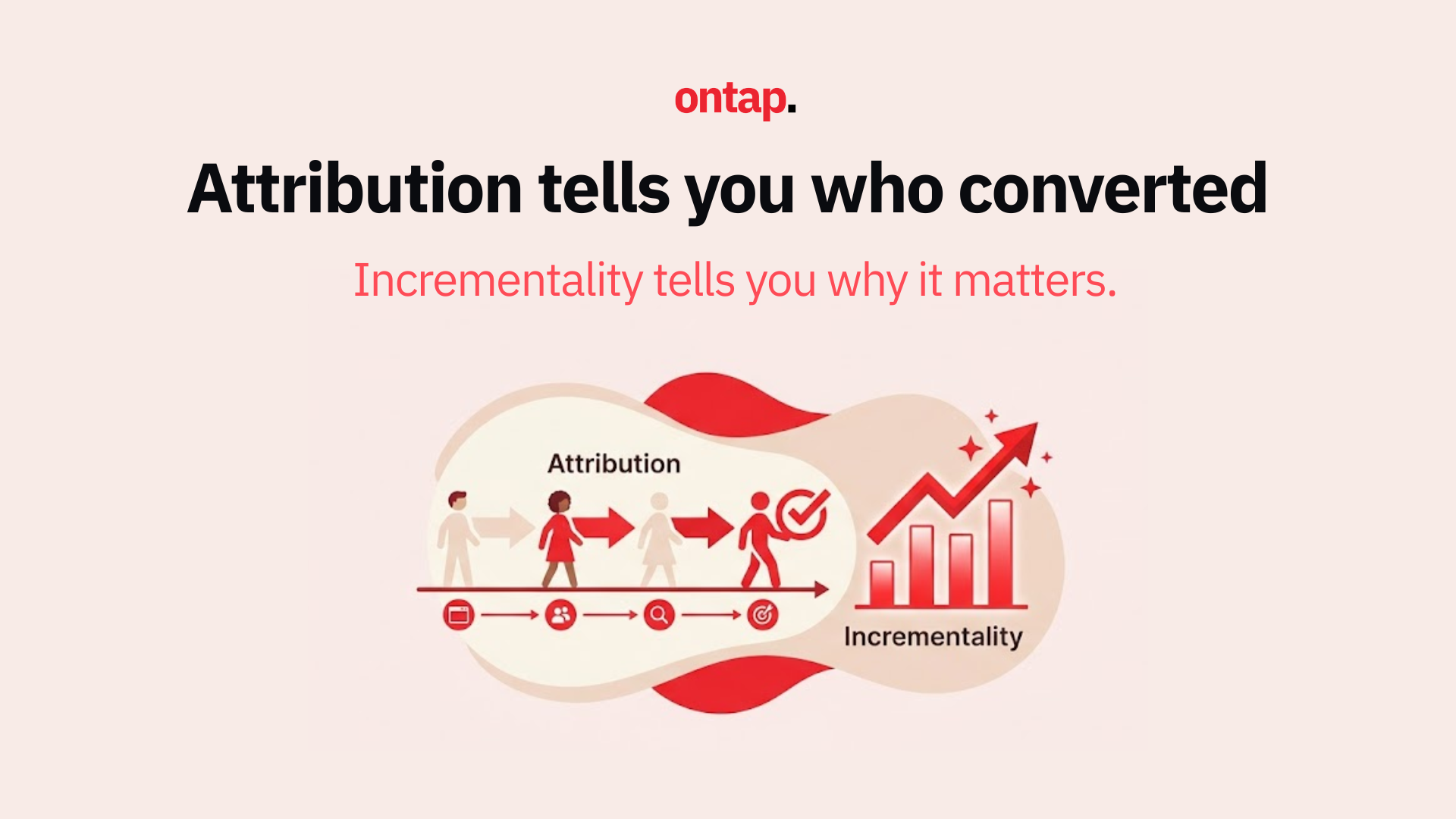
Attribution models assign credit for a conversion to the marketing touchpoints a customer interacted with before purchasing. Last-click gives all the credit to the final touchpoint. Multi-touch distributes it across the journey. Both approaches answer the same question: which channels were involved in the path to purchase?
What neither approach answers is whether the marketing caused the purchase. A customer who searches for your brand name, clicks a branded paid search ad, and buys would have purchased anyway. Your branded search ad captured the conversion. It did not create it. Attribution says paid search drove that sale. Incrementality measurement would reveal the ad was redundant.
This distinction matters enormously at scale. If 20% of your paid search conversions are from customers who would have purchased through organic search without the ad, that is 20% of your search budget generating zero incremental revenue. For a merchant spending £50,000 a month on paid search, that could represent £10,000 per month in wasted spend.
Why this is getting worse, not better
Three forces are widening the gap between attribution and reality for eCommerce businesses.
-
Signal loss: Cookie deprecation, iOS privacy changes, and consent management have eroded the data quality that attribution models depend on. Multi-touch attribution in particular has become less reliable as tracking gaps create incomplete journey data.
-
Platform automation: Google's decision to separate Target CPA and Target ROAS as standalone bidding strategies from 17 August 2026 highlights how much control advertisers are ceding to algorithmic optimisation. When algorithms optimise towards conversion targets, they naturally gravitate towards the easiest conversions, which are often the least incremental. Without incrementality measurement, you cannot tell whether the algorithm is finding new customers or harvesting existing demand.
-
Channel proliferation: As merchants add channels, including ChatGPT Ads, TikTok Shop, retail media networks, and delivery marketplace advertising, the overlap between channels increases. A customer might see your product on TikTok, search for it on Google, and buy through your website. Three channels claim attribution credit for one conversion. Only incrementality testing reveals which exposure actually influenced the purchase decision.
How incrementality measurement works
The core concept is straightforward: compare what happened with your marketing to what would have happened without it. The most common approaches include:
-
Geo-based holdout tests: Run your campaign in some geographic regions and withhold it from others. Compare conversion rates between the two groups. The difference is your incremental lift.
-
Audience-based holdout tests: Split your target audience into exposed and unexposed groups. Measure the conversion difference. This works well for channels such as display and social where you can control who sees the ad.
-
Media mix modelling (MMM): Use statistical analysis of historical data to estimate the incremental contribution of each channel. Less precise than holdout tests, but applicable across all channels simultaneously. Nearly half of US marketers now plan to invest in incrementality and MMM tools in 2026, a significant shift from the attribution-only approach that dominated the previous decade.
-
Platform-level experiments: Google, Meta, and other platforms offer built-in incrementality testing tools. These are useful starting points, though they obviously measure incrementality within their own ecosystem.
What this means for eCommerce budget decisions
The practical implication is that most eCommerce businesses are systematically over-investing in some channels and under-investing in others. Attribution tells you where conversions happen. Incrementality tells you where marketing creates value. The two are often very different.
Here is a common pattern: branded paid search shows a high ROAS in attribution reports, so it gets a large budget allocation. Prospecting display campaigns show a low ROAS, so they get cut. But incrementality testing reveals that branded search has near-zero incremental impact; those customers were coming anyway, while prospecting display is creating new demand that eventually converts through other channels.
The budget allocation that attribution recommends is almost the inverse of what incrementality data would support.
A practical framework for getting started
You do not need a data science team to start measuring incrementality.
-
Start with your largest spend channels: Focus incrementality testing on the channels consuming the most budget. That is where the largest potential savings, or validation, lies.
-
Run geo-based holdout tests: Pick a geographic region, pause a campaign there for two to four weeks, and measure the impact on conversions in that region. This is the simplest and most convincing form of incrementality evidence.
-
Compare attributed ROAS to incremental ROAS: For every major channel, calculate both. The gap between them reveals how much of your attributed performance is genuinely incremental.
-
Use incrementality data to inform bidding strategy: As Google separates Target CPA and Target ROAS into standalone strategies, use your incrementality findings to set more informed targets. If a channel delivers strong incremental value, a higher target CPA may be justified. If incrementality is low, tighten the target.
-
Retest regularly: Incrementality is not static. It changes as your brand grows, your competitive landscape shifts, and your channel mix evolves. Quarterly testing cadence is a reasonable starting point.
The bigger picture
Attribution and incrementality are not competing approaches. They answer different questions. Attribution tells you the operational story of how conversions flow through your marketing channels. Incrementality tells you the economic story of which marketing investments are actually creating value.
Every eCommerce business has attribution. Very few have incrementality measurement. And the ones that do consistently find that their budget allocation looks very different from what attribution alone would suggest.
In a market where customer acquisition costs are rising, and marketing budgets are under scrutiny, knowing which pounds are working and which are wasted is not a nice-to-have. It is the difference between a marketing function that drives growth and one that reports on conversions while quietly subsidising demand that would have existed anyway.
About On Tap
On Tap is a growth-focused eCommerce consultancy helping mid-market and enterprise merchants build marketing measurement frameworks that distinguish between attributed and incremental value. From incrementality testing design and media mix modelling to bidding strategy optimisation and budget reallocation, On Tap helps merchants ensure their marketing spend creates genuine growth, not just reported conversions.
If you want to understand which of your marketing pounds are actually working, get in touch.