 Best full-service eCommerce agency 2026


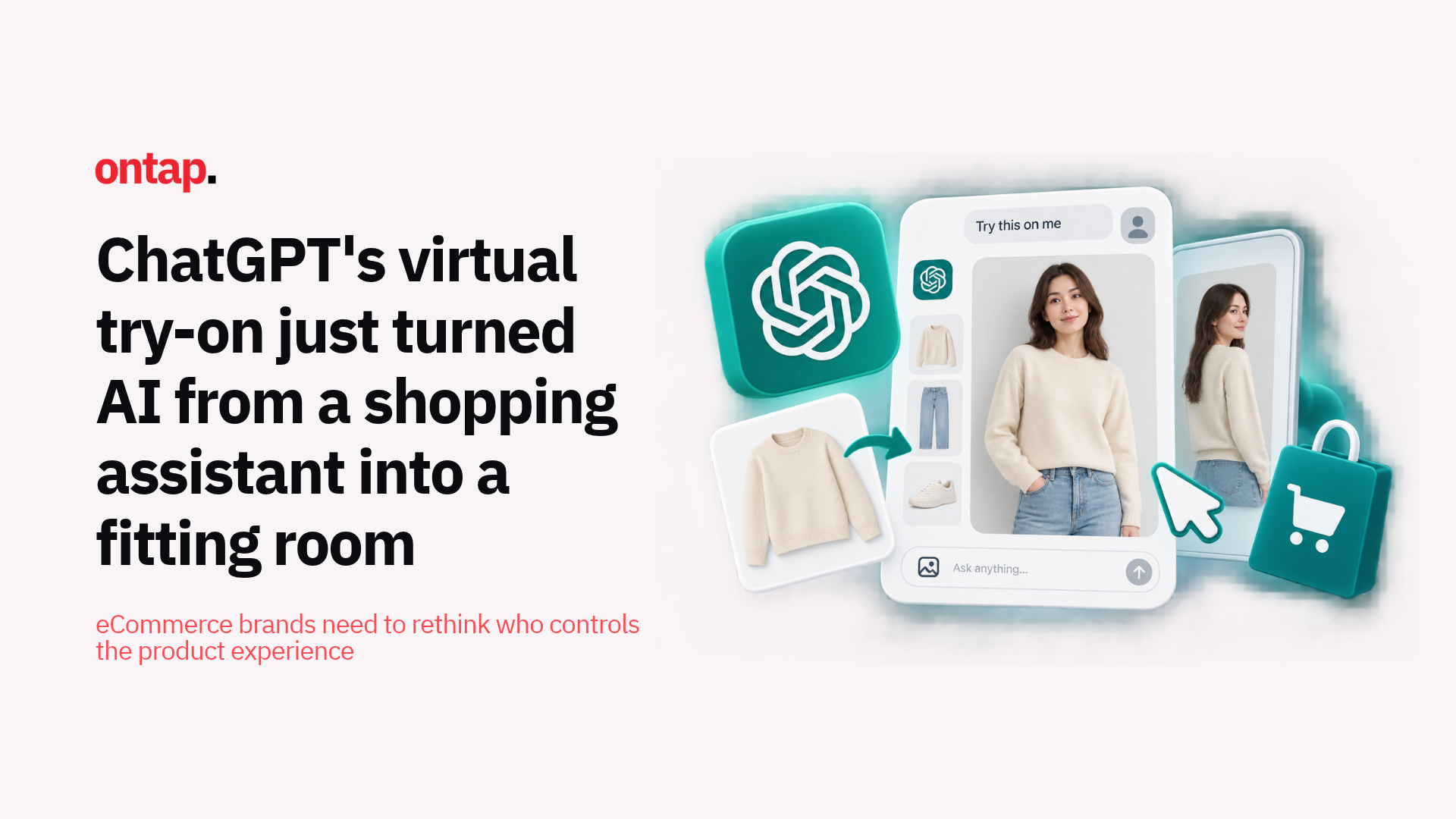
On 1 October 2026, OpenAI launched virtual try-on for ChatGPT. Users can now take or upload a selfie, click a Try on button next to clothing and accessories, and generate an image showing how the product could look on them, all without leaving ChatGPT.
This is not a gimmick. It changes where part of the product experience can happen in eCommerce. Brands selling clothing, accessories and other visually dependent products need to understand what just changed.
The product experience no longer lives only on your website
For years, eCommerce brands have invested heavily in product photography, lifestyle imagery, size guides and on-model shots. Much of that investment has been built around one assumption: the customer will evaluate the product through the visual experience the brand provides.
ChatGPT's virtual try-on changes that assumption. When a shopper discovers clothing or accessories in ChatGPT, they can now see an AI-generated version of how the product could look on them before visiting the merchant's website.
The implications cascade quickly.
-
The brand's product photos become inputs as well as outputs. ChatGPT shopping results use product imagery and product information to present products, while virtual try-on creates a new image around the shopper's reference photo. The brand controls the underlying product assets, but it does not approve each generated try-on image.
-
The fitting room is now inside the AI. Historically, many virtual try-on experiences have lived inside retailer- or brand-controlled shopping journeys. ChatGPT moves that experience into the AI platform itself. The merchant provides the product information, while ChatGPT provides the try-on interaction.
-
Product evaluation can happen before your site loads. A shopper can discover a product, compare options, and virtually try it on inside ChatGPT before clicking through to the merchant. For some eligible products and merchants, Instant Checkout can also allow the transaction to happen without leaving ChatGPT.
That means the merchant website can enter later in the decision journey than it traditionally has.
The return rate problem nobody is talking about
Here's the tension: virtual try-on can give shoppers more context before buying, but the generated image is still an approximation.
OpenAI explicitly warns that try-on images may not represent the product or the shopper's appearance exactly and do not guarantee fit or size. Customers are still advised to check the merchant's measurements, product details, and return policy before purchasing.
That distinction matters. A coat that appears in a slightly different shade, or a dress whose generated drape does not match the physical fabric, can create an expectation that the real product then has to meet.
eCommerce brands have no direct approval over each ChatGPT try-on image. They can make sure the underlying product imagery and information are accurate, but the final visualisation is generated by ChatGPT.
This matters heading into peak season. According to the ICSC survey, 49% of shoppers are concerned about being able to afford holiday gifts this year. Customers are value-conscious and comparing their options carefully.
If an AI-generated try-on creates an expectation that the physical product does not meet, any resulting return still flows through the merchant's returns operation.
What Google did first, and what ChatGPT adds
Google introduced generative AI virtual try-on in 2023 for women's tops, using a diverse range of real models, and expanded it to dresses in 2024.
But the difference between Google and OpenAI is no longer simply that ChatGPT lets customers use their own image. In May 2025, Google also introduced a personalised experience that lets shoppers upload their own photo to try on clothing, later expanding it to shoes.
What ChatGPT adds is the conversational context around the try-on.
The shopper can ask for recommendations, refine what they want, compare products and then try an item on without leaving the same AI conversation. The fitting-room experience sits inside a broader product discovery journey rather than operating as a standalone visual tool.
ChatGPT also lets shoppers save products to Favorites and organise them into folders in their Library. That gives shoppers another way to build and return to AI-curated product shortlists over time.
What eCommerce brands should do now?
1. Audit your product imagery for AI consumption: Your product photos are no longer only website assets. They can also appear in AI shopping experiences and feed the wider product context around virtual try-on. Check that the primary image accurately represents the correct variant, colour, and product. OpenAI's commerce specification requires a main product image and expects colour information to remain consistent with that image.
2. Enrich your product data with material and fit attributes: AI shopping systems need structured information to understand what they are presenting. OpenAI's product feeds support attributes including material, colour, size and size type alongside descriptions, images, availability and variant information.
This does not mean those attributes directly control how the virtual try-on image is rendered. OpenAI has not documented that relationship. But richer, accurate data gives ChatGPT better product context during discovery and gives customers more information to verify what they see.
3. Monitor how your products appear in AI try-on contexts: Test products that surface in ChatGPT and compare the generated result with the actual product. Pay particular attention to colour, silhouette, and details that materially affect purchase expectations.
If the result does not represent the product well, make sure your source imagery and product data are accurate and use ChatGPT's feedback tools where appropriate. The goal is to understand the gap before customers expose it through reviews or returns.
4. Re-evaluate your returns strategy for AI-mediated purchases: Do not assume virtual try-on will automatically reduce returns. Track return reasons for products that receive meaningful AI-driven traffic and watch for expectation gaps around colour, appearance, or fit.
If AI try-on increases product confidence and conversion, that is valuable. But the returns economics still depend on whether the generated expectation matches the physical product.
5. Invest in your owned product experience as a differentiation point: If products can be discovered and tried on inside ChatGPT, your owned storefront still matters as the place where customers can verify measurements, materials, fit notes, reviews, and other brand-controlled details.
Do not abandon the on-site experience because AI platforms offer a faster path to product evaluation. Use the owned experience as the quality anchor that gives customers more certainty before purchasing.
The bigger question: who owns the customer's product experience?
The competitive dynamic here is no longer only between brands competing for customers. AI platforms are also taking a larger role in shaping how those customers experience products before buying.
When a customer tries on your jacket inside ChatGPT and then buys it through a link to your store, who shaped that purchase decision? You provided the product and the underlying information. OpenAI provided part of the shopping experience.
This is the next evolution of the same tension that has been building across agentic commerce all year. AI systems are not just finding products for customers. They can compare them, explain them, and now show customers an AI-generated version of what they could look like wearing them.
The product page may be becoming the new homepage, but AI try-on suggests even the product page may not be where the decision begins.
For eCommerce brands, the answer isn't to resist this shift. It is to ensure that the product data and imagery feeding AI shopping experiences are accurate enough to represent the product well, while recognising that the generated try-on itself remains outside the merchant's direct control.
Better product data gives AI shopping systems better inputs. It does not guarantee a perfect output.
Peak season starts in weeks. Customers can now try products on inside ChatGPT before they visit your website. Test what they see, compare it with the real product and make sure the information around that AI-generated experience gives them enough detail to make an informed decision.
About On Tap
On Tap is a growth-focused eCommerce consultancy helping mid-market and enterprise merchants improve their digital commerce operations. From product data and storefront experience to integrations, analytics, and customer journeys, we help businesses prepare for how customers discover and buy across emerging commerce channels.
To review how your product data and storefront experience are prepared for AI-assisted shopping, get in touch.