
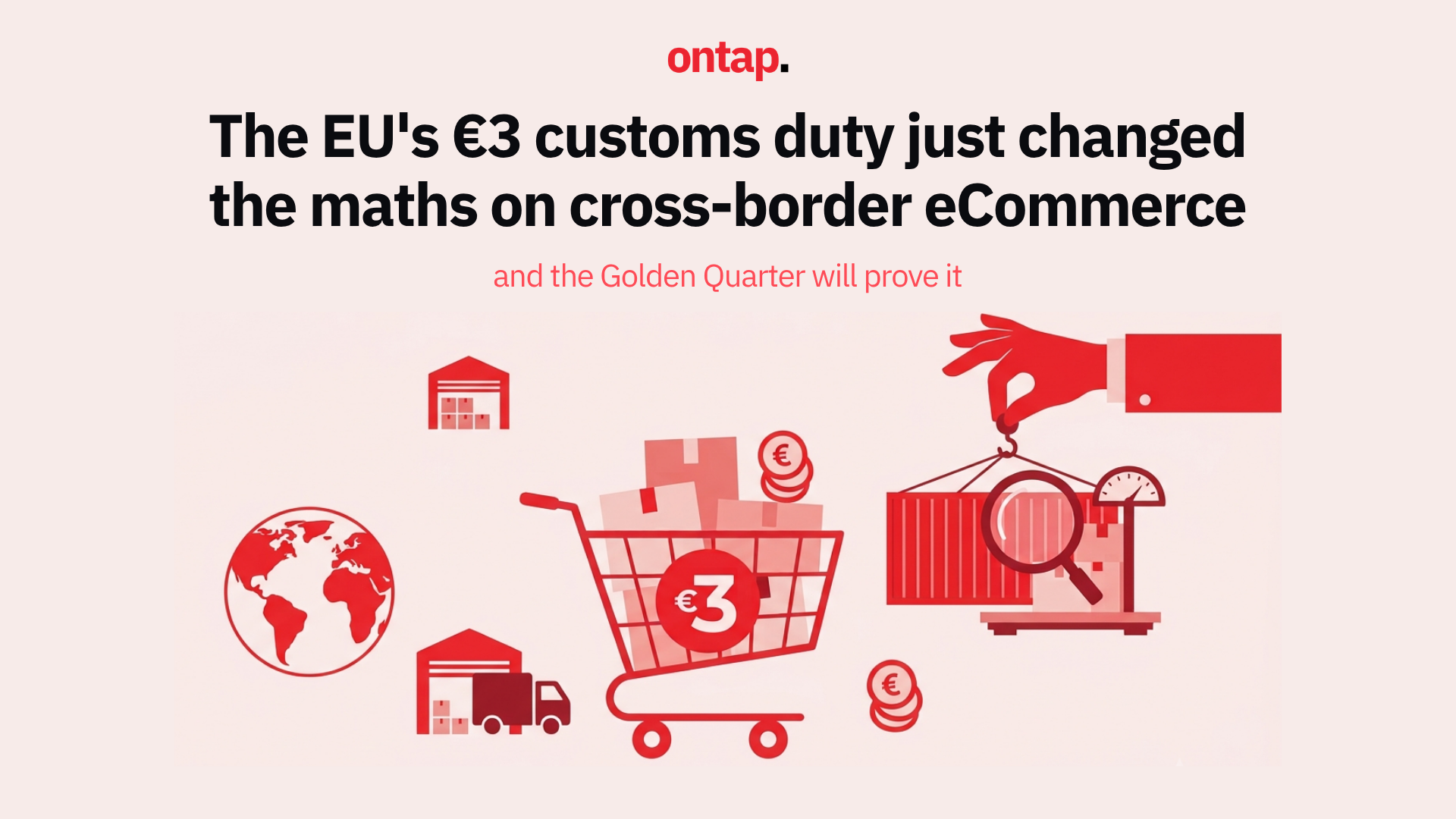
The EU's €3 customs duty just changed the maths on cross-border eCommerce, and the Golden Quarter will prove it
Since 1 July 2026, every parcel entering the European Union valued under €150 now carries a flat customs duty of €3 per item type. The previous exemption, which allowed low-value goods to cross EU borders duty-free, is gone. For eCommerce merchants selling into European markets from the UK, US, or anywhere outside the EU, this changes the fundamental economics of cross-border selling.
And the Golden Quarter, when order volumes peak and margins matter most, will be the first real test of whether those economics still work.
What the €3 duty actually means in practice
The duty applies per item type per parcel, based on customs code classification. If a customer orders three different product types in a single shipment, that is €9 in additional duty before any existing VAT or tariff obligations.
This might sound modest. For high-value goods, it is. A €200 electronics accessory absorbs a €3 duty easily. But for the long tail of low-value eCommerce, including fashion accessories, beauty products, phone cases, stationery, and gifts under €30, the duty represents a meaningful erosion of margin.
Consider a merchant selling a product for €15 with landed costs of €10. The previous margin was €5 per unit, or 33%. Add a €3 duty, and the margin drops to €2, a 60% reduction. Scale that across thousands of orders during the Golden Quarter, and the impact on overall profitability becomes significant.
Why the Golden Quarter amplifies the problem
Volume magnifies margin erosion. A €3 per-item cost that is ignorable at low volumes becomes material at peak scale. Merchants who do 40 to 60% of their annual cross-border EU revenue in Q4 will feel the aggregate impact for the first time during their most important trading period.
-
Low-value gifting drives cross-border orders: The Golden Quarter is disproportionately driven by gifting, where average order values tend to be lower. The €3 duty hits hardest on exactly the product categories that peak during the gift-buying season.
-
Return costs compound the problem: Under DDP models, increasingly the standard for EU-bound shipments, merchants collect duty at checkout. If a customer returns the item, the merchant may not recover the duty paid. Returns rates during peak season are typically 20 to 30% higher than the annual average.
-
Price sensitivity is already high: If consumer caution extends into Q4, shoppers will be price-conscious. Passing the €3 duty through as a visible checkout charge risks increasing abandonment for price-sensitive purchases.
A structural shift, not a one-off adjustment
The EU's decision to abolish the €150 de minimis exemption is part of a broader customs reform programme that includes the creation of a new European Customs Authority. The €3 flat duty is itself described as an interim measure, likely to be replaced by more granular, product-specific tariffs as the new customs infrastructure matures.
The regulatory direction is clear: the era of frictionless, low-cost cross-border eCommerce for small parcels into Europe is over. Merchants who plan for this as a permanent change will make better strategic decisions than those who treat it as a temporary inconvenience.
What should merchants do before Q4?
-
Model the duty impact by SKU: Map the €3 duty against your actual product margins for EU-destined orders. Identify which SKUs remain profitable cross-border and which do not.
-
Reconsider your EU pricing strategy: You have three options: absorb the duty and accept lower margins, pass it through and risk abandonment, or raise prices to offset the cost. Make a deliberate choice rather than defaulting to absorption.
-
Evaluate minimum order thresholds for EU shipments: A €3 per-item duty on a single -value item is painful. The same duty spread across a multi-item order is manageable. Consider duty-inclusive pricing thresholds that encourage larger basket sizes.
-
Review your returns policy for EU orders: If you are collecting duty at checkout under DDP and absorbing it on returns, your returns cost has just increased. Consider whether your EU returns policy needs adjustment.
-
Assess whether EU-based fulfilment changes the equation: For merchants with sufficient EU volume, fulfilling from within the EU eliminates the cross-border duty.
-
Update your checkout to present duties transparently: Customers who understand why the price is higher are less likely to abandon. Transparency reduces abandonment more than hiding costs.
About On Tap
On Tap is a growth-focused eCommerce consultancy helping mid-market and enterprise merchants optimise their cross-border and international commerce strategies. From duty impact modelling and checkout configuration to EU pricing strategy and fulfilment evaluation, On Tap helps merchants plan for permanent regulatory changes before they arrive.
If you need help modelling the impact of duty changes on your EU business, get in touch.