
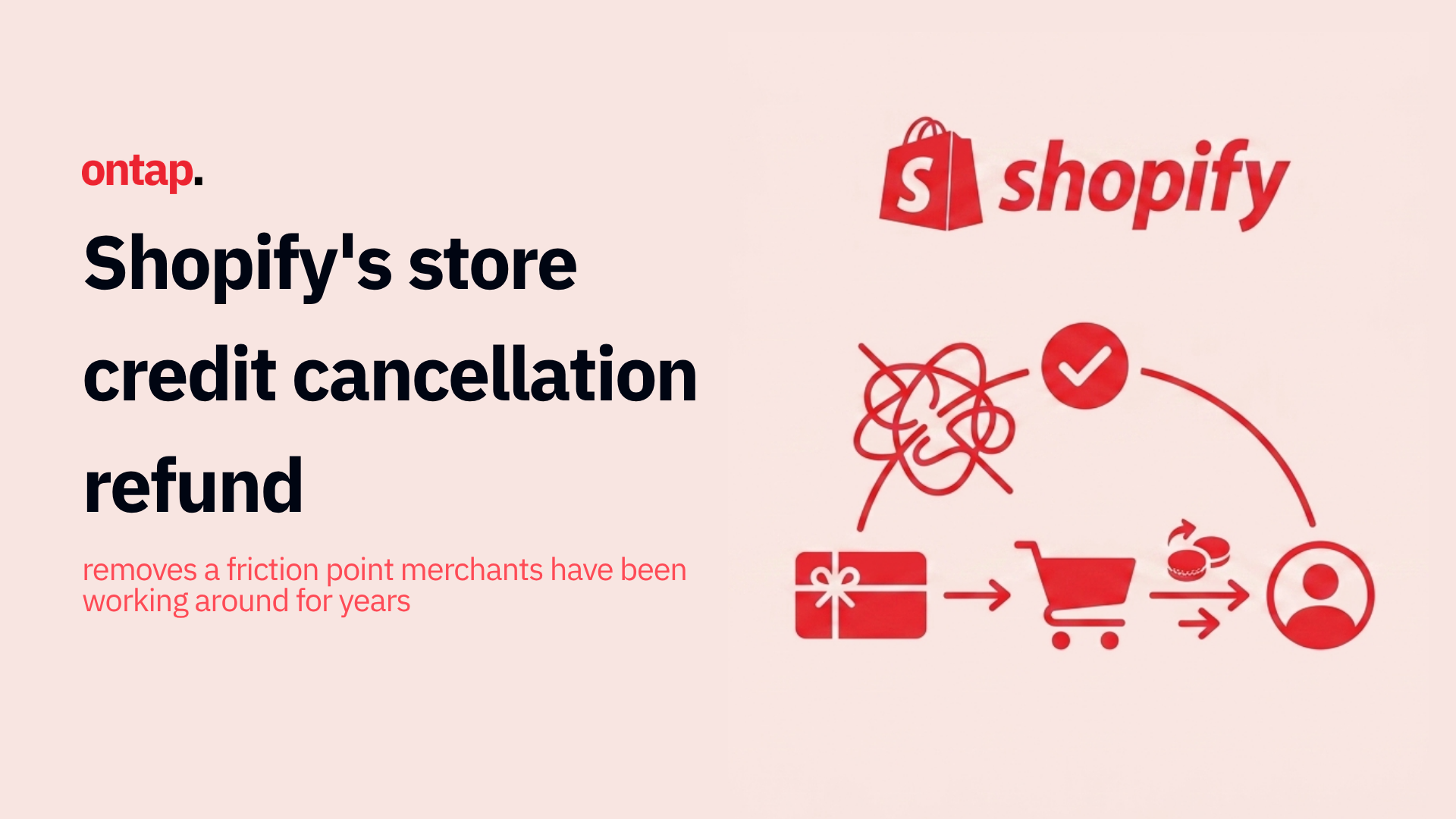
If you have ever cancelled a Shopify order and wished you could issue store credit instead of sending money back to the customer's bank account, you are not alone. As of this week, Shopify has added store credit as a refund method when cancelling an order, a seemingly small change that has significant implications for how merchants handle cancellations, retain revenue, and manage customer relationships.
The problem this solves
Until now, Shopify merchants cancelling an order had a limited set of options: refund to the original payment method or select "refund later" and manage the process manually. If you wanted to offer store credit, you had to create a workaround: process the cancellation, then separately issue a store credit gift card. Most merchants just refunded to the original payment method because it was easier, even though it meant the money left their business entirely.
This matters more than it might seem. Cancellations are inevitable in eCommerce. What determines the financial impact is not the cancellation itself. It is how you handle the recovery. A refund to the original payment method is a complete revenue loss and often a customer loss. Store credit is a retention mechanism that keeps the funds in your ecosystem and gives the customer a reason to come back.
Why the timing matters
Shopify has released this alongside a series of operational improvements over the past two weeks that together paint a picture of a platform preparing its merchants for peak season.
-
DHL Express labels are now available directly in the Shopify admin for merchants in the UK, Germany, France, Italy, and Spain, consolidating international shipping workflows into a single interface.
-
Tax recalculation on shipping address changes eliminates the need to cancel and recreate orders when a customer's address changes, reducing one common source of unnecessary cancellations.
-
The Managed Markets DDU-to-DDP switch arrives on 24 August, which will change how international orders handle duties at checkout.
The store credit cancellation feature slots into this pattern. Shopify is systematically removing the operational friction points that cost merchants money during high-volume periods.
The retention economics
-
Customers are more likely to return: Store credit creates a financial incentive to come back. The customer has money in your store that they can only use by making another purchase.
-
Average order value tends to increase: Customers spending store credit typically add items to exceed the credit balance. A £30 store credit often generates a £45 or £50 order. The incremental spend above the credit amount is net new revenue.
-
The timing favours the merchant: Store credit does not hit the customer's bank account, which means there is no processing time, no potential for failed refund transactions, and no waiting period.
How to configure and use it
The feature requires the "Refund to store credit" order permission for staff members. Store owners have access by default. When cancelling an order, the store credit option now appears alongside the original payment method in the refund method dropdown.
-
Review staff permissions: Make sure the right team members have access, but do not grant it universally. Cancellation decisions should go through team members who understand the retention implications.
-
Build a cancellation workflow: Decide your default policy: merchant-initiated cancellations (stock issues, shipping problems) are strong candidates for store credit with a small goodwill bonus. Customer-initiated cancellations might offer store credit as the default with the original payment method as an alternative.
-
Communicate the store credit option: A clear cancellation confirmation email with a direct link back to your store is the difference between retained revenue and forgotten credit.
-
Track redemption rates: Once you have been issuing store credits for a few weeks, measure how many are being redeemed and at what average order value.
The bigger picture
This update is part of a broader Shopify strategy visible throughout 2026: making the platform's native capabilities comprehensive enough that merchants do not need third-party apps for core workflows. Every third-party app adds page weight, introduces a potential point of failure, and costs money. Regularly audit your app stack to identify tools that duplicate capabilities Shopify now provides natively.
The practical takeaway is simple: activate the store credit cancellation option now and build your cancellation policy before peak season volumes arrive. The merchants who treat cancellations as a retention opportunity rather than an administrative task will retain more revenue during the Golden Quarter.
About On Tap
On Tap is a growth-focused eCommerce consultancy helping mid-market and enterprise merchants optimise every stage of the customer lifecycle, including the moments that typically leak revenue. From checkout optimisation and cancellation flow design to peak season readiness and retention strategy, On Tap helps merchants turn operational details into competitive advantages.
If you want to audit your cancellation and retention workflows before peak season, get in touch.