 Best full-service eCommerce agency 2026


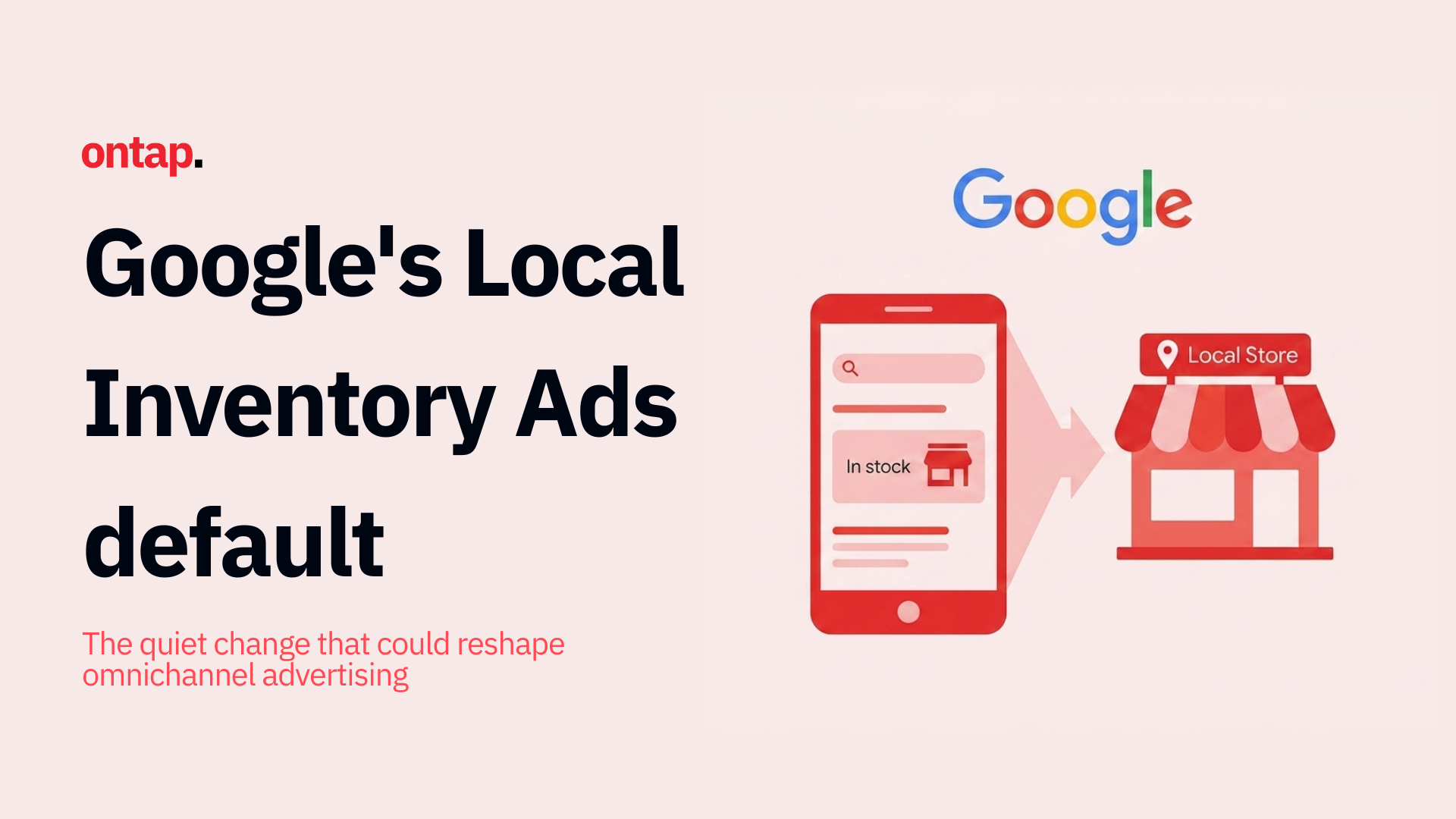
On 20 July, Google confirmed via the Google Ads Developer Blog that Local Inventory Ads (LIA) will be enabled by default for all Shopping campaigns starting 31 August 2026. This is not a feature launch. It is a policy change with real budget and strategy implications for every eCommerce merchant running Google Shopping campaigns.
What is actually changing
Until now, Local Inventory Ads have been an opt-in feature. Merchants who wanted to show product availability at nearby physical stores alongside their standard Shopping ads had to actively configure and enable LIA. Starting 31 August, the default flips: LIA will be turned on automatically for all Shopping campaigns linked to a Merchant Centre account with the LIA add-on enabled.
-
As Search Engine Land confirmed, "advertisers will no longer be able to disable Local Inventory Ads through the Google Ads API." The enable_local field will be ignored by the API backend, which will automatically override its value to true. On API version 25.1 and above, attempting to set the field to false will return a hard error. The existing "Local products" setting under campaign settings will be removed entirely and replaced with the Inventory filter, using Channel = Local or Channel = Online.
-
As PPC.land's analysis noted, this aligns Shopping campaigns with Performance Max for Retail campaigns, which already treat local product serving as standard behaviour. For advertisers who never touched the setting, nothing visibly breaks. For those who deliberately kept local inventory out of certain campaigns, this is a forced change that requires action before the deadline.
-
Google emailed manager accounts on 16 July, a week before the developer blog confirmation. As Search Engine Roundtable documented, the email stated: "If you'd like to separate your online and local budgets, review your Shopping campaigns before 08/31/2026 and update your 'Inventory' filter settings."
Why Google is doing this
Google's motivation is transparent: they want to capture more of the purchase decision for products that consumers could buy either online or in a nearby store. By making local inventory the default rather than the exception, Google is betting that blended online-offline ad experiences will perform better for most advertisers, increasing click-through rates and, critically for Google, ad revenue.
The timing aligns with several other moves Google has been making to blur the line between digital and physical commerce. Earlier this month, Google AI Mode added Instacart integration, directly connecting search queries to real-time local product availability. And we have seen the continued expansion of Performance Max campaigns to incorporate Local Services Ads with automatic Google Business Profile syncing.
The pattern is clear: Google is systematically building a commerce layer that treats online stores and physical stores as a single, unified shopping experience. The LIA default change is perhaps the most concrete step yet, because it affects ad spend directly.
The immediate impact for merchants
If you have physical stores
This is a net positive, but only if your local inventory data is accurate and well-maintained. LIA showing "available at a store near you" alongside your product listing ad can significantly boost click-through rates and drive foot traffic. But if your local feed says an item is in stock when it is not, you are paying for clicks that lead to frustration.
Action item: before 31 August, audit your local inventory feed in Merchant Centre. Verify that stock levels are syncing accurately and frequently, daily at minimum. Check that store hours, addresses, and pickup options are current. Google will be showing this information by default. Inaccurate data will cost you money and trust.
If you are pure-play eCommerce
This change creates a competitive disadvantage you need to understand. When a shopper sees two Shopping ads, one showing online-only availability and another showing "In stock at the Maple Street location, 0.3 miles away," the local option wins more clicks, all other things being equal.
As Common Thread Collective warned: "For online-only brands, the real risk is invisible spend. A default setting change can quietly redirect budget before you notice the performance drop." If an online-only brand has the LIA add-on active in Merchant Centre without realising it, their campaigns could begin routing spend towards local inventory signals after 31 August.
You cannot suddenly open physical stores to compete, but you can focus on what pure-play does best: broader selection, competitive pricing, faster shipping, and superior product content. Make sure your product listings, reviews, and delivery promises are strong enough to compete against the immediacy of local availability.
If you are a marketplace seller
This change primarily affects merchants with first-party Merchant Centre accounts and physical stores. But marketplace sellers should watch for how this shifts competitive dynamics. If big-box retailers gain an automatic LIA advantage in Shopping campaigns, marketplace sellers may find themselves pushed further down in the ad auction for overlapping products.
The broader trend: Default settings as strategy
There is a strategic lesson here that goes beyond LIA. When a platform provider changes a default setting, it is not just a technical change. It is a declaration of what they consider the standard experience. Google is declaring that showing local inventory is the norm, not the exception.
We have seen this pattern before. When Google made Performance Max the recommended campaign type, it fundamentally shifted how advertisers thought about campaign structure. When Shopify made its checkout extensibility model the default, it changed how apps integrate. Defaults shape behaviour at scale.
For merchants, the lesson is to never ignore a default change. The platforms you depend on are constantly nudging you towards their preferred model of commerce. Sometimes that model aligns with your interests; sometimes it does not. But ignoring it puts you at a disadvantage against competitors who adapt.
What else Google shipped on 20 July
This LIA change did not arrive in isolation. On the same day, Google announced several other advertising updates:
-
Lead Form assets now available without the previous $50K spend requirement. This opens native lead generation to smaller advertisers who were previously locked out, a meaningful democratisation of an effective ad format.
-
Google Tag Manager added guided setup for Google Ads purchase tracking. The new guided workflow simplifies conversion tracking configuration, reducing the technical barrier for merchants who struggle with tag implementation.
-
Brand Lift Studies now offer an enhanced measurement option, giving advertisers who commit a higher budget access to more sensitive campaign measurement data.
Each of these changes individually is modest. Together, they represent Google's continued strategy of making its advertising tools more accessible while simultaneously making the platform more sticky for merchants who adopt the full suite.
The bigger picture
The platforms are building a commerce reality where the distinction between "online store" and "physical store" becomes invisible to the consumer. Google wants every product search to feel like it could be fulfilled from anywhere: a warehouse, a nearby store, or a combination.
For merchants, this means the era of managing your online and offline channels as separate strategies is ending. Your inventory data, your product content, your pricing, and your fulfilment options need to be unified, not just in your back-office systems, but in the signals you send to every platform that mediates the customer relationship.
If your product data across channels is inconsistent, the platforms will expose that inconsistency. If your local inventory feed is stale, Google will now show stale data by default. The cost of data quality problems just went up.
Treat 31 August as a deadline. Audit your Merchant Centre setup. Verify your local feeds. And if you have physical stores but have not set up LIA, the clock is ticking on visibility you are leaving on the table.
About On Tap
On Tap is a growth-focused eCommerce consultancy helping mid-market and enterprise merchants optimise their presence across digital commerce platforms. From Google Merchant Centre audits and local inventory feed management to omnichannel advertising strategy and product data architecture, On Tap helps merchants turn platform changes into competitive advantages.
If you need help preparing for the 31 August LIA default change, get in touch.