
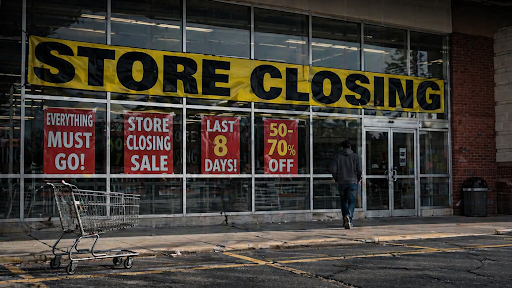
UBS analysts dropped a sobering forecast this week: more than 40,000 retail stores could close in the United States over the next five years. The drivers are familiar, accelerating eCommerce adoption (supercharged by AI), shifting consumer behaviour, and macro pressures from tariffs and immigration policy, but the scale of the projection demands that every eCommerce operator sits up and thinks carefully about what comes next.
40,000 store closures: What the data actually shows
According to UBS analyst Michael Lasser and his team, the U.S. lost roughly 5,000 stores between Q3 2024 and Q3 2025, a shift from recent years when openings outpaced closures. There are now fewer than three stores per 1,000 people in the U.S., down approximately 12% from 2003. If population growth stalls, a real possibility given flat birth rates and restrictive immigration policy, the number could climb to nearly 70,000 closures.
Department stores and speciality retailers are most at risk. Off-price retailers will continue expanding. And the large chains, Walmart, Costco, Target, are positioned to benefit as smaller and independent retailers struggle to compete on the dimensions that increasingly matter: speed, location, assortment, experience, and price.
What store closures mean for eCommerce competition
It's tempting to read this as "physical retail is dying, eCommerce wins." That's too simple. Here's what's actually happening and why it matters for digital commerce operators:
- The survivors will be better omnichannel competitors: When 40,000 marginal stores close, the remaining physical retailers will be the strongest, best-funded, most operationally excellent players. These survivors will have robust eCommerce operations, sophisticated fulfilment networks, and the marketing budgets to compete aggressively online. For pure-play eCommerce merchants, your competition isn't getting weaker; it's getting more concentrated and more capable.
- Local market dynamics will shift: Store closures create local demand vacuums. Consumers who previously bought in-store will migrate, some to other physical retailers, many to online channels. For eCommerce merchants with strong local SEO, targeted advertising, and fast shipping to specific markets, closures in those markets represent genuine acquisition opportunities.
- Consumer expectations are consolidating: UBS specifically calls out speed, assortment, experience, and price as the key differentiators. These aren't just physical retail attributes; they're exactly what consumers demand from eCommerce. If you're an online merchant competing on none of these dimensions, the same forces closing physical stores will eventually pressure your business too.
How AI is accelerating the shift
UBS explicitly ties the acceleration of store closures to AI-driven eCommerce growth. This connects directly to what we've been seeing across the industry: AI is changing not just how consumers discover products, but how they evaluate and purchase them.
When a consumer can ask an AI assistant to find the best running shoe for their specific gait, budget, and style preference, and have it delivered to their door, the value proposition of driving to a speciality running store diminishes. When AI-powered search can surface better product comparisons than a department store associate, the information advantage of physical retail erodes.
For eCommerce merchants, the practical question is: are you building your product data, content, and brand presence in a way that AI systems can understand and recommend? The stores closing over the next five years are losing partly because they can't compete in an AI-mediated discovery environment. Don't make the same mistake in your digital channel.
Even the biggest brands like Nike are restructuring
The same week UBS released its forecast, Nike announced it's cutting 1,400 jobs, the majority in its technology department, as part of its "Win Now" turnaround strategy. Nike is consolidating its tech footprint to two hubs and leaning into automation.
Read these stories together. Even the largest brands are restructuring to be leaner, faster, and more automated. The retail industry that emerges from this cycle of closures and restructuring will be fundamentally different from what we've known. It will be more digital, more automated, more AI-integrated, and more concentrated among fewer, stronger players.
5 things eCommerce merchants should do now
- Invest in differentiation, not just efficiency: In a market consolidating around large players, being slightly cheaper or slightly faster than Amazon isn't a strategy. Identify the specific value you provide that AI agents and large retailers cannot replicate: deep expertise, unique products, personalised service, and community.
- Build for AI discoverability now: Structured product data, rich entity relationships, and strong brand signals aren't optional anymore. They're the foundation of how your products will be discovered in the next generation of search and shopping interfaces.
- Monitor local market dynamics: Use tools to track store closures in your key markets. When a competitor closes a physical location, that's your cue to increase targeted advertising and content in that geography.
- Strengthen your owned channels: In a world where AI mediates more product discovery and large retailers dominate marketplace channels, your email list, your SMS subscribers, and your direct customer relationships become even more valuable. Practical eCommerce made this point well this week: at 55 years old, email remains vital precisely because it's a direct connection with your audience that no algorithm change can take away.
- Prepare for a different competitive landscape: The retailers that survive the next five years of closures will be formidable omnichannel competitors. Start planning now for how you'll differentiate against them, not against the marginal players currently keeping the lights on.
On Tap's perspective
The 40,000-store closure forecast isn't a death sentence for physical retail; it's a restructuring. And restructurings create both losers and winners. The eCommerce operators who understand the forces driving these closures and position themselves accordingly will find genuine opportunities in the shifting landscape.
But here's the catch: those same forces, AI-driven discovery, consumer demand for speed and experience, and market concentration, will pressure weak eCommerce businesses just as hard as weak physical stores. The lesson isn't "eCommerce wins." It's "the best operators win, regardless of channel."
If you want to discuss how these trends affect your specific business, reach out to us at On Tap. We help eCommerce businesses build the strategic clarity, injecting AI into your business operations and technical foundations needed to thrive in exactly this kind of market environment.