 Best full-service eCommerce agency 2026


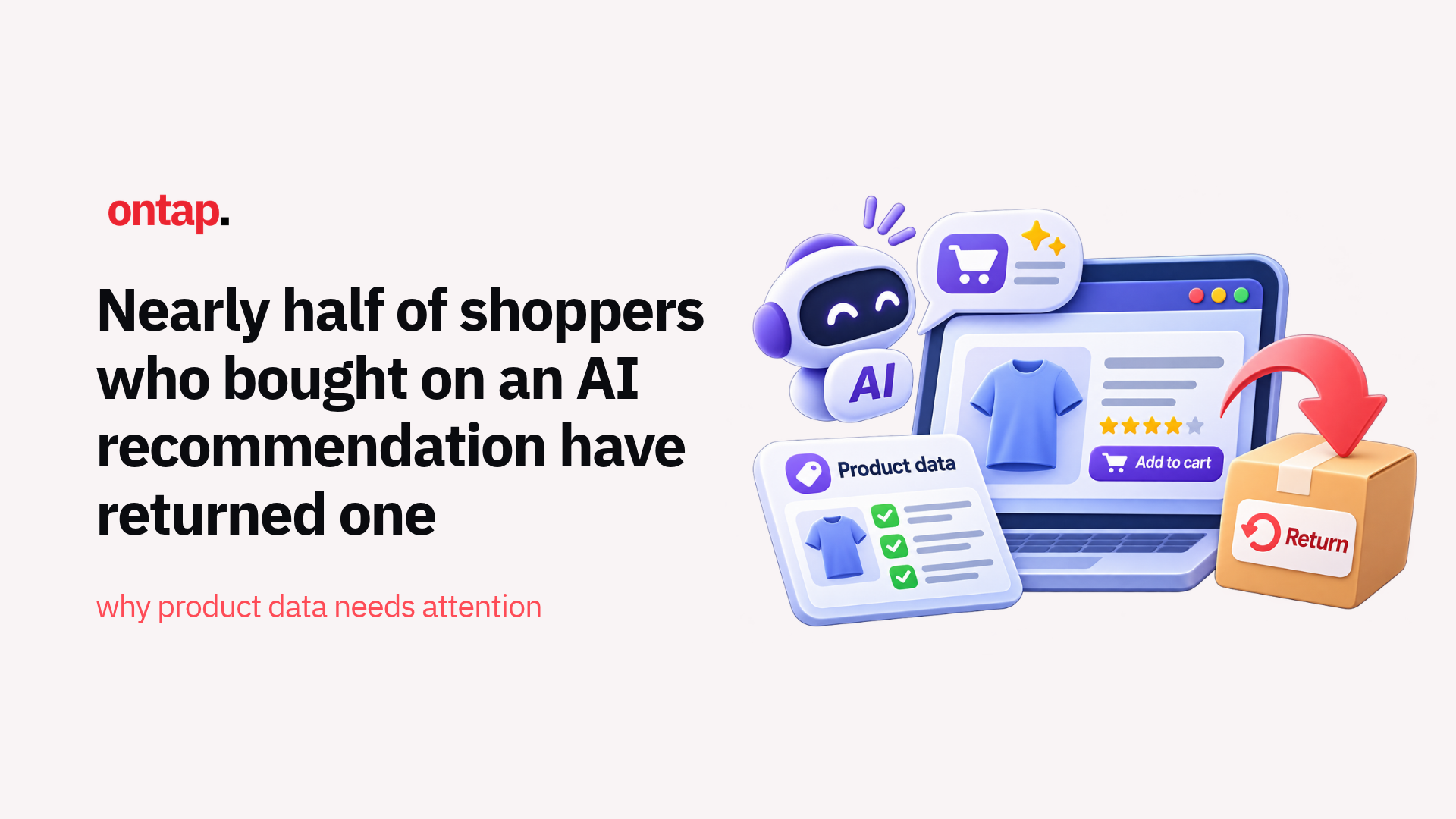
There's a data point in Blue Yonder's 2026 Consumer Retail Returns Survey that eCommerce merchants should pay attention to.
Nearly a quarter of US consumers have bought a product based on an AI recommendation. Among those shoppers, 46% have returned at least one AI-recommended item in the past year.
The return reason is just as important.
For US returns overall, incorrect size or fit is the most common reason at 42%, while 20% say the product was different than described.
Among shoppers returning an AI-recommended purchase, that order changes:
-
Different than described: 36%;
-
Incorrect size or fit: 23%.
That doesn't prove AI is better at selecting the right size. Different products, shoppers, and recommendation journeys can produce different return patterns.
But it does highlight a practical problem for merchants: when AI helps a customer evaluate a product, the quality and accuracy of the product information it can access becomes part of the customer experience.
The return reason that changes the conversation
Blue Yonder surveyed more than 5,000 consumers across the US, Australia, France, Germany, and the UK, including 2,000 US consumers.
Among the US respondents, 24% had purchased something after receiving an AI recommendation.
Of those shoppers, 46% had returned one of those products during the previous year.
The most common reason, at 36%, was that the product was different from what was described.
That finding matters because AI shopping experiences increasingly rely on merchant-supplied information to explain, compare and recommend products.
Blue Yonder CEO Duncan Angove framed the problem around the information available to AI systems, arguing that product data built for traditional search isn't necessarily sufficient for machines recommending products to individual shoppers.
That doesn't make every description-related return a product-data failure.
An AI system can misunderstand information, omit context, or generate an inaccurate answer even when the source data is correct. Customer expectations can also change between recommendation and delivery.
But product information is one part of the process that merchants can directly improve.
AI needs product information it can interpret clearly
Human shoppers and AI shopping systems don't always use product information in the same way.
A customer can combine several signals at once:
-
product photography;
-
marketing copy;
-
specifications;
-
reviews;
-
sizing information;
-
prior experience with the brand.
AI systems can also use multiple sources, depending on the platform, but structured and explicit product information gives them less ambiguity to resolve.
For example, Shopify recommends providing detailed product specifications, structured attributes, sizing guides, material information and care instructions when optimising product pages for AI-powered search and shopping assistants.
Google similarly stresses the importance of accurate product attributes, including colour, size, material, variants and consistent information between the merchant's website and product feed.
The practical lesson is straightforward.
Marketing copy still matters for persuading shoppers. But it shouldn't be the only place where a product's important characteristics are communicated.
What merchants should fix first?
Improving product information for AI doesn't require rewriting an entire catalogue around machines.
The priority is reducing ambiguity in the information already being distributed across storefronts, feeds, marketplaces and agentic channels.
Add clear specifications alongside marketing copy
A product description can still communicate benefits, positioning and brand voice.
Alongside that, customers and AI systems need concrete information about what they're buying.
Depending on the category, that can include:
-
Material: composition, finish or construction;
-
Dimensions: measurements using the relevant unit system;
-
Weight: where it affects use, delivery or compatibility;
-
Colour: clear and consistent colour names across variants and feeds;
-
Care: washing, cleaning or maintenance instructions;
-
Compatibility: devices, accessories, use cases or technical requirements;
-
Included items: exactly what comes in the package.
The relevant fields will differ by category. A T-shirt needs different information from a sofa, laptop, or skincare product.
The goal is completeness where the information affects the buying decision.
Make colour and variant data consistent
Creative colour names can support branding, but they shouldn't create ambiguity across sales channels.
If your storefront calls a variant "Midnight Ocean" while a product feed identifies it differently, check that the underlying colour and variant information remains consistent and understandable.
For Google Merchant Center, for example, colour values should describe the actual product colour and remain consistent across variants.
This matters beyond AI.
Conflicting variant information can create incorrect listings, display issues and customer expectations that don't match the product delivered.
Action: audit your highest-volume variants for mismatches between product titles, option names, descriptions, feeds and imagery.
Check whether imagery and written information tell the same story
Photography can create expectations that specifications alone can't communicate.
Lighting, styling, scale and editing can all affect how a product appears online.
The answer isn't to make product images purely functional. It is to check that customers aren't receiving contradictory signals.
For example:
-
Does the colour description reasonably match the product photography?
-
Do dimensions align with how the item appears in contextual images?
-
Are accessories shown in images actually included?
-
Does the photographed variant match the selected variant information?
-
Are materials and finishes represented consistently?
AI optimisation doesn't remove the need for human merchandising QA. It makes consistency across the different sources describing the product more important.
Improve sizing information instead of assuming AI will solve fit
Incorrect size or fit remains the second-largest reason for returns of AI-recommended purchases in Blue Yonder's survey, at 23%.
There is also a trust gap. Blue Yonder found that only one in five US consumers trusts AI to recommend the correct size and fit.
Merchants should therefore give both customers and recommendation systems better sizing information rather than assuming personalisation will solve the problem.
Depending on the category, useful information can include:
-
size charts using clear measurements;
-
regional size systems;
-
garment or product measurements;
-
model measurements and size worn;
-
fit description;
-
material stretch or construction where relevant;
-
variant-specific sizing information.
The exact data matters more than the amount. Include information that genuinely helps a customer understand which variant will suit them.
Write descriptions that answer buying questions
Product descriptions shouldn't become specification sheets with no brand personality.
But they should answer the questions a customer needs before purchasing.
For each important product, check whether the page clearly answers:
-
What is it?
-
What is it made from?
-
What are the dimensions or size?
-
Which variant is being shown?
-
What is included?
-
Are there compatibility limitations?
-
How should it be used or cared for?
-
What information could change whether the customer buys it?
If a shopper needs to infer the answer from photography or vague marketing language, an AI system may face the same ambiguity.
This problem can grow as AI becomes another discovery layer
AI-assisted shopping is still developing, but consumer interest is already significant.
Gartner found that 34% of US consumers are very or extremely willing to use generative AI tools or chatbots for holiday gift recommendations.
Gartner's wider finding is equally important: AI is currently adding to, rather than replacing, existing discovery channels.
Consumers using AI for holiday inspiration consult more sources on average than people who don't use AI. Retailer websites, traditional search, marketplaces, physical stores and recommendations from friends and family remain important.
For merchants, this means product data has to remain consistent across more surfaces.
A customer might discover an item through AI, verify it on Google, read the PDP, compare a marketplace listing and then return to an AI assistant with another question.
The same product needs to remain recognisable and accurately described throughout that journey.
Product-data improvements should support every channel
The value of better data isn't limited to AI recommendations.
Accurate, structured product information also supports:
-
marketplace feeds;
-
Google Shopping;
-
internal site search;
-
filters and faceted navigation;
-
product comparison;
-
accessibility;
-
customer service;
-
merchandising;
-
agentic storefronts.
For Shopify merchants, Shopify Catalog already uses information including titles, descriptions, images, product organisation, barcodes and variant data when making eligible products available to AI platforms and shopping sites.
Shopify specifically recommends keeping this information clear, accurate and detailed to improve how AI platforms understand and match products to customer searches.
That still doesn't guarantee a particular recommendation, ranking or return-rate improvement.
It does give the system better source information to work with.
Returns policy still matters
Product information can reduce avoidable uncertainty, but some returns will always remain part of eCommerce.
Blue Yonder found that 51% of US respondents had chosen one retailer over another purely because it offered a better returns policy.
The same survey found strong resistance to retailers restricting returns based on return frequency.
That creates two parallel priorities for merchants:
-
reduce avoidable returns by improving the information customers use before buying;
-
maintain a returns experience that customers can understand and trust when a product still isn't right.
In AI-assisted shopping, returns information also needs to be easy for AI systems to retrieve accurately.
For Shopify merchants, that can include maintaining current store policies and Knowledge Base information so connected AI experiences can reference the correct terms.
Action: review whether your returns window, exclusions, refund process and holiday-specific terms are consistent across your storefront, help centre, feeds and agent-facing information.
What eCommerce merchants should do now
Actions to take:
-
Audit AI-recommended product data: start with high-volume and high-return products rather than attempting to rewrite the whole catalogue;
-
Compare descriptions with attributes: make sure materials, dimensions, colour, size and other important details agree across the PDP and product feeds;
-
Review variant consistency: check that titles, options, imagery and feed attributes describe the same variant;
-
Strengthen sizing data: add useful measurements and fit context where sizing contributes to returns;
-
Check agent-facing data: review how platforms such as Shopify Catalog, Google Merchant Center and other connected channels receive your product information;
-
Track return reasons: separate "different than described", size or fit, quality, damaged product and other reasons rather than treating all returns as one metric;
-
Compare AI-assisted orders where possible: if your analytics or platform identifies AI-referred or agentic transactions, monitor their return reasons alongside other acquisition channels;
-
Review returns information: keep policy details clear and consistent wherever customers or AI assistants can retrieve them.
The objective isn't to rewrite product data for an imagined future shopper.
It is to make the information more accurate for every customer and channel already using it.
The bigger picture
Blue Yonder's findings don't prove that AI recommendations inherently cause more returns.
They show that among US consumers who have already purchased based on an AI recommendation, returns are common and "different than described" is the leading reported reason.
That changes where merchants should look for improvements.
The response shouldn't be limited to choosing a better AI platform or waiting for recommendation models to improve.
Merchants control a major part of the input: product information.
As AI becomes another layer in product discovery, vague descriptions, inconsistent attributes and mismatched feeds can be repeated across more customer touchpoints.
Accurate data won't eliminate returns.
But it reduces one source of ambiguity before the order is placed.
Conclusion
AI shopping creates a new reason to revisit an old eCommerce problem: whether the information describing a product actually matches what arrives at the customer's door.
Blue Yonder's data makes that gap particularly visible. Among US consumers returning AI-recommended products, 36% cite the item being different from what was described, ahead of incorrect size or fit at 23%.
For merchants, product data is one of the most practical places to respond.
Make specifications explicit. Keep variants consistent. Give customers usable sizing information. Make sure imagery, storefront copy, and product feeds describe the same product.
Better data won't guarantee a recommendation or eliminate every return.
It gives customers and the AI systems helping them make decisions a more reliable version of the product to evaluate.
About On Tap
On Tap is a growth-focused eCommerce consultancy helping mid-market and enterprise merchants improve their digital commerce operations, from product data and storefront optimisation to integrations, customer experience and returns strategy.
To review how your product information, feeds, and eCommerce experience are prepared for AI-assisted shopping, get in touch.